
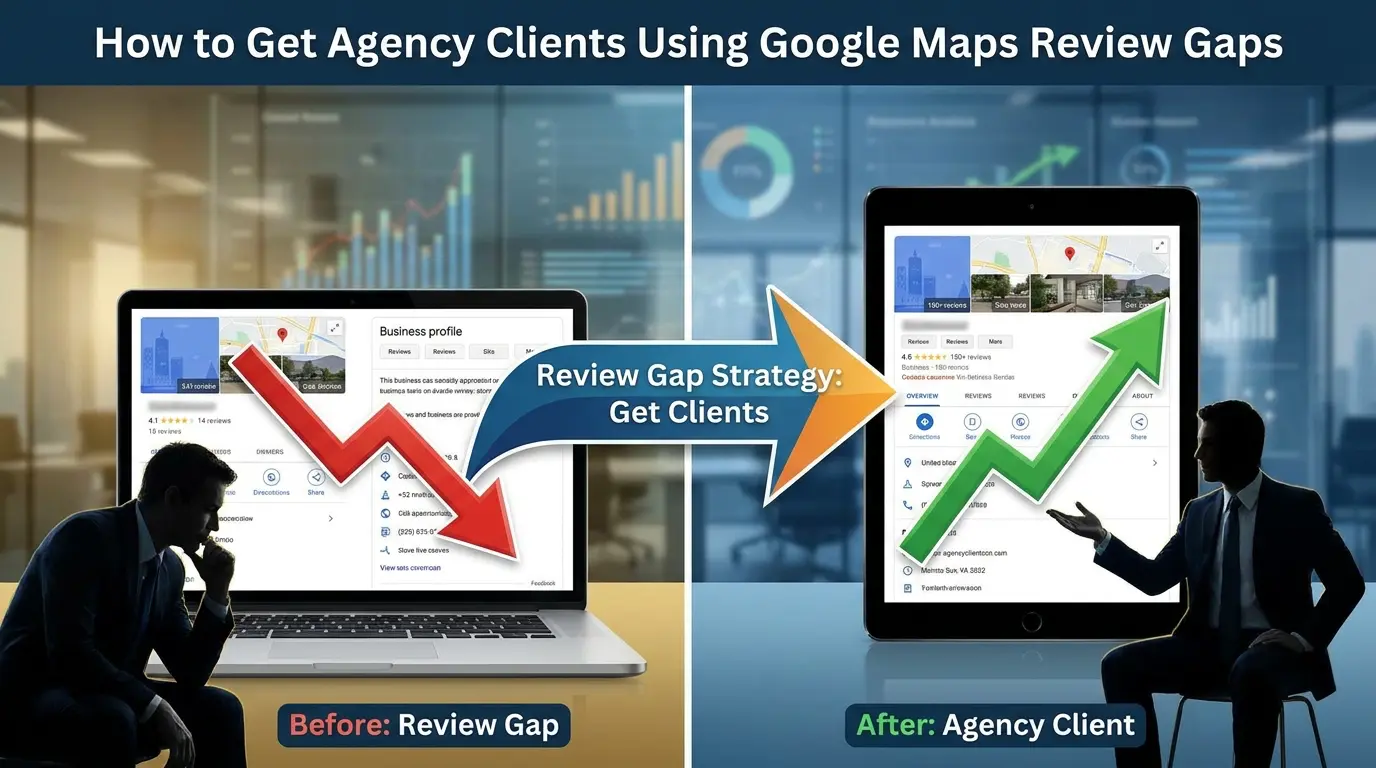

Most people trying to start a digital marketing agency make the same mistake.
They spend weeks, sometimes months, debating what service to sell. SEO? Social media? Paid ads? They watch every video, read every post, and still feel stuck.
Here is the uncomfortable truth nobody talks about: the service you choose matters far less than whether the client can seethe result.
That single insight changes everything.
There is a category of service where the problem is visible on a screen in under 60 seconds, the solution is provable within 30 days, and the before-and-after result is impossible to argue with. That service is Google review management. And the entry point into it is a concept called the Review Gap.
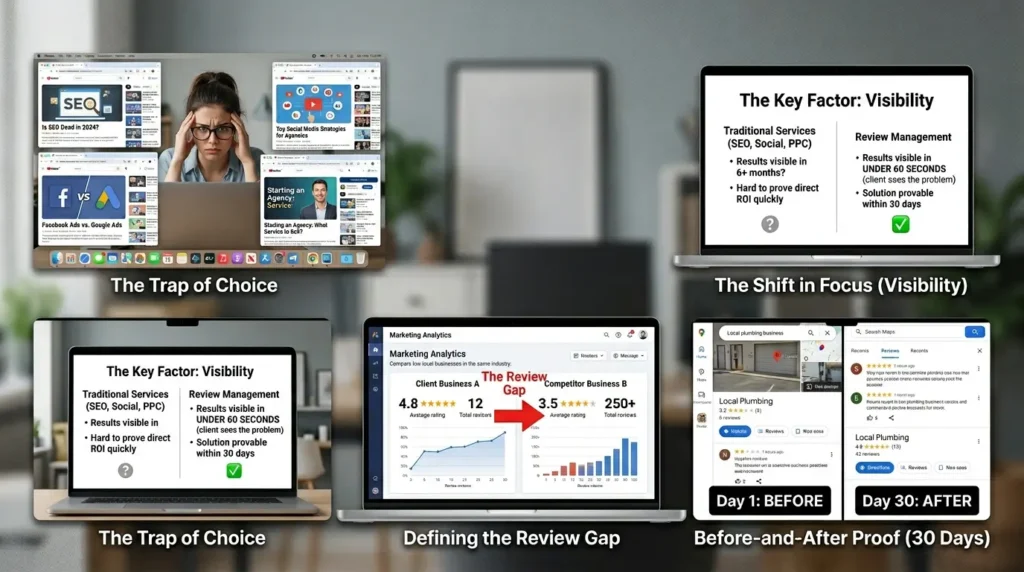
This guide walks you through the complete Review Gap system, how to find prospects in 10 minutes using Google Maps, how to send a free audit that earns trust without a sales pitch, and how a $297-a-month review service quietly turns into a $1,300-a-month retainer. No cold calls. No pretending you have experience you do not have yet.
✅ What the Review Gap is and why it is the easiest agency entry point
✅ The 3-step system: Find the Gap → Run the Audit → Offer the Fix
✅ The 6 digital gap signals that score prospect quality
✅ Why review velocity beats total review volume for local rankings
✅ How “Ask Maps” (Gemini AI) is rewiring the review economy
✅ The compliance line between Review Routing and illegal Review Gating
✅ How a $297 service scales to $10,000/month with simple service stacking
✅ Real case studies with measurable outcomes
What Is the Review Gap? (And Why It Matters More Than Any Marketing Strategy)
The Review Gap is the numerical deficit between a local business’s review count and the top three competitors in its market.
It sounds simple. It is. But the implications run deeper than most people realize.
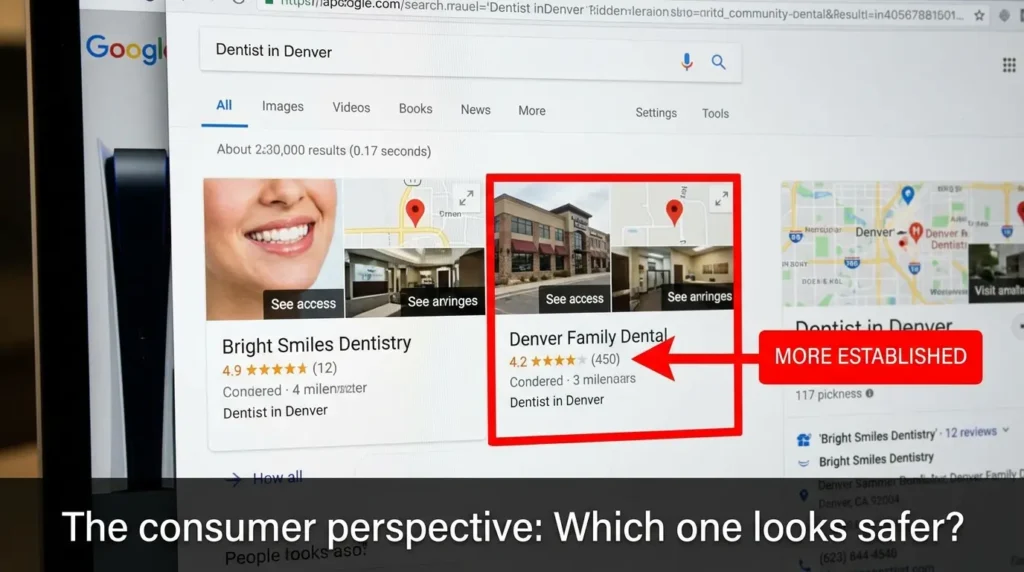
When a potential customer searches for a plumber, an HVAC company, or a dentist on Google Maps, they do not call the best business. They call the business that looks the safest. And on Google Maps, “safe” means reviews, specifically, the volume of them, how recent they are, and what the text inside them actually says.
A business with a 4.9-star rating and 12 reviews will lose, every time, to a competitor with a 4.2-star rating and 450 reviews. Not because the first business is worse. Because the second one looks more established, more trusted, more proven.
That gap, 438 reviews in this case, is your product.
Definition: Review Gap The measurable difference between a local business’s current review volume and the review volume of the top-ranking competitor in the same Google Maps category. Businesses with a significant review gap lose search visibility, clicks, and calls to competitors regardless of actual service quality.
According to BrightLocal’s 2023 Local Consumer Review Survey, 98% of consumers read online reviews for local businesses before making a contact decision. And found that businesses with more than 25 Google reviews generate an average of 108% more revenue than businesses near the local average.
The gap is not just an optics problem. It is a revenue problem. And business owners feel it, they just do not know what is causing it.
That is your opening.
Why Google Reviews Beat Every Other Agency Service for Beginners
Before getting into the system itself, it is worth understanding why reviews are uniquely powerful as a first service to offer.
Most marketing services have an invisibility problem. If you sell SEO, the client has to trust you for 6 months before seeing anything. If you sell social media management, growth feels abstract. If you sell paid ads, you need a budget and landing pages and conversion tracking just to start.
Review management is different in three specific ways.
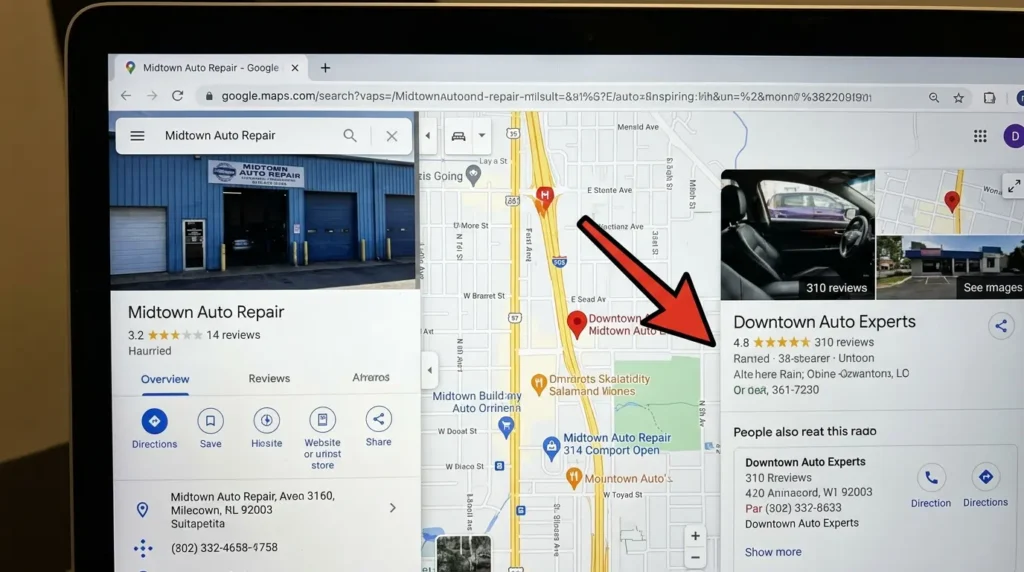
- The problem is visible: You can show a business owner their Google listing next to a competitor’s listing in 10 seconds flat. No explanation needed. They see 14 reviews. They see the competitor has 310. The problem explains itself.
- The solution is measurable: Unlike brand awareness or engagement, reviews are countable. You promise 15 new reviews in 30 days. You deliver 18. The client sees every single one land in real time.
- The result has a direct business consequence: More reviews means higher ranking in the Local Pack (the map results at the top of a Google search). Higher ranking means more calls. More calls means more revenue. The chain of causality is short and easy to explain.
This is the secret to closing a first client without a portfolio, without case studies, and without years of experience. You are not asking them to trust your expertise. You are asking them to look at a number on their screen and agree that it should be bigger.
The Economics of the Review Gap: What the Data Says
The financial impact of review volume is well-documented, and the numbers are worth knowing before you pitch a single prospect.
| Metric | Revenue Impact | Source |
|---|---|---|
| 10+ Google reviews | 52% more revenue vs. average | Womply |
| 25+ Google reviews | 108% more revenue vs. average | Womply |
| 4+ star average rating | 15% more revenue | Womply |
| Responding to 25%+ of reviews | 35% more revenue | Womply |
| 0.1-star rating increase | ~25% conversion rate lift | Industry aggregated |
| Positive Google reviews | 18% revenue increase from search | WiserReview 2026 |
According to Harvard Business Review research on Yelp reviews, a one-star increase in a business’s rating corresponds to a 5–9% increase in revenue. And PowerReviews’ 2025 consumer research found that 96% of consumers say ratings and reviews are the single most influential factor in a purchase decision.
The trust threshold matters too. Most consumers do not fully trust a business until it has somewhere between 20 and 50 reviews, with recency weighing heavily. A 4.8-star business with its last review from two years ago will consistently lose to a 4.3-star business that got a review yesterday.
That recency dynamic creates a concept called Review Velocity, and it is the real lever you are selling.
Review Velocity: The Metric That Beats Total Volume
Here is an insight most generic articles on this topic miss entirely.
Total review count matters. But Review Velocity, the rate at which new reviews arrive, often matters more for local ranking.
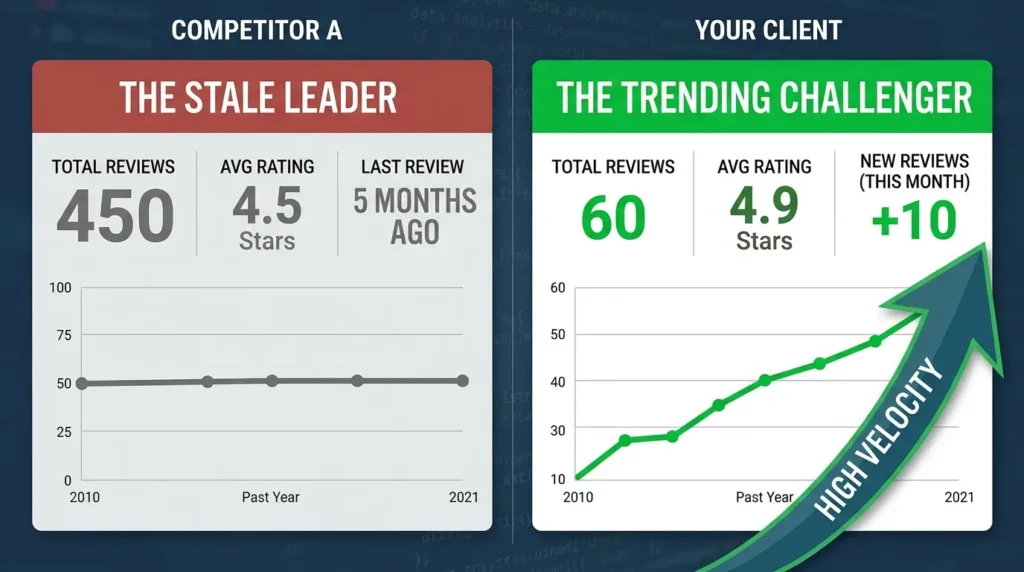
Google’s local algorithm interprets a consistent stream of new reviews as a signal that a business is active, trusted, and relevant right now. A business with 500 reviews that has not received a new one in four months is algorithmically stale. A business with 60 reviews that receives three new ones every week is sending a stronger freshness signal.
This creates a practical opportunity. You do not need to close the entire gap to start winning. You need to out-pace the competitor on velocity.
If the market leader has 450 reviews but gets zero new ones per month, and your client has 60 reviews but generates 10 per month through your automation system, your client becomes the “trending” option in Google’s eyes. They begin stealing positions in the Local Pack, the map results section that Whitespark’s Local Search Ranking Factors estimates accounts for approximately 17–20% of Google’s local ranking decision.
The pitch changes accordingly. You are not saying “I will help you catch up.” You are saying “I will help you win the velocity race.”
Step One: Find the Gap (10 Minutes on Google Maps)
The first step of the system is finding the right prospects. And the tool for this is already on your phone.
Open Google Maps. Pick a local service category, roofers, plumbers, HVAC technicians, dentists, appliance repair companies, landscapers. Pick any city, anywhere in the world. You do not need to be local.
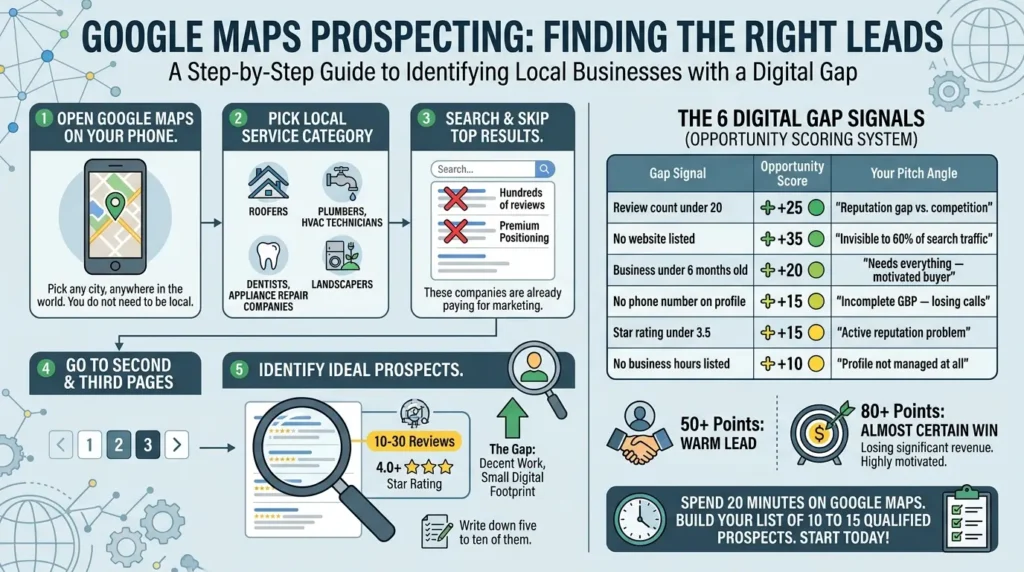
Search for that category. Scroll past the top results, the businesses with hundreds of reviews and premium positioning. Those companies are already paying someone for marketing. They are not your prospects.
Go to the second and third pages of results. You are looking for businesses with 10 to 30 reviews that have decent star ratings (4.0 or above). These businesses do good work. They just do not have the digital footprint to match.
That is the gap. Write down five to ten of them.
The 6 Digital Gap Signals (Opportunity Scoring System)
Not all low-review businesses are equal prospects. Some signals indicate stronger motivation and bigger opportunities than others. Here is how to score them:
| Gap Signal | Opportunity Score | Your Pitch Angle |
|---|---|---|
| Review count under 20 | +25 | “Reputation gap vs. competition” |
| No website listed | +35 | “Invisible to 60% of search traffic” |
| Business under 6 months old | +20 | “Needs everything — motivated buyer” |
| No phone number on profile | +15 | “Incomplete GBP — losing calls” |
| Star rating under 3.5 | +15 | “Active reputation problem” |
| No business hours listed | +10 | “Profile not managed at all” |
A business that scores 50+ points across these signals is a warm lead. A business that scores 80+ points is almost certainly losing significant revenue to avoidable problems, and they know it, even if they cannot articulate why.
Spend 20 minutes on Google Maps and you will have a list of 10 to 15 qualified prospects. That is enough to start.
Step Two: Run the Audit (The “Trojan Horse” That Does the Selling)
This is the step where most beginners get it completely wrong.
They find the gap, they find the contact information, and then they send a message that sounds something like this:
“Hi, I’m a marketing consultant specializing in reputation management. I’d love to hop on a quick call to discuss how we can help grow your business.”
Do not send that message. It is a sales pitch wearing a disguise. Business owners get ten of those a week. They delete them without reading.
Instead, do the work first and send the value before the pitch.
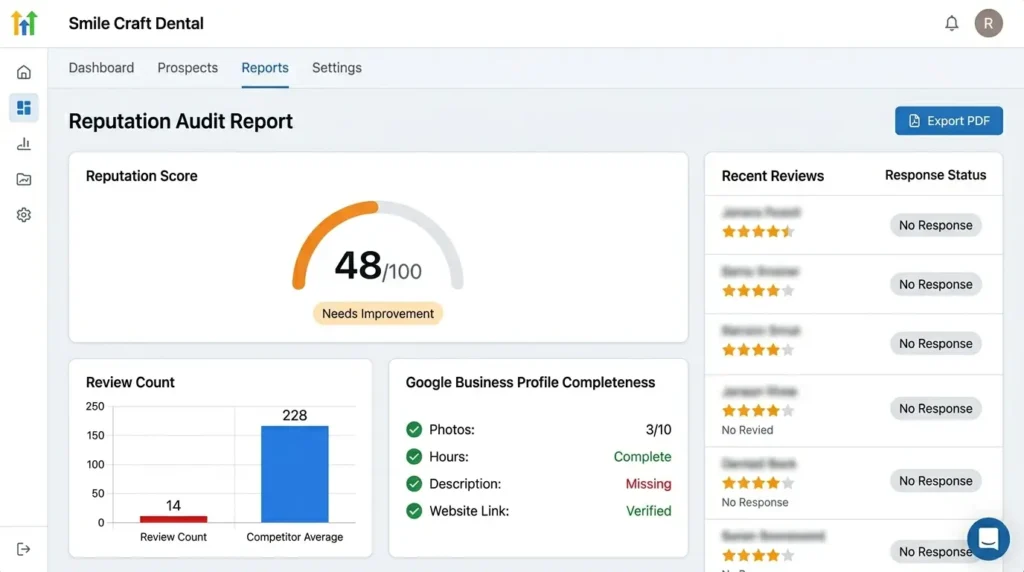
A free audit is not a sales document. It is evidence. It shows the business owner, in specific numbers, exactly where they are losing to a competitor they probably did not know was beating them. When a business owner opens that report and sees that their main competitor has 280 reviews while they have 14, the problem becomes impossible to ignore.
The psychology here is important. The audit creates two reactions simultaneously: I did not know this and whoever sent this clearly looked at my business carefully. Both reactions build credibility instantly. You have not mentioned your service yet. You have already established trust.
How to Build the Audit
- Manual approach (free): Google each prospect. Count their reviews. Note their average rating, whether they respond to reviews, whether their Google Business Profile is complete (hours, photos, description, website link). Compare those numbers to the top three competitors in the same category. Put the comparison in a simple document or spreadsheet. Takes about 20 minutes per prospect.
- Tool-based approach (fast): Platforms like GoHighLevel include a prospecting tool that generates a full digital audit, covering reviews, profile completeness, website performance, response rate, and local SEO signals, in under 60 seconds. The output is a scored report you can export as a PDF and send directly. What takes 20 minutes manually takes under a minute with a tool.
Either approach works. The point is the same: arrive with evidence, not promises.
What to Include in the Audit
A strong audit covers these elements at minimum:
- Review count (client vs. top 3 competitors)
- Average star rating (client vs. top 3 competitors)
- Date of most recent review (recency check)
- Review response rate (are they responding to customers at all?)
- Google Business Profile completeness (photos, hours, website, description)
- Website presence and basic mobile performance
You do not need to be a technical expert to gather this data. It is all publicly visible. The skill here is in presenting the data clearly, not in collecting it.
Step Three: Offer the Fix (Without Sounding Like a Salesperson)
Now comes the message.
Most beginners overthink this step. They build elaborate sales decks. They create pricing packages with three tiers. They write five-paragraph emails about their background and qualifications.
None of that is necessary. Here is what works:
“Hey [Name], I was looking at [business category] companies in [city] and noticed a few things on your Google listing that are probably costing you calls. I put together a quick audit showing what I found, sending it over here in case it’s helpful.”
That is the entire first message. No pitch. No ask. Just evidence delivered as a gift.
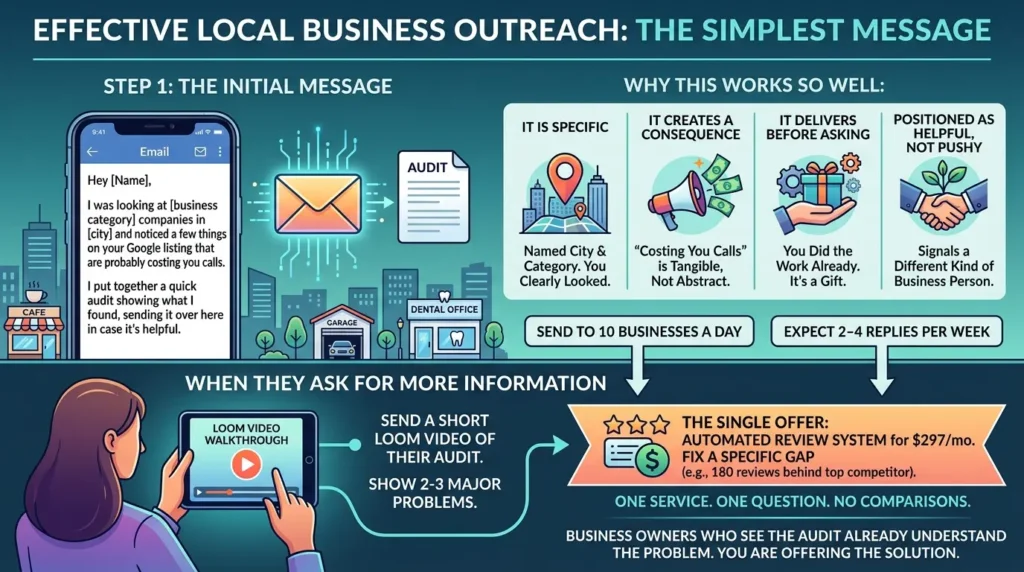
Why does this work so well?
- It is specific. You named the city and the category. You clearly looked.
- It creates a consequence. “Costing you calls” is tangible. It is not abstract marketing language.
- It delivers before asking. You did the work already. That signals a different kind of person than the average cold emailer.
- It positions you as helpful, not pushy.
Send that to 10 businesses a day. Expect 2–4 replies per week. Some will ask questions. Some will want to know more. A few will book a call.
When They Ask for More Information
When a business owner replies, resist the urge to explain everything. Send a short Loom video (screen-recorded walkthrough) of their audit. Show the two or three most glaring problems. Explain what those problems are costing them in plain language.
Then make one specific offer:
“The easiest place to start is reviews. You’re 180 reviews behind the top competitor, and that gap is costing you business. I can set up an automated review system for $297 a month that helps you generate reviews consistently and strengthen your Google presence. Want help with that?”
One service. One question. No package comparison. No proposal PDF.
Business owners who have seen the audit, and who asked what to do about it, already understand the problem. They are not being sold to. They are being offered a solution to a problem they just acknowledged exists.
The Review Automation System: What You’re Actually Delivering
Once a client says yes, many beginners freeze. They got the payment. Now what?
The good news: you are not building anything from scratch.
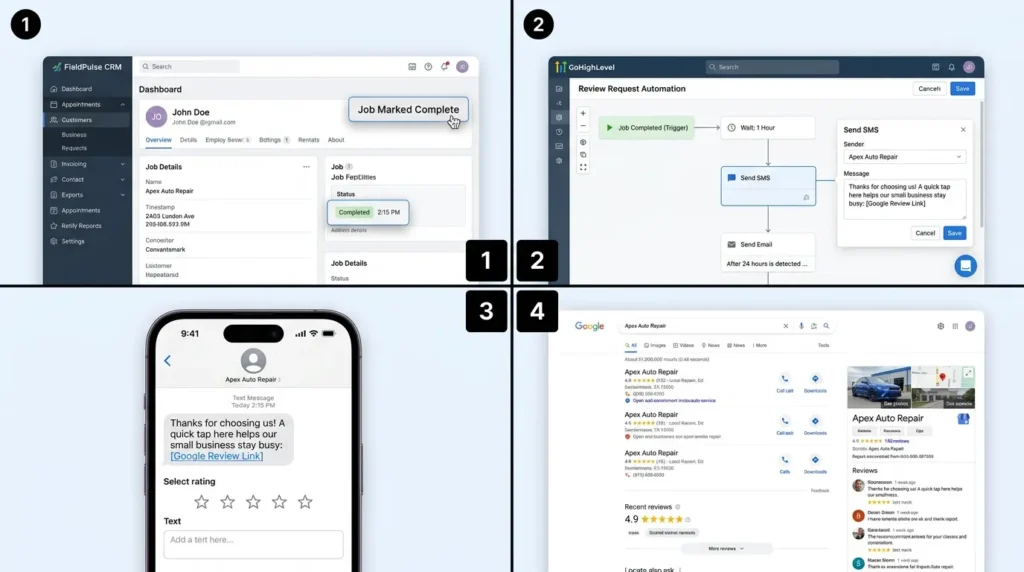
The core of the service is a review request automation. After a job is completed, the client’s customer receives a text message and a follow-up email asking for feedback. The timing matters, it should arrive within an hour or two of service completion, while the experience is still fresh.
The sequence looks like this:
- Job marked complete in the client’s system
- Automated SMS fires: “Thanks for choosing us! A quick tap here helps our small business stay busy: [Google Review Link]”
- If no review is left within 24 hours, a polite reminder goes out
- New review appears on the client’s Google listing
The client does not have to remember to ask. The staff does not have to remember. You do not have to manage it manually. The system runs on its own.
Platforms like GoHighLevel have pre-built templates for exactly this workflow. You configure it once, test it, and it operates indefinitely.
Within 30 days, most clients start seeing new reviews arrive consistently. Within 60 days, the change on Google Maps is visible. Their listing looks more active. Their ranking in the Local Pack begins to improve. And every time they open Google Maps and see the new reviews, they are reminded of the value you are delivering.
The Compliance Line You Cannot Cross
Review automation is legal and encouraged. But there is a specific practice called Review Gating that Google prohibits, and it is important to understand the line.
- Review Gating (Prohibited): Asking customers to rate their experience before directing them to Google, and only sending satisfied customers to leave a public review. This filters out negative feedback, which violates Google’s review policies.
- Review Routing (Compliant): Asking all customers for an honest review via an automated sequence. If someone is unhappy, you can include a secondary option to submit private feedback, but the path to the Google review page must be available to everyone, regardless of their experience.
The distinction matters both for ethical practice and for protecting your client’s listing from being penalized or removed.
Google also prohibits: bulk review requests from shared devices (kiosks/tablets), incentivizing reviews with discounts or gifts, and AI-generated fake reviews. The rule of thumb: every request should go to every customer, asking for honest feedback. Automation of the request is allowed. Automation of the outcome is not.
The Hidden Force Reshaping Review Strategy: Google’s “Ask Maps” and Gemini AI
Here is an angle most articles about review management miss entirely, and it is arguably the most important development in local search in the last two years.
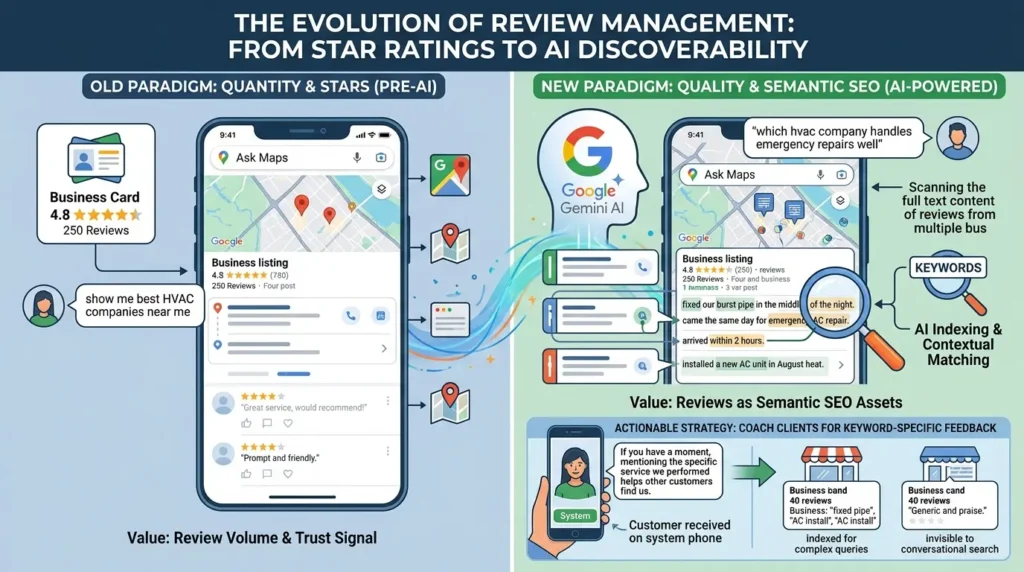
Google is integrating its Gemini AI model into Maps through a feature being rolled out as “Ask Maps.” Instead of just showing star ratings and review counts, the AI now reads the text content of reviews to answer conversational queries.
A user searching for “which HVAC company handles emergency repairs well” no longer just sees star ratings. Google’s AI scans review text across all listings for phrases like “emergency,” “fast response,” “middle of the night,” and “came the same day”, and surfaces businesses whose reviews contain that language.
This changes the value proposition of review management fundamentally.
You are no longer just selling more reviews. You are selling AI discoverability.
A business with 10 reviews that all say “great service, would recommend” is nearly invisible to this system. A business with 40 reviews where customers specifically mention the type of work done (“fixed our burst pipe,” “installed a new AC unit in August heat,” “arrived within 2 hours”) is being indexed for every one of those queries.
The advanced version of this service involves coaching clients on how to prompt their customers for keyword-specific feedback. Instead of just asking for a review, the system message might say: “If you have a moment, mentioning the specific service we performed helps other customers find us.”
This transforms each review from a trust signal into a semantic SEO asset.
Real-World Case Studies: What This Looks Like in Practice
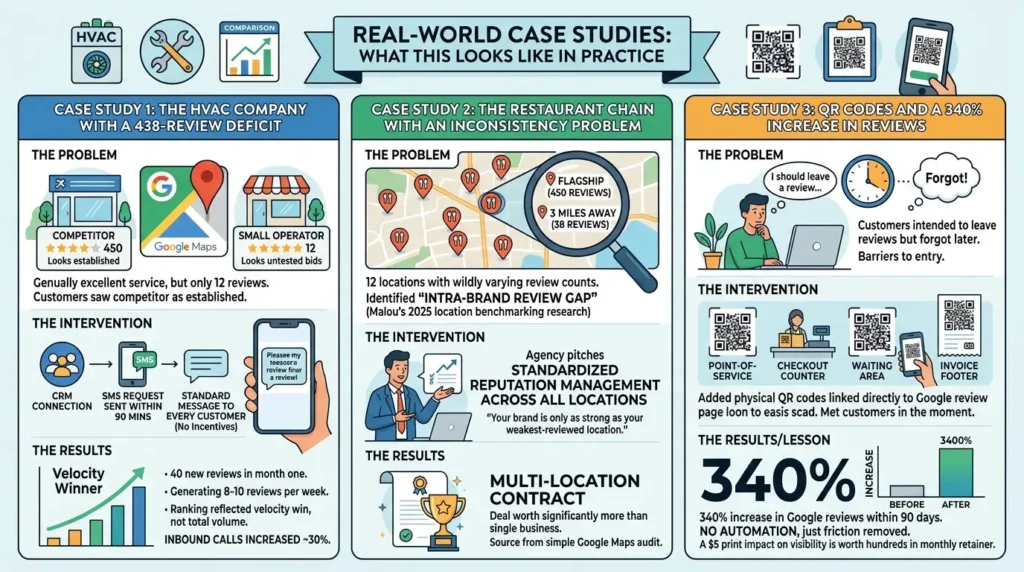
Case Study 1: The HVAC Company with a 438-Review Deficit
A small HVAC business had a 4.9-star average, genuinely excellent service, but only 12 reviews. Their primary competitor had 4.2 stars and 450 reviews.
Despite better service quality, the small operator was losing bids consistently. Customers in the search-and-compare phase saw the competitor as established and trusted. The smaller company looked untested.
The intervention:
- A review automation was connected to the company’s CRM
- Every completed job triggered an SMS request within 90 minutes
- No incentives, no filtering, every customer received the same message
Result: 40 new reviews arrived in month one. By month three, the business was generating 8–10 reviews per week, a higher velocity than the competitor, who was getting fewer than two per month. Google’s local algorithm began surfacing the client more prominently. Inbound calls increased by approximately 30%.
The client had not caught the competitor on volume. But they had won the velocity race, and the ranking reflected it.
Case Study 2: The Restaurant Chain with an Inconsistency Problem
A restaurant group with 12 locations discovered through a simple audit that their review counts varied wildly across locations. One flagship location had 450 reviews. A location three miles away had 38.
This is what Malou’s 2025 location benchmarking research calls the “intra-brand review gap”, the same problem occurring inside a single organization.
The agency pitched not individual locations but the organization itself, offering “standardized reputation management across all locations.” The pitch: “Your brand is only as strong as your weakest-reviewed location.”
The result was a multi-location contract worth significantly more than any single-business deal, all sourced from an observation anyone could make by searching the restaurant name on Google Maps.
Case Study 3: QR Codes and a 340% Increase in Reviews
A service business added physical QR codes at their point-of-service locations, checkout counter, waiting area, invoice footer, linking directly to their Google review page.
The change removed the primary barrier: customers intending to leave a review but forgetting by the time they got home. The QR code met them in the moment when the experience was still fresh.
The result was a 340% increase in Google reviews within 90 days. No automation software required. No cold outreach. Just friction removed.
The lesson for agencies: sometimes the audit reveals problems that do not need complex solutions. A QR code is a $5 print. The impact on visibility is worth hundreds of dollars in monthly retainer.
How to Calculate Your Own Review Gap
Before pitching a prospect, it helps to quantify the gap precisely. Here is a simple formula:
Review Gap = Competitor Review Average (Top 3) − Client Current Review Count
Monthly Reviews Needed = Review Gap ÷ Months to Close
Use this calculation in your audit document. Showing a business owner a specific number, “you need 47 more reviews to match the top competitor”, converts abstract urgency into a concrete action plan.
From $297 to $1,300 a Month: The Service Stacking Path
Getting a client is only the beginning.
The review service is a foot in the door. It is not the ceiling. Once you have delivered results, and the client can see those results every time they open Google Maps, the relationship becomes easier. Trust is established. They start asking what else you can help with.
This is where service stacking changes the economics of your agency.
Review automation
$297/mo
+ AI receptionist (missed call text-back)
+$400/mo
+ Follow-up automation
+$300/mo
+ Website redesign & maintenance
+$300/mo
Notice the pattern. You did not sell four services at once. You sold one, proved it, and let the client’s growing trust open the door to each additional service.
This also explains why agencies built on this model have dramatically lower churn than typical social media or paid ads agencies. When a client has review automation, an AI receptionist, follow-up sequences, and a website all running together, switching providers is a major operational disruption. The switching cost is high. Retention, almost by default, improves.
The math for scaling is straightforward. Ten clients at $1,000 average monthly retainer equals $10,000 a month. Getting there from zero does not require massive infrastructure or a team. It requires a repeatable process for finding gaps, running audits, and delivering one service at a time.
The Week-One Reality Check: What This Actually Looks Like
This is what a first week running the Review Gap system looks like in practice, even if you have a full-time job:
- Monday: Open Google Maps, search three business categories in your city. Identify 7 businesses with visible review gaps. Note their names and find contact info.
- Tuesday: Build or generate a simple audit for each of the 7 businesses. Compare their review count to their top 3 competitors.
- Wednesday: Send the audit message to all 7. Short, specific, no pitch.
- Thursday–Friday: Two businesses reply. One asks how it works. One asks what you charge.
- The following week: One books a 15-minute call. You walk through the audit on Loom first. They say yes.
That is your first $297-a-month client.
The hardest step in that entire sequence is sending the first five messages. Not because it is technically difficult. Because it feels uncomfortable. Once you send them and someone replies, the discomfort disappears. The process takes over.
Three Warnings Before You Start
These are not theoretical. They are the specific mistakes that kill momentum for new agency owners.
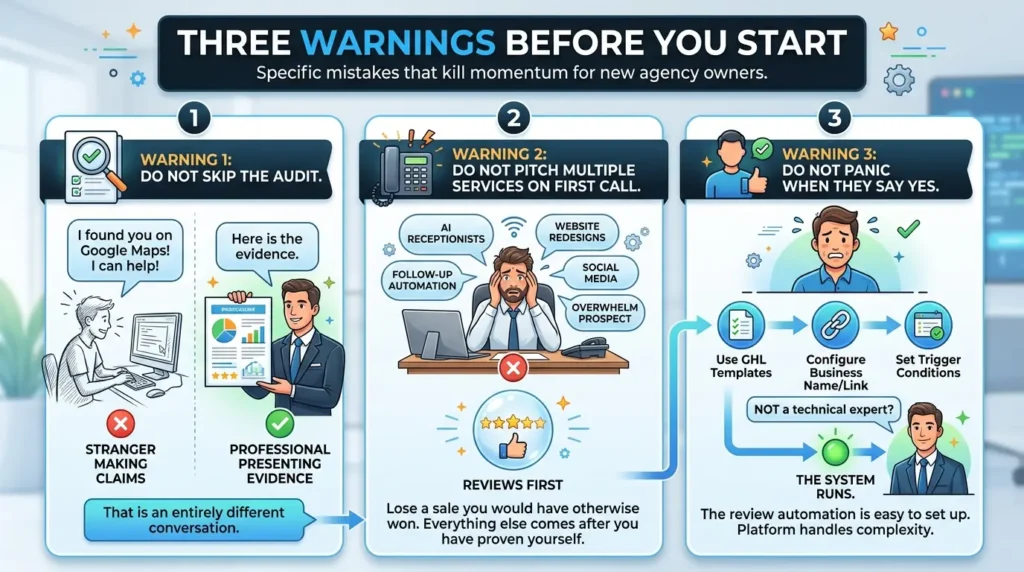
Warning 1: Do not skip the audit.
It is tempting. You found the gap on Google Maps. You have the contact info. You want to just reach out and offer to help. But without the audit, you are a stranger from the internet making claims. With the audit, you are a professional presenting evidence. That is an entirely different conversation.
Warning 2: Do not pitch multiple services on the first call.
You will be tempted to mention AI receptionists, follow-up automation, website redesigns, and social media all at once. Do not. You will overwhelm the prospect and lose a sale you would have otherwise won. Reviews first. Everything else comes after you have proven yourself.
Warning 3: Do not panic when they say yes.
The review automation is the easiest system to set up. GoHighLevel templates are pre-built. You configure the business name, the Google review link, and the trigger conditions. The system runs. You do not need to be a technical expert to deliver this service. The platform handles the complexity.
Common Mistakes That Stall Beginner Agencies
Before vs. After: The Review Gap Transformation
| Situation | Before Review Gap System | After Review Gap System |
|---|---|---|
| Local Map Pack position | Page 2–3, rarely visible | Top 3 positions within 60–90 days |
| Monthly inbound calls | Inconsistent, mostly referrals | +20–40% increase from search |
| New reviews per month | 0–2 (when remembered) | 8–15 consistently |
| AI search visibility (Ask Maps) | Invisible to Gemini queries | Keyword-rich reviews surface in AI answers |
| Client trust in agency | Low (no visible result) | High (client sees reviews land daily) |
| Monthly agency revenue | $0 | $297 growing to $1,300+ |
Conclusion: The First Step Is the Hardest One
The Review Gap is not a complicated system. It does not require technical expertise, a portfolio, or years of experience. It requires one thing: the willingness to open Google Maps, find a problem that is hiding in plain sight, and offer a solution backed by evidence.
Every element of this approach is designed to remove friction, friction in finding prospects, friction in starting the conversation, friction in delivering the service. What remains is a clear path from zero to a functioning agency that grows with every client you help.
The beginners who fail do not fail because the market is saturated. They fail because they are still looking for the perfect service to offer. Reviews are not glamorous. They are not the hottest thing in digital marketing.
But they are visible, provable, and compounding.
Start with one prospect this afternoon. Build one audit. Send one message. See what happens.
The gap is there. Someone is going to close it. It may as well be you.





[…] Read the Full Article → […]