
Confusion reigns. You’ve seen both terms used interchangeably in job descriptions. Your boss asks you to “improve security” but doesn’t specify which kind. You’re researching career paths but can’t tell if you should learn InfoSec or cybersecurity first.
Here’s the truth: they’re not the same thing, though they overlap significantly.
Think of it this way: Information Security (InfoSec) is the universe. Cybersecurity is one galaxy within it.
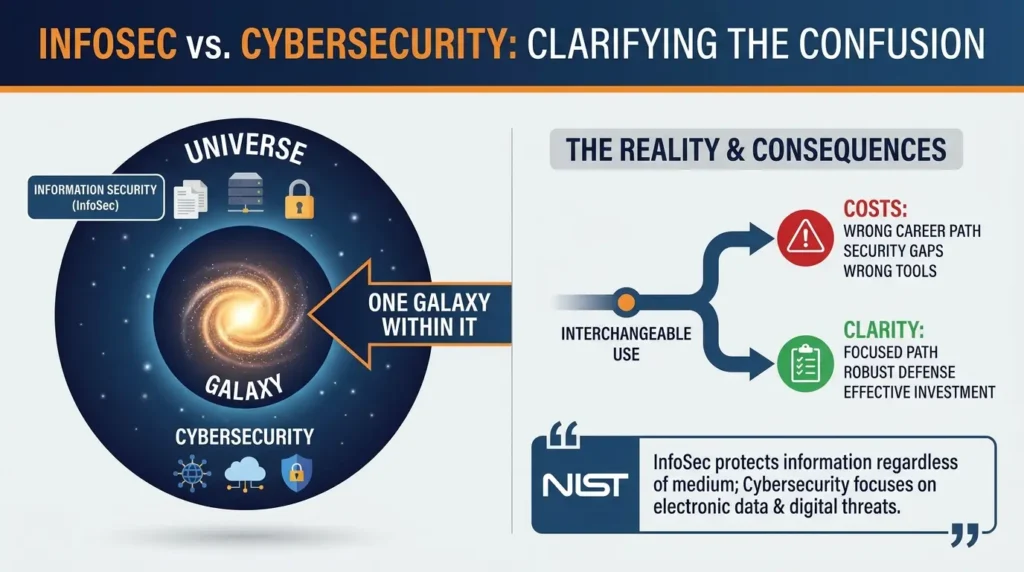
According to the National Institute of Standards and Technology (NIST), information security protects information and information systems from unauthorized access regardless of medium, while cybersecurity focuses specifically on securing computer systems, networks, and digital information from cyber threats.
Most people including hiring managers use these terms interchangeably. But getting the distinction wrong can cost you. It can send your career down the wrong path. It can leave gaps in your company’s defenses. It can make you invest in the wrong tools.
Let’s clear this up once and for all.
At a Glance:
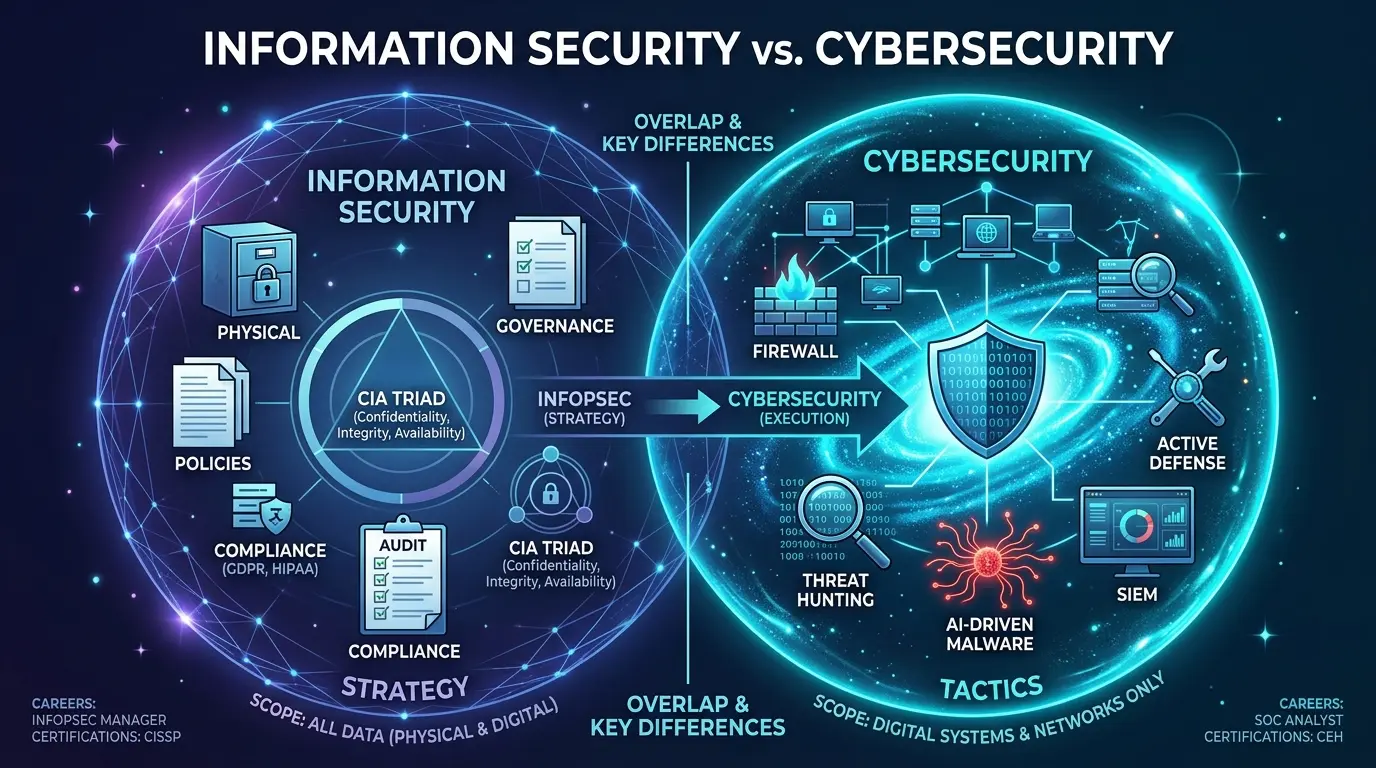
- The Core Difference: Information Security (InfoSec) is the broader discipline protecting all data (physical, digital, intellectual), whereas Cybersecurity is a specialized subset focusing strictly on protecting digital assets and networks.
- Strategic vs. Tactical: InfoSec focuses on governance, risk management, and the CIA triad (Confidentiality, Integrity, Availability). Cybersecurity focuses on technical implementation, threat hunting, and active defense tools.
- Career Paths: InfoSec roles (e.g., Compliance Officer, Manager) lean towards policy and auditing. Cybersecurity roles (e.g., Pentester, SOC Analyst) are hands-on and highly technical.
- 2026 Reality: Modern threats like AI-driven malware and ransomware require organizations to integrate both disciplines—using InfoSec for strategy and Cybersecurity for execution (e.g., in Zero Trust frameworks).
What Information Security Really Means
Information Security protects all information assets. Period.
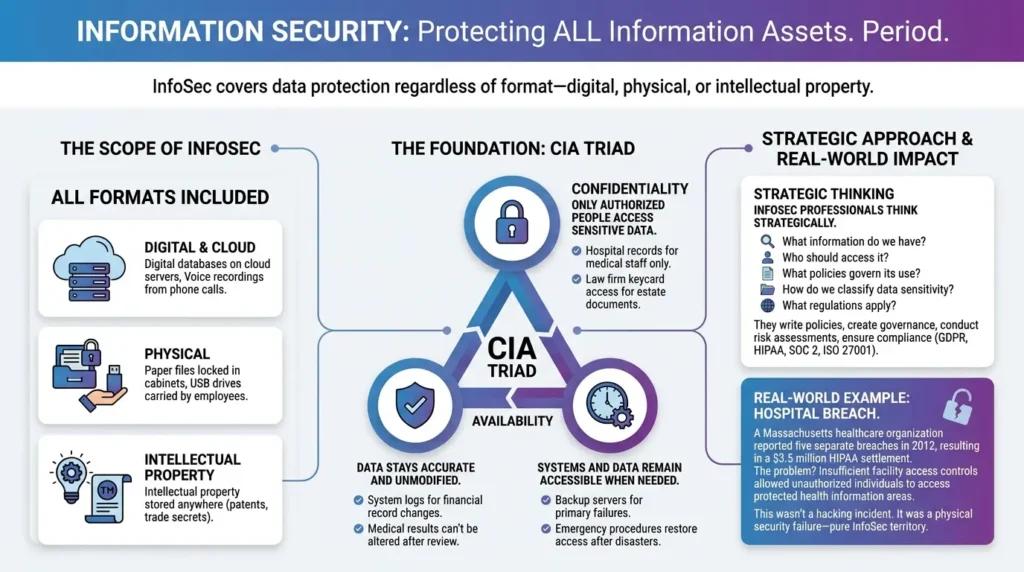
That includes:
- Paper files locked in cabinets
- USB drives carried by employees
- Digital databases on cloud servers
- Voice recordings from phone calls
- Intellectual property stored anywhere
InfoSec covers data protection regardless of format—digital, physical, or intellectual property like patents and trade secrets.
The foundation is the CIA triad: Confidentiality, Integrity, Availability. These three principles drive every InfoSec decision.
Confidentiality means only authorized people access sensitive data. A hospital restricts patient records to medical staff who need them. A law firm locks estate planning documents in a room with keycard access.
Integrity ensures data stays accurate and unmodified. When someone changes a financial record, the system logs who made the change and when. Medical test results can’t be altered after a doctor reviews them.
Availability guarantees systems and data remain accessible when needed. Backup servers kick in if primary systems fail. Emergency procedures restore access after disasters.
Real-World Example: Hospital Breach
A Massachusetts healthcare organization reported five separate breaches in 2012. The problem? Insufficient facility access controls allowed unauthorized individuals to access areas where protected health information was stored, resulting in a $3.5 million HIPAA settlement. This wasn’t a hacking incident. It was a physical security failure—pure InfoSec territory.
Information Security professionals think strategically. They ask:
- What information do we have?
- Who should access it?
- What policies govern its use?
- How do we classify data sensitivity?
- What regulations apply?
They write policies, create governance frameworks, conduct risk assessments, and ensure compliance with GDPR, HIPAA, SOC 2, ISO 27001.
What Cybersecurity Actually Covers
Cybersecurity is narrower and more tactical.
It defends digital systems from cyber threats. Full stop.
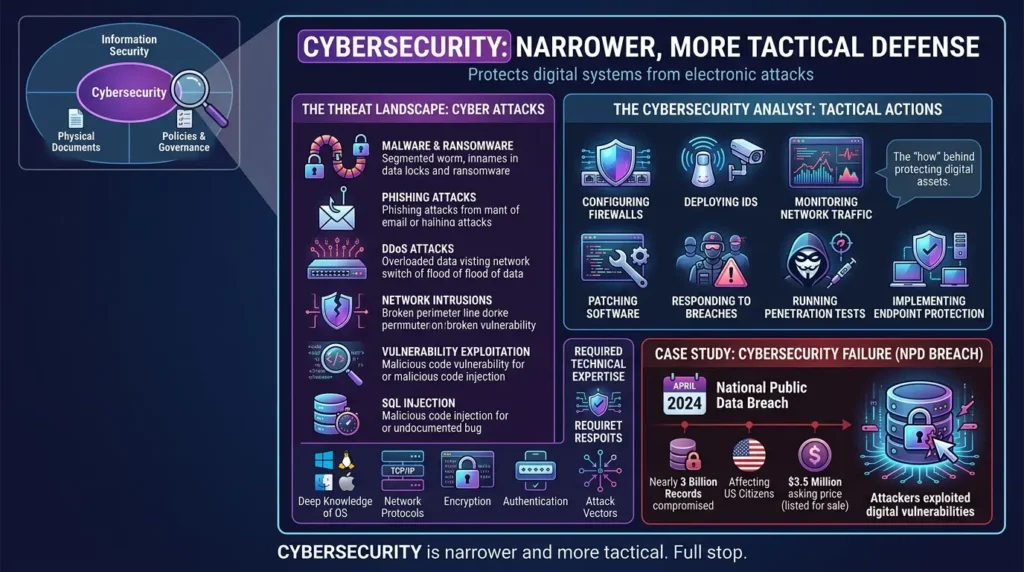
Cybersecurity professionals protect servers, endpoints, databases, and networks from electronic attacks. They deal with:
- Malware and ransomware
- Phishing attacks
- DDoS attacks
- Network intrusions
- Vulnerability exploitation
- SQL injection
- Zero-day exploits
Think of cybersecurity as the “how” behind protecting digital assets.
A cybersecurity analyst might:
- Configure firewalls
- Deploy intrusion detection systems
- Monitor network traffic for anomalies
- Patch software vulnerabilities
- Respond to active breaches
- Run penetration tests
- Implement endpoint protection
The work is highly technical. Cybersecurity specialists need deep knowledge of network protocols, operating systems, encryption, authentication mechanisms, and attack vectors.
When National Public Data suffered a breach affecting nearly 3 billion US citizens in April 2024, exposing names, social security numbers, and addresses listed for sale at $3.5 million, that was a cybersecurity failure. Attackers exploited digital vulnerabilities to access systems.
The Critical Differences That Matter
Let’s break down what actually separates these fields:
| Aspect | Information Security | Cybersecurity |
|---|---|---|
| Scope | All data (digital, physical, verbal) | Digital data only |
| Primary Focus | CIA triad, governance, compliance | Defending against cyber threats |
| Threats Addressed | Theft, unauthorized access, natural disasters, insider threats | Malware, phishing, DDoS, hacking, ransomware |
| Approach | Policy-first, strategic | Threat-first, tactical |
| Tools | Access controls, classification systems, policies, audits | Firewalls, IDS/IPS, SIEM, EDR, antivirus |
| Example Roles | InfoSec Manager, Compliance Officer, Security Auditor | SOC Analyst, Penetration Tester, Security Engineer |
Here’s the key insight: Information Security Analysts are primarily reactive, dealing with threats after they occur and ensuring compliance, while Cybersecurity Specialists are proactive, anticipating threats and actively working to prevent them.
InfoSec sets the “what” and “why.” Cybersecurity delivers the “how.”
Why Companies Confuse Them (And Why It Matters)
Job postings mix these terms constantly.
You’ll see “Information Security Analyst” roles that actually require firewall configuration. You’ll find “Cybersecurity Engineer” positions that want policy writing experience.
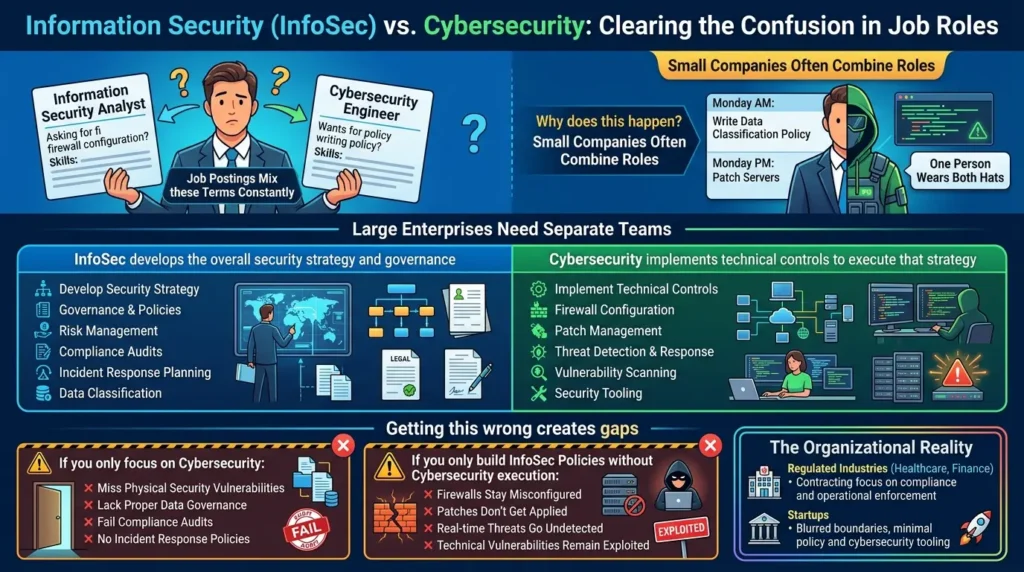
Why does this happen?
Small companies often combine roles. One person wears both hats. They write the data classification policy Monday morning and patch servers Monday afternoon.
In many Western organizations, the terms are used practically interchangeably despite having distinct meanings.
But as organizations grow, the split becomes critical.
Large enterprises need separate teams:
- InfoSec develops the overall security strategy and governance
- Cybersecurity implements technical controls to execute that strategy
The Organizational Reality
In regulated industries like healthcare and finance, InfoSec responsibilities often contract around compliance requirements while cybersecurity becomes operational enforcement. In startups, these boundaries blur completely—InfoSec policy might be minimal while cybersecurity tooling takes center stage.
Getting this wrong creates gaps.
If you only focus on cybersecurity, you might:
- Miss physical security vulnerabilities
- Lack proper data governance
- Fail compliance audits
- Have no incident response policies
If you only build InfoSec policies without cybersecurity execution:
- Firewalls stay misconfigured
- Patches don’t get applied
- Real-time threats go undetected
- Technical vulnerabilities remain exploited
Modern Security: Where They Converge
The digital transformation blurred these lines.
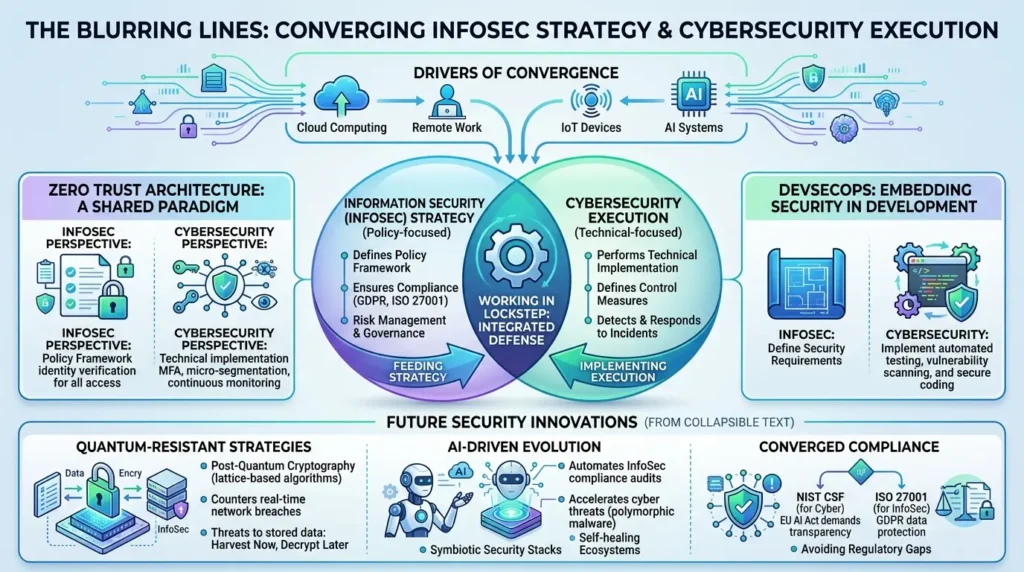
Cloud computing, remote work, IoT devices, AI systems, these created environments where information security strategy and cybersecurity execution must work in lockstep.
Consider Zero Trust architecture, which has become the de facto standard for modern cybersecurity in 2026, requiring continuous authentication and stringent access controls.
Zero Trust operates at both levels:
- InfoSec perspective: Policy framework requiring identity verification for all access
- Cybersecurity perspective: Technical implementation using MFA, micro-segmentation, continuous monitoring
Similarly, DevSecOps embeds security into software development. It requires InfoSec to define security requirements and cybersecurity to implement automated testing, vulnerability scanning, and secure coding practices.
Click to explore: Future Security Innovations
Quantum-Resistant Strategies: Quantum computing threatens both fields uniquely. InfoSec’s symmetric encryption faces “harvest now, decrypt later” attacks on stored data. Cybersecurity must implement post-quantum cryptography like lattice-based algorithms to counter real-time network breaches.
AI-Driven Evolution: AI automates InfoSec compliance audits but also accelerates cyber threats like polymorphic malware. Organizations need “symbiotic security stacks” where AI agents in cyber realms feed predictive models for InfoSec governance, creating self-healing ecosystems.
Converged Compliance: Emerging regulations like the EU AI Act demand cyber-specific transparency, while GDPR emphasizes broad InfoSec data protection. Organizations need decision trees comparing NIST CSF (for Cyber) versus ISO 27001 (for InfoSec) to avoid regulatory gaps.
The Data Tells The Story
Numbers don’t lie about why both disciplines matter.
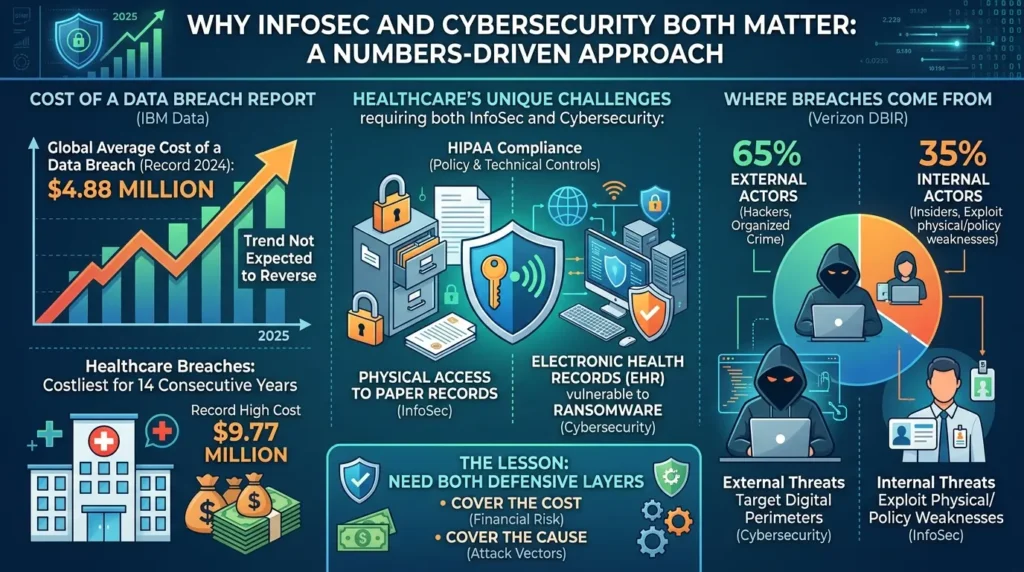
According to IBM’s Cost of a Data Breach Report, the global average cost of a data breach reached a record $4.88 million in 2024. Don’t expect this trend to reverse in 2026.
Healthcare data breaches remain the most expensive at $9.77 million per incident, maintaining their position as the costliest for 14 consecutive years.
Why? Healthcare has unique challenges requiring both InfoSec and cybersecurity:
- Physical access to paper records (InfoSec)
- Electronic health records vulnerable to ransomware (Cybersecurity)
- HIPAA compliance requiring both policy and technical controls
Meanwhile, Verizon’s Data Breach Investigations Report (DBIR) reveals how these breaches happen. Their latest data shows that 65% of breaches involved external actors (hackers, organized crime), while 35% involved internal actors.
Internal threats often exploit physical access or policy weaknesses, classic InfoSec vulnerabilities. External threats target digital perimeters, classic Cybersecurity territory.
The lesson? You need both defensive layers to cover the cost (financial risk) and the cause (attack vectors).
Career Paths: Which Field Fits You?
This matters if you’re choosing a career direction.
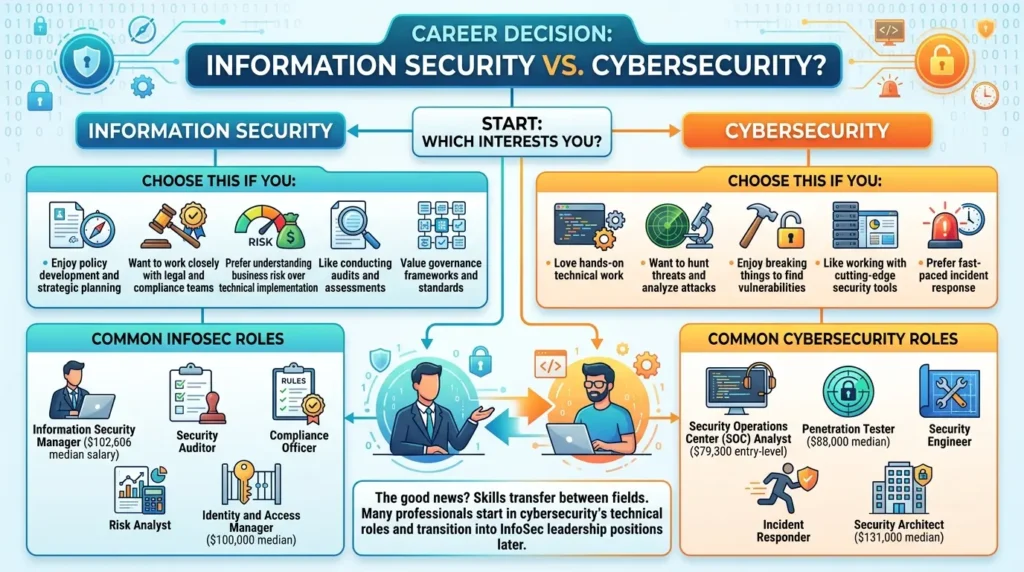
Choose Information Security if you:
- Enjoy policy development and strategic planning
- Want to work closely with legal and compliance teams
- Prefer understanding business risk over technical implementation
- Like conducting audits and assessments
- Value governance frameworks and standards
Common InfoSec roles:
- Information Security Manager ($102,606 median salary)
- Security Auditor
- Compliance Officer
- Risk Analyst
- Identity and Access Manager ($100,000 median)
Choose Cybersecurity if you:
- Love hands-on technical work
- Want to hunt threats and analyze attacks
- Enjoy breaking things to find vulnerabilities
- Like working with cutting-edge security tools
- Prefer fast-paced incident response
Common Cybersecurity roles:
- Security Operations Center (SOC) Analyst ($79,300 entry-level)
- Penetration Tester ($88,000 median)
- Security Engineer
- Incident Responder
- Security Architect ($131,000 median)
The good news? Skills transfer between fields. Many professionals start in cybersecurity’s technical roles and transition into InfoSec leadership positions later.
Certifications: Which Ones Match Which Field?
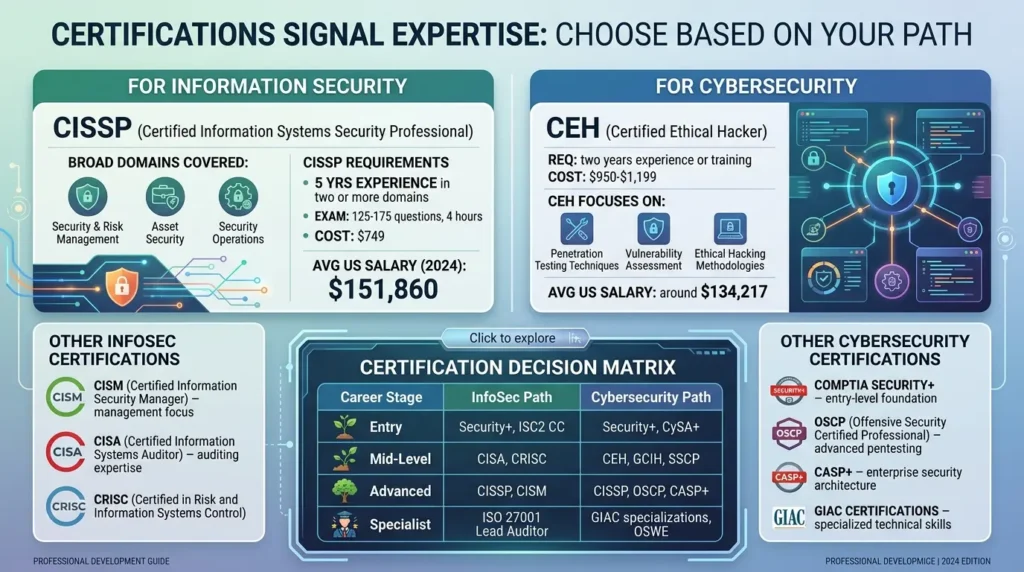
Certifications signal expertise. Choose based on your path.
For Information Security:
The CISSP (Certified Information Systems Security Professional) certification covers broad domains including security and risk management, asset security, and security operations, with an average US salary of $151,860 in 2024.
CISSP requirements:
- 5 years experience in two or more domains
- Exam: 125-175 questions, 4 hours
- Cost: $749
Other InfoSec certifications:
- CISM (Certified Information Security Manager) – management focus
- CISA (Certified Information Systems Auditor) – auditing expertise
- CRISC (Certified in Risk and Information Systems Control)
For Cybersecurity:
The CEH (Certified Ethical Hacker) certification requires two years of information security experience or approved training, costs $950-$1,199, and holders earn around $134,217 on average.
CEH focuses on:
- Penetration testing techniques
- Vulnerability assessment
- Ethical hacking methodologies
Other cybersecurity certifications:
- CompTIA Security+ – entry-level foundation
- OSCP (Offensive Security Certified Professional) – advanced pentesting
- CASP+ – enterprise security architecture
- GIAC certifications – specialized technical skills
Click to explore: Certification Decision Matrix
| Career Stage | InfoSec Path | Cybersecurity Path |
|---|---|---|
| Entry | Security+, ISC2 CC | Security+, CySA+ |
| Mid-Level | CISA, CRISC | CEH, GCIH, SSCP |
| Advanced | CISSP, CISM | CISSP, OSCP, CASP+ |
| Specialist | ISO 27001 Lead Auditor | GIAC specializations, OSWE |
Which One Does Your Company Need?
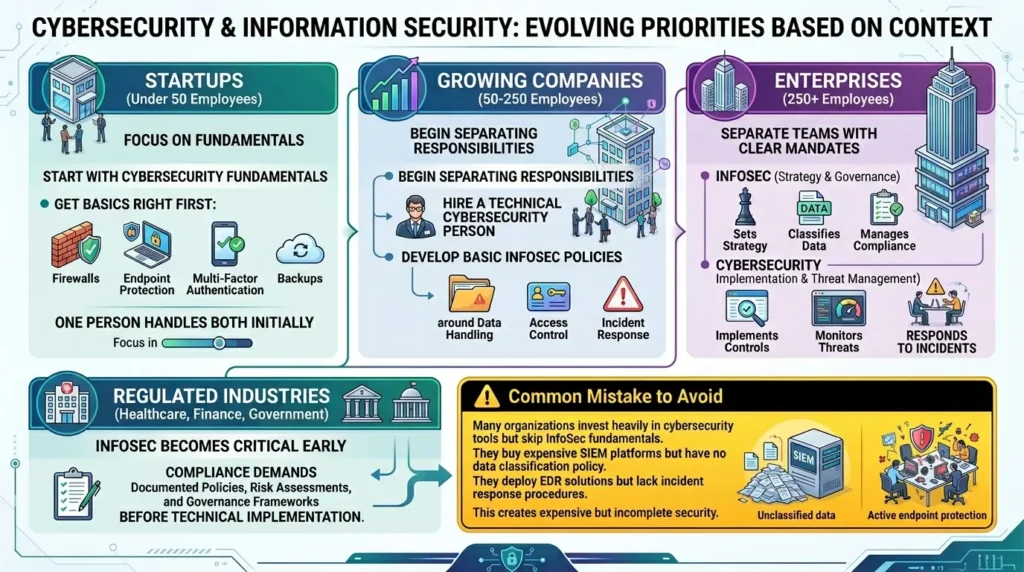
Both. But priorities shift based on context.
- Startups (under 50 employees): Start with cybersecurity fundamentals. Get basics right first, firewalls, endpoint protection, MFA, backups. One person can handle both initially.
- Growing companies (50-250 employees): Begin separating responsibilities. Hire a technical cybersecurity person. Develop basic InfoSec policies around data handling, access control, and incident response.
- Enterprises (250+ employees): Separate teams with clear mandates. InfoSec sets strategy, classifies data, manages compliance. Cybersecurity implements controls, monitors threats, responds to incidents.
- Regulated industries (healthcare, finance, government): InfoSec becomes critical early. Compliance demands documented policies, risk assessments, and governance frameworks before technical implementation.
⚠️ Common Mistake to Avoid
Many organizations invest heavily in cybersecurity tools but skip InfoSec fundamentals. They buy expensive SIEM platforms but have no data classification policy. They deploy EDR solutions but lack incident response procedures. This creates expensive but incomplete security.
Real-World Scenario: Hospital Ransomware
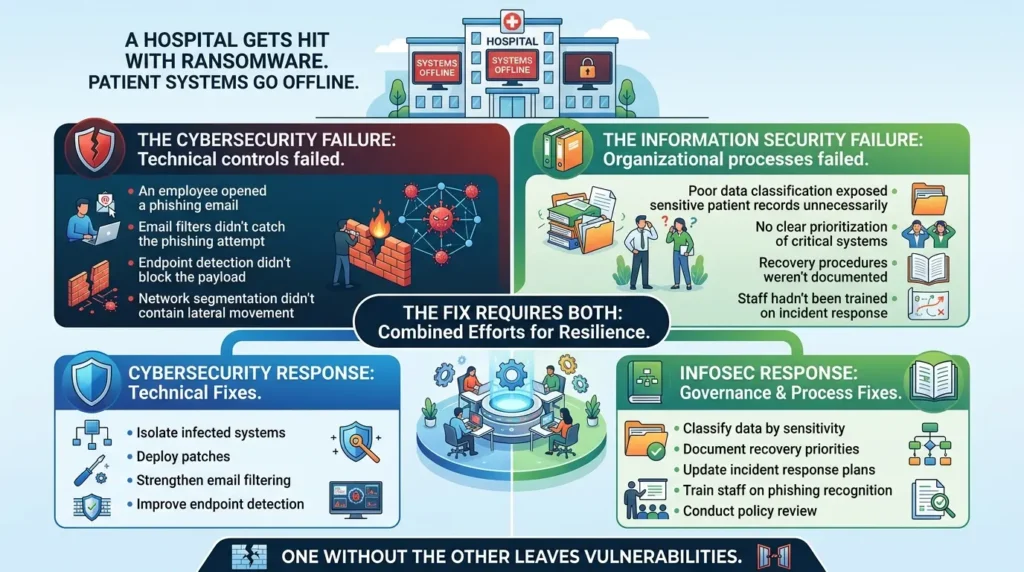
Let’s see how both disciplines work together.
A hospital gets hit with ransomware. Patient systems go offline.
- The Cybersecurity Failure: An employee opened a phishing email, allowing attackers to bypass email security defenses and deploy ransomware. Technical controls failed, email filters didn’t catch the phishing attempt, endpoint detection didn’t block the payload, network segmentation didn’t contain lateral movement.
- The Information Security Failure: Poor data classification exposed sensitive patient records unnecessarily, lacking proper categorization of what data was most critical. The hospital had no clear prioritization of critical systems. Recovery procedures weren’t documented. Staff hadn’t been trained on incident response.
The fix requires both:
- Cybersecurity response: Isolate infected systems, deploy patches, strengthen email filtering, improve endpoint detection
- InfoSec response: Classify data by sensitivity, document recovery priorities, update incident response plans, train staff on phishing recognition, conduct policy review
One without the other leaves vulnerabilities.
The Bottom Line
Information Security and Cybersecurity aren’t the same thing.
InfoSec is strategic. It protects all information using policy, governance, and risk management. It asks “what are we protecting and why?”
Cybersecurity is tactical. It defends digital systems from cyber threats using technical tools and active defense. It asks “how do we stop attackers?”
Think of InfoSec as the architect. Cybersecurity is the builder and the security guard.
Both are essential. Neither is optional.
Small organizations blur these lines by necessity. As you grow, separation becomes critical. The organizations that thrive understand this distinction and invest accordingly.
Global cybersecurity spending is projected to grow 12.2% in 2025, exceeding $377 billion by 2028, reflecting how seriously organizations now take both disciplines.
The digital transformation didn’t make Information Security obsolete. It made it more important. Physical documents still exist. Policies still matter. Governance still drives compliance.
And the digital realm didn’t eliminate traditional risks. It added new attack vectors that demand specialized cybersecurity expertise.
Your move: stop using these terms interchangeably. Understand which skills you need. Build both capabilities appropriately. Protect your information universe—not just the digital galaxy within it.
Frequently asked questions (FAQ)
Is Information Security the same as Cybersecurity?
No. Information Security protects all data regardless of format (digital, physical, verbal), while Cybersecurity specifically defends against threats targeting digital systems and networks. Cybersecurity is a subset of Information Security.
Which career pays more: InfoSec or Cybersecurity?
Both offer competitive salaries. According to recent data, Information Security Analysts earn around $102,606 median salary, while specialized cybersecurity roles like Security Architects can reach $131,000 median. Senior InfoSec management positions like CISO often pay more than technical cybersecurity roles, but advanced pentesting and engineering positions offer strong compensation.
Can I start in Cybersecurity and move to Information Security later?
Yes. Many professionals start with technical cybersecurity roles and transition into InfoSec leadership positions as they gain experience. The technical foundation helps understand implementation challenges when creating strategic security policies.
Which certification should I get first: CISSP or CEH?
It depends on your career path. CEH is better for those focused on technical cybersecurity roles like penetration testing. CISSP suits those aiming for broader security management roles spanning both InfoSec and Cybersecurity. CISSP requires 5 years of experience, while CEH needs only 2 years, making CEH more accessible for mid-career professionals.
Do small businesses need both Information Security and Cybersecurity?
Yes, but one person can handle both initially. Start with essential cybersecurity controls (firewalls, MFA, backups) and basic InfoSec policies (data handling, access control). As you grow past 50 employees, consider separating these functions.
How does Zero Trust relate to Information Security vs. Cybersecurity?
Zero Trust operates at both levels. From an InfoSec perspective, it’s a policy framework requiring continuous verification of all access. From a Cybersecurity perspective, it’s the technical implementation using tools like MFA, micro-segmentation, and continuous monitoring. Both disciplines must collaborate to implement Zero Trust successfully.
Which is more important: Information Security or Cybersecurity?
Neither is more important—they’re complementary. Cybersecurity without InfoSec governance creates uncoordinated technical controls. InfoSec without cybersecurity execution leaves digital assets vulnerable despite having policies. Organizations need both working together.
How do GDPR and HIPAA relate to InfoSec vs. Cybersecurity?
These regulations span both disciplines. They require InfoSec elements (policies, risk assessments, data governance) and Cybersecurity elements (encryption, access controls, breach detection). Compliance demands coordinated effort from both teams.