
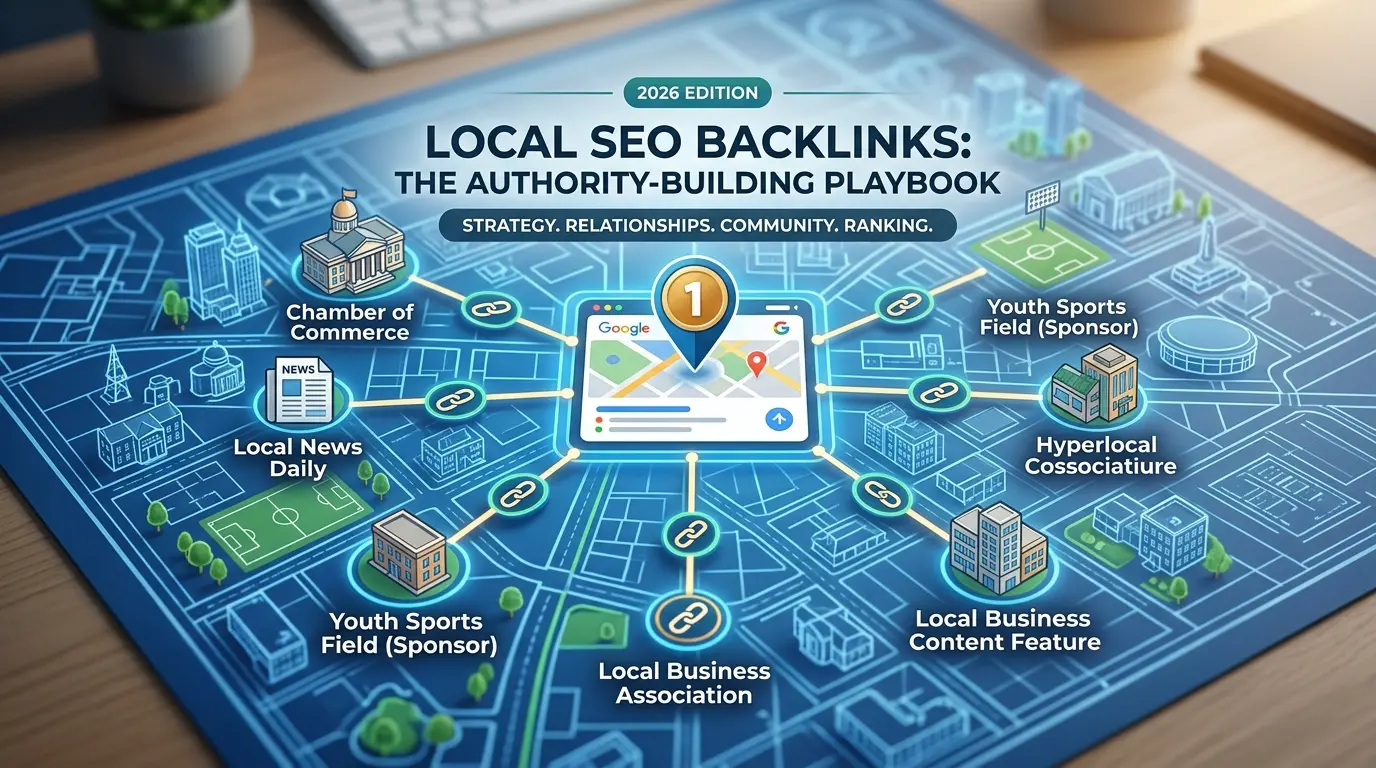

Here’s something most local businesses get completely wrong. They spend months chasing links from high-authority websites with massive domain ratings, guest posting on national blogs, and paying for expensive link-building campaigns, all while ignoring the one type of link that actually moves the needle for local rankings: a well-placed link from a respected source in their own backyard.
Local SEO is different from regular SEO, and the way backlinks work in local search is fundamentally different from what you may have learned elsewhere. A plumber in Austin doesn’t need a link from Forbes. They need a link from the Austin Chamber of Commerce, a mention in the Austin American-Statesman, or a feature on the local home improvement blog that parents in their neighborhood actually read.
The stakes are real. According to BrightLocal’s annual Local SEO industry survey, link building is consistently ranked as the third most important local ranking factor, right behind Google Business Profile signals and NAP citation consistency. Nearly 46% of all Google searches carry local intent. And a huge chunk of those users click directly on the Map Pack, the three-business box at the top of local results, and never scroll further.
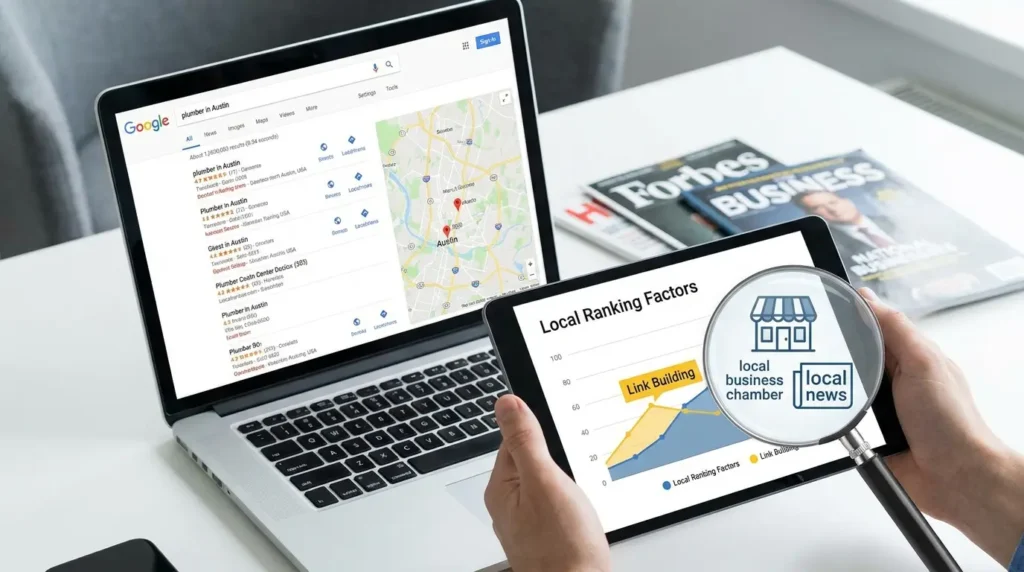
If your business isn’t in that box, you’re invisible to a massive portion of ready-to-buy customers. And if you’re in the box but ranking third instead of first, local backlinks are often the deciding factor.
This guide is going to walk you through everything: what local backlinks actually are, why they work, a practical framework for building them at every stage, what mistakes to avoid, and exactly how to approach this whether you have zero budget or a solid monthly investment to make.
What Local Backlinks Actually Are (and What They’re Not)
Before diving into tactics, let’s make sure we’re talking about the same thing. There’s a lot of confusion in this space about citations, mentions, and backlinks, and they’re not the same.
A local backlink is a clickable hyperlink from another website pointing to your website, where that linking site has geographic or topical relevance to your business location. The key distinction is that it’s not just any link, it’s a link from a source that Google associates with your city, region, or industry community.
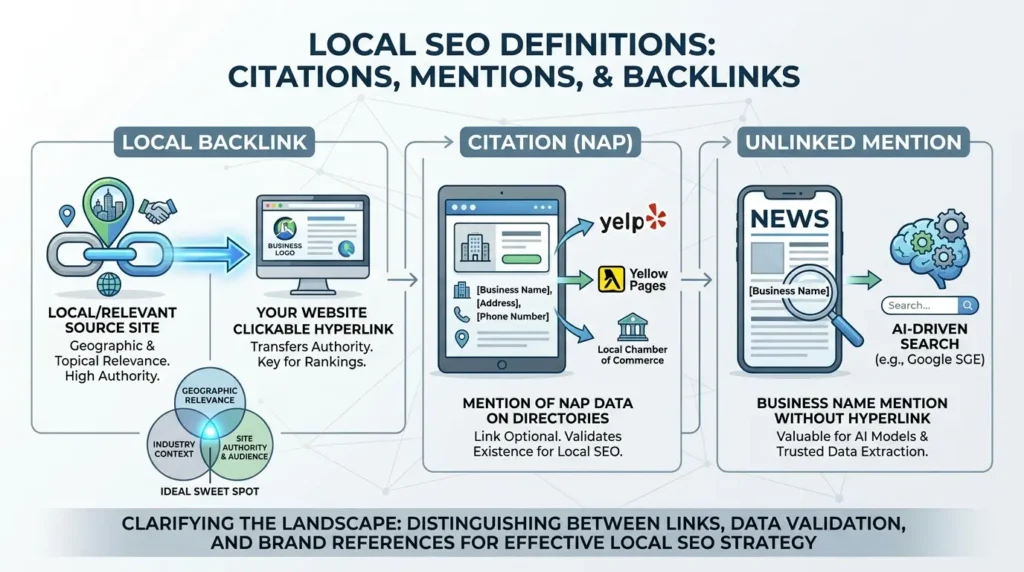
A citation, on the other hand, is a mention of your business name, address, and phone number (NAP) on a directory like Yelp, Yellow Pages, or a local chamber website. Citations may or may not include a link. They matter for local SEO, but they’re more about validation than authority transfer.
An unlinked mention is when a website talks about your business by name but doesn’t link to you. These are increasingly valuable in the era of AI-driven search, since models like Google’s SGE pull business data from trusted sources whether or not there’s a hyperlink present.
The ideal local backlink sits in the sweet spot of three things: it comes from a page with local geographic relevance, it’s contextually relevant to your industry, and it comes from a site with real authority and a real audience. You won’t always find all three, and that’s fine, but always be working toward that combination.
Why Google Rewards Local Backlinks More Than Ever
Google’s local search algorithm has three core pillars, and understanding how they interact changes everything about your link-building strategy.
Proximity is the physical distance between the searcher and your business. You can’t control this much. If someone searches “dentist near me” from two miles away from your office, that proximity filter is working in your favor. But if they’re five miles away and your competitor is two miles closer, proximity filters them in first.
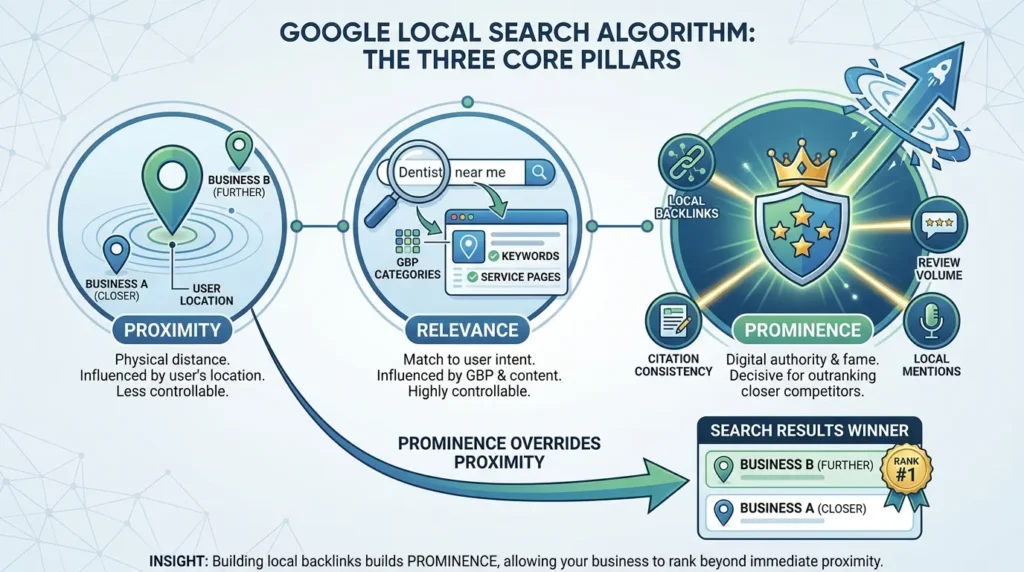
Relevance measures how well your Google Business Profile and website match what the user is actually searching for. This is influenced by your GBP categories, the keywords on your service pages, and how clearly your site communicates what you do and where.
Prominence is where local backlinks become decisive. Google describes prominence as how well-known a business is, and in the digital world, that’s measured largely through your backlink profile, review volume, citation consistency, and how frequently you’re mentioned on trusted local sources. According to Google’s own documentation on local ranking, prominence is calculated using information about a business that Google finds across the web.
Here’s the insight that most local SEO guides miss: Prominence can override Proximity. If your business has a significantly stronger local authority signal than a competitor who’s physically closer to the searcher, you can still outrank them. This is the whole game. Building local backlinks is how you build Prominence, and Prominence is how you get seen by people who are searching slightly outside your immediate neighborhood.
The 2021 “Vicinity” update made proximity more aggressive as a filter, which made a lot of businesses nervous. But the solution wasn’t to move offices, it was to build stronger Prominence signals. Businesses with rich local backlink profiles started appearing in searches well beyond their immediate block.
Here’s a visual breakdown of how these three pillars interact and where your backlink strategy fits in:
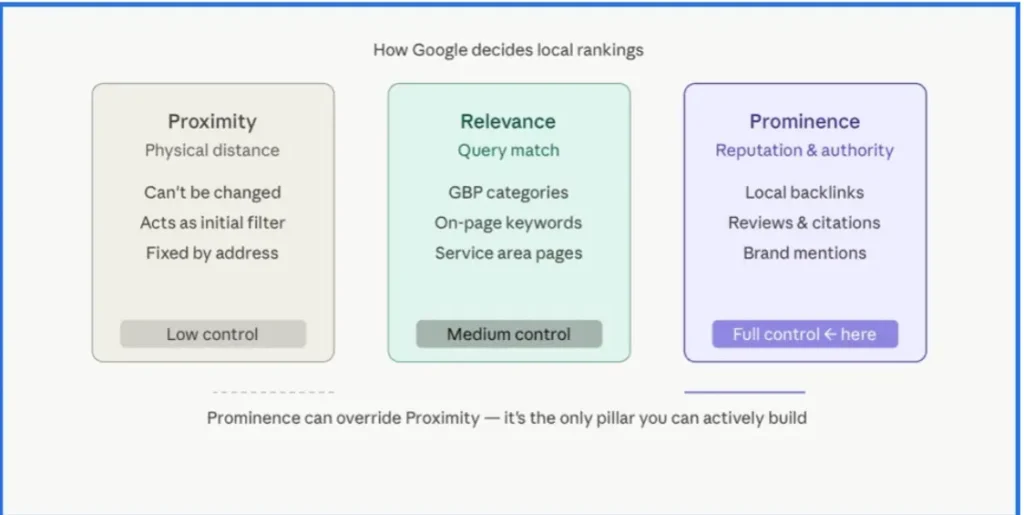
Key takeaway: Proximity filters. Relevance qualifies. But Prominence is what determines your final position, and backlinks are the primary driver of local Prominence.
The Local Link Ladder: A Framework for Building Authority in Layers
Most local SEO advice treats link building as a grab-bag of tactics. Do this, then do that, sprinkle in some directory listings. The problem with that approach is it gives you no sense of priority, and you end up doing everything at once and doing none of it particularly well.
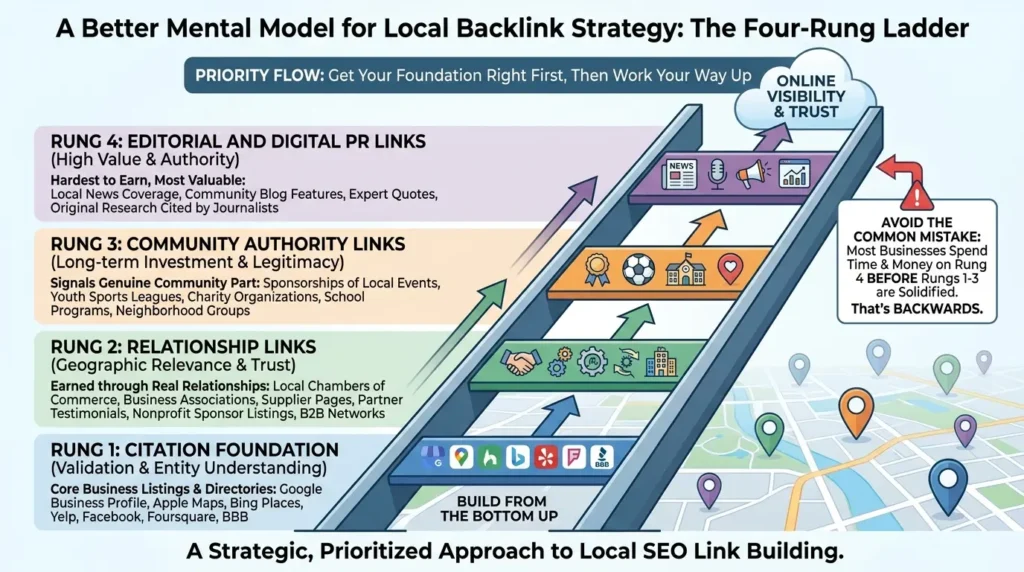
Here’s a better mental model: think of your local backlink strategy as a ladder with four distinct rungs. You have to build from the bottom up. Skipping rungs doesn’t work.
- Rung 1: Citation Foundation. These are your business listings on core directories, Google Business Profile, Apple Maps, Bing Places, Yelp, Facebook, Foursquare, and the BBB. They’re not pure backlinks in the traditional sense, but they validate your entity to search engines and they’re the first thing Google checks when trying to understand who and where you are.
- Rung 2: Relationship Links. Local chambers of commerce, business associations, supplier pages, partner testimonials, nonprofit sponsor listings, and B2B networks. These are earned through real relationships and community involvement. They carry strong geographic relevance.
- Rung 3: Community Authority Links. Sponsorships of local events, youth sports leagues, charity organizations, school programs, and neighborhood groups. These are the links that signal long-term community investment, not just “I paid for a link” but “this business is genuinely part of this place.”
- Rung 4: Editorial and Digital PR Links. Links earned through local news coverage, community blog features, expert quotes in local publications, and original research that journalists and bloggers want to cite. These are the hardest to earn and the most valuable.
Most businesses are spending time and money on Rung 4 tactics before they’ve solidified Rungs 1 through 3. That’s backwards. Get your foundation right first, then work your way up.
Your Foundation Layer: Citations and NAP Consistency
What is NAP consistency? NAP stands for Name, Address, and Phone number, the three pieces of business information that need to be identical across every directory, listing, and website where your business is mentioned. Even small discrepancies (“St.” vs “Street,” or different phone number formats) can confuse search engines trying to validate your entity.
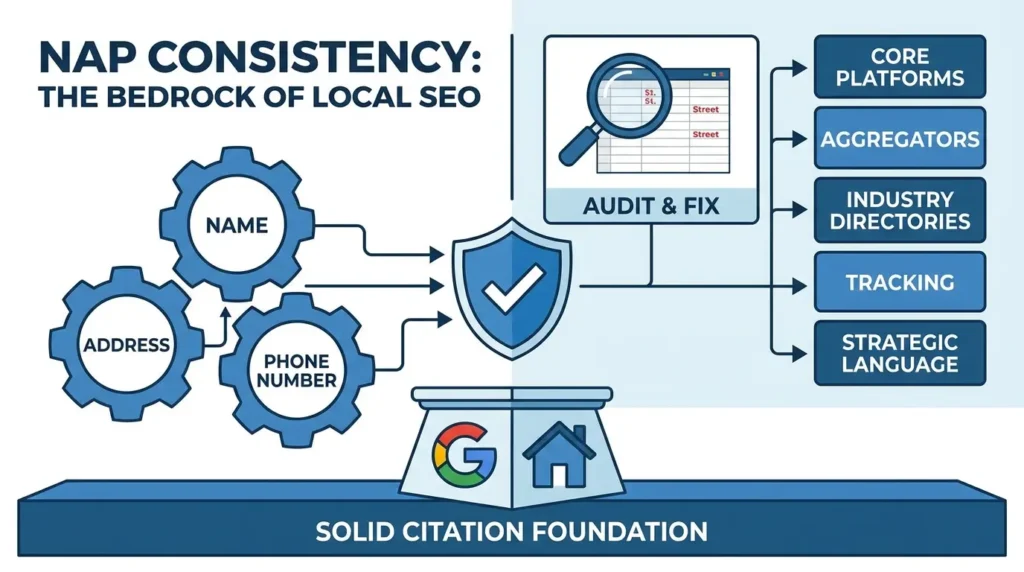
Here’s the step-by-step process for building a solid citation foundation:
Step 1: Audit what you already have
Before creating any new listings, find out what’s already out there. Use a free tool like BrightLocal’s Citation Tracker or Semrush’s Local tool to run a scan of your business name and address. You’ll almost certainly find duplicate listings, outdated phone numbers, or old addresses that need to be cleaned up.
Step 2: Fix your core platforms first
Google Business Profile is the single most important citation you have. Make sure it’s fully completed, primary category, secondary categories, hours (including holiday variations), photos, and a description with location-modified keywords. Then move to Apple Maps Connect, Bing Places, Yelp, and Facebook Business. These five platforms send data to hundreds of other directories and voice assistants downstream.
Step 3: Submit to data aggregators
Platforms like Data Axle and Neustar Localeze (in the US) feed your business information to hundreds of smaller directories, navigation apps, and smart speakers. Getting your data right at the aggregator level has a multiplying effect, it’s like correcting the source rather than each individual copy.
Step 4: Find industry-specific directories
A restaurant should be on OpenTable and Zomato. A lawyer should be on Avvo and FindLaw. A contractor should be on Angi and HomeAdvisor. These niche directories carry topical relevance that general directories can’t provide.
Step 5: Track everything in a spreadsheet
This sounds boring but it’s critical. Log every listing with its URL, the exact NAP language you used, and the date you submitted. When you expand to a new location or change your phone number, you’ll need this list to update every single listing systematically.
A pro tip from the video research: be strategic with your citation language, not just consistent. One listing might say “Bob’s Plumbing is a Denver-based residential plumbing company.” Another might say “Bob’s Plumbing serves Austin and Denver with emergency drain cleaning and water heater repair.” Both are accurate, but each one strengthens different keyword and location associations. You’re not spinning content, you’re layering contextual signals.
Key takeaway: Citation consistency is the bedrock. You can have dozens of excellent backlinks, but if your NAP data is a mess across 50 directories, Google struggles to assign that authority to the correct entity.
The Relationship Layer: Community and Partner Links
This is where most businesses get their first real wins, and where the process feels more like networking than “SEO.”
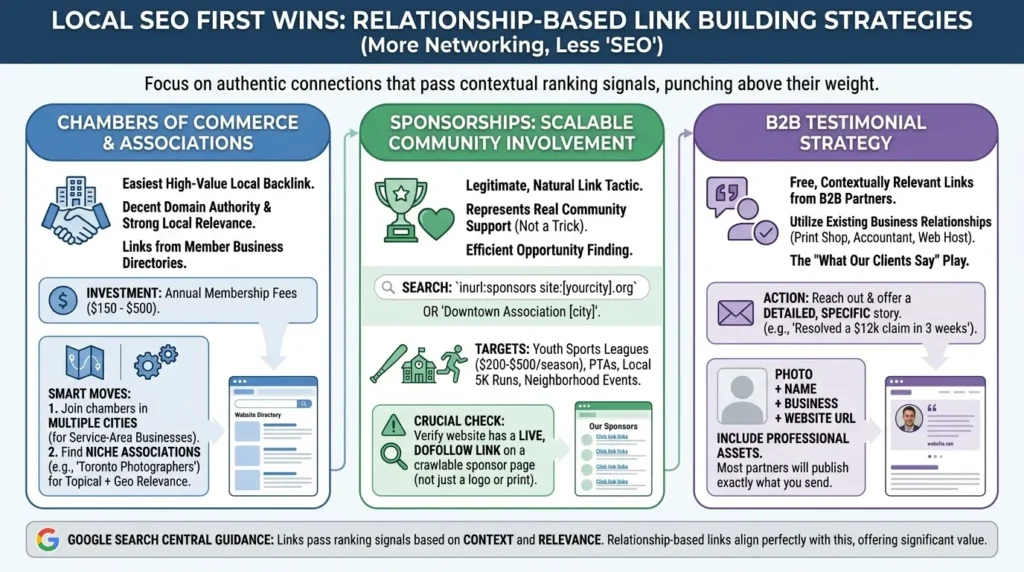
Chambers of Commerce and Business Associations
Your local chamber of commerce is probably the easiest high-value local backlink you can get. Chamber websites typically have decent domain authority, strong local relevance, and they link out to their members via a business directory. Annual membership fees run anywhere from $150 to $500 depending on your city and business size. For the link value alone, that’s an excellent return.
One smart move: if you serve multiple cities, join chambers in multiple locations. Each membership gets you a separate listing on a geo-relevant site. A service-area business like a landscaper or house cleaner might join three or four local chambers and pick up a cluster of strong local links in one month.
Beyond chambers, look for niche business associations. A photographer in Toronto should search for “Toronto photographers association.” A dentist should look for the regional dental society directory. These associations often have member directories with live links, and they give you the bonus of topical relevance alongside geographic relevance.
Sponsorships: The Relationship Link Strategy That Scales
Sponsoring local organizations is one of the most legitimate, natural link-building tactics available. Not because it “tricks” Google, but because it actually represents what Google is trying to measure: real community involvement.
Here’s how to find opportunities efficiently. Go to Google and search: inurl:sponsors site:[yourcity].org, this shows you local nonprofit and organization pages that have a sponsors section. You can also search for terms like “downtown association [city],” “Main Street program [city],” or “business improvement district [city].” These are local economic organizations that routinely list and link to supporting businesses.
Youth sports leagues are a particularly strong option. A sponsorship for a kid’s baseball or soccer team can run as little as $200–$500 per season, and most modern youth sports programs have websites that list sponsors with links. Same for school PTAs, local 5K charity runs, and neighborhood association events.
Before you commit to a sponsorship purely for SEO reasons, do one thing: check whether their website actually includes a linked sponsor page. Some organizations list sponsors only in a printed program or just display logos without links. If you’re investing for SEO benefit, you need a dofollow link on a page Google can actually crawl.
The Testimonial Strategy for B2B Links
Think about every professional service your business uses regularly. Your local print shop. Your business insurance agent. Your accountant. Your web hosting company. These businesses often have “What our clients say” pages or case study sections on their websites.
Here’s the play: reach out and offer to write a detailed, specific testimonial about how they helped your business. Not a generic “great service!” blurb, but a real story: “We switched to XYZ Insurance after struggling with claims processing delays. Their team resolved a $12,000 liability claim in three weeks.” Send that testimonial with a professional headshot, your name, your business name, and your website URL. Most of the time they’ll paste exactly what you sent, including the link.
This strategy is free, local, contextually relevant (business services), and produces editorial-looking links without any cold outreach awkwardness.
According to Google Search Central’s guidance on links and ranking, links pass ranking signals based on context and relevance, which is exactly why these relationship-based links punch above their weight compared to links from random high-DA sites.
Managing Your Anchor Text: The Distribution That Looks Natural
One thing that trips up businesses as they start building more links is over-optimizing their anchor text. If 80% of your backlinks say “best plumber in Chicago,” that pattern looks manipulative. Here’s an interactive reference for what a natural anchor text profile looks like:
Anchor text distribution calculator
Anchor Text Distribution CheckerEnter how many links you have of each type to see if your profile looks natural.
A natural local backlink profile looks organic because it is organic. When businesses sponsor events, get listed in chambers, and earn testimonial links, the anchor text naturally defaults to the business name or a naked URL, which is exactly what a healthy profile looks like.
The Content Layer: Creating Links Through Value
There’s a version of content marketing that works incredibly well for local businesses, and it’s almost the opposite of what most content strategists recommend.
Instead of writing broad “top 10 tips” posts that compete with thousands of national websites, the goal is to create hyperlocal resource content so specific and useful that your city’s websites have no choice but to link to it. Think about what national websites can’t write: they don’t know your city’s specific regulations, local events, neighborhood dynamics, or community quirks. You do.
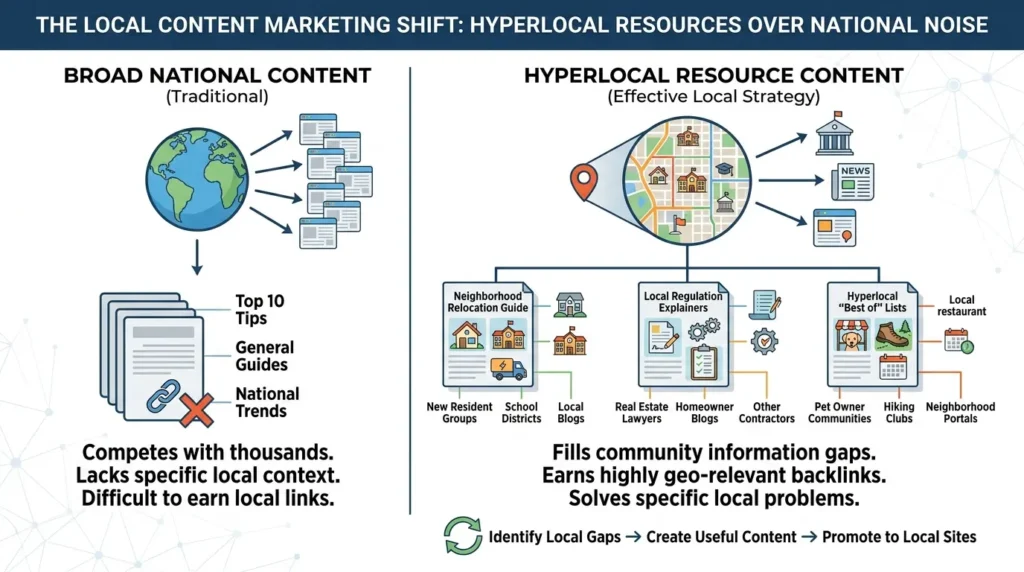
Some examples that consistently earn local backlinks:
- Neighborhood relocation guides: A moving company or real estate agent creates a detailed guide covering school district information, utility setup processes, garbage collection schedules, and local services for people moving into specific neighborhoods. New resident Facebook groups, school district websites, and local blogs link to these constantly.
- Local regulation explainers: A contractor creates a plain-language breakdown of local building permit requirements. Other contractors, real estate lawyers, and homeowner blogs link to it because they’d rather send readers to a clear explanation than try to summarize it themselves.
- “Best of” local lists: A dog-friendly restaurant guide. A list of every hiking trail within 30 minutes. Local event calendars. These attract links from pet owner communities, hiking clubs, and neighborhood portals, all of which are highly geo-relevant sources.
The formula is simple: identify what information gaps exist in your local community, fill them with genuinely useful content, then promote that content to the local sites that should be linking to it.
Once you’ve got these pages, you can use Google search operators to find who’s already linking to similar resources, and reach out to sites that haven’t found yours yet. According to Moz’s guide to local search ranking factors, content that serves a specific local community is consistently one of the strongest drivers of organic link acquisition.
The Authority Layer: Digital PR and Unlinked Mentions
This is the top of the Local Link Ladder, the hardest to reach but the most rewarding.
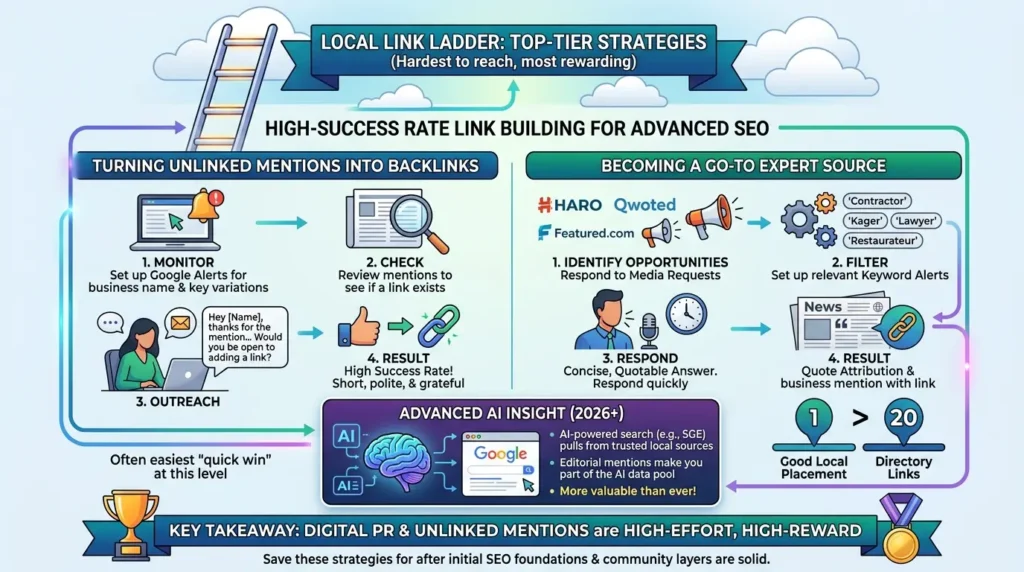
Turning Unlinked Mentions Into Backlinks
This is the quickest win at this level, and most businesses have no idea they’re sitting on it. Every time a local blog, news outlet, or community website mentions your business by name without linking to you, that’s a free backlink waiting to be claimed.
Set up Google Alerts for your business name and key variations. Every time a mention appears, check whether it includes a link. If it doesn’t, reach out to the writer or editor with a simple message:
“Hey [Name], thanks so much for the mention in your recent article about [Topic], that was a great piece. I noticed you mentioned [Business Name] but didn’t include a link. Would you be open to adding one? It would make it easy for your readers to find us if they’re interested.”
That’s it. Keep it short and be grateful. These outreach messages have a very high success rate because the relationship already exists, the journalist already decided you were worth mentioning.
Becoming a Go-To Expert Source
Journalists covering local news constantly need expert sources. A contractor can comment on storm damage trends. A lawyer can explain what a new local ordinance means. A restaurateur can weigh in on downtown development issues. Each of these earns a quote attribution with a business mention, and often a link.
Use platforms like HARO (Help a Reporter Out), Qwoted, or Featured.com to respond to media requests in your expertise area. Set up keyword alerts so you only see relevant queries. When you spot one that fits your expertise, respond quickly with a concise, quotable answer. A single good placement in a local newspaper or regional publication can be worth more than 20 directory links.
Advanced insight: In 2026, AI-powered search (Google’s SGE and similar tools) pulls content from trusted local sources to generate answers. Getting your business mentioned in a local newspaper article doesn’t just help with traditional rankings, it makes your business part of the data pool those AI overviews draw from. This makes editorial mentions significantly more valuable than they were even two or three years ago.
Key takeaway: Digital PR and unlinked mention reclamation are high-effort, high-reward strategies. Save them for after your foundation, relationship, and community layers are solid.
Before vs. After: What Building Local Backlinks Actually Changes
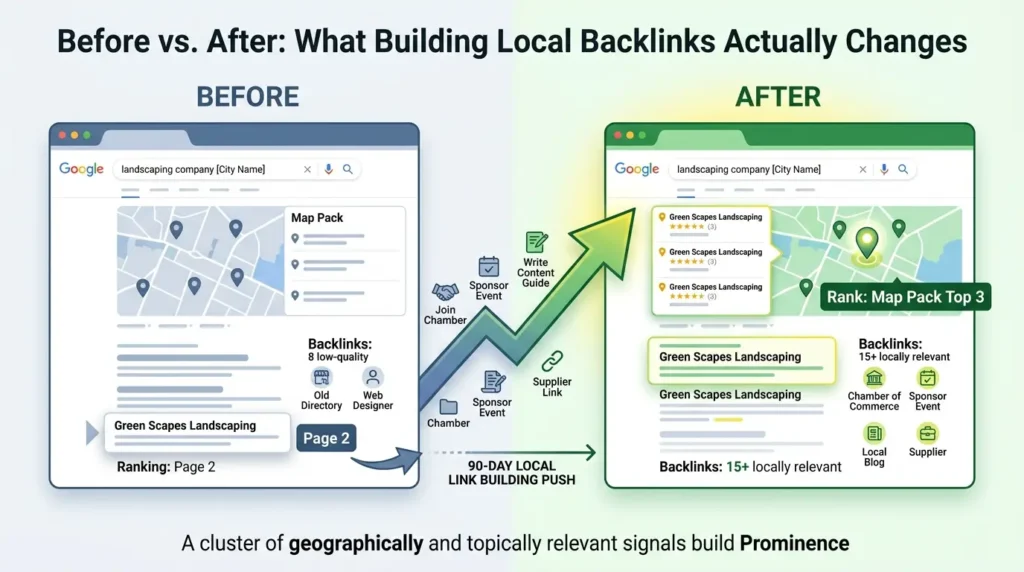
Here’s a real-world scenario to make this concrete.
Before: A landscaping company in a mid-size city has a decent website, a Google Business Profile, and maybe 8 backlinks, most from their web designer and a couple of old directory submissions. They rank on page two for “landscaping company [city]” and don’t appear in the Map Pack at all. Their competitor, who does similar quality work, ranks in the top three.
After a 90-day local link-building push: They join the local chamber (1 strong link). They sponsor a neighborhood association’s spring cleanup event ($300, plus a link from the event page). They write a guide to seasonal lawn care regulations in their county that gets linked by a local gardening blog and a school district’s community resources page. They reclaim two unlinked mentions from local real estate websites. Their supplier features them as a “trusted landscape partner” with a link. That’s 7–9 new locally relevant links.
Within two to three months of that campaign, they’re appearing in the Map Pack for their primary service area. Within six months, they’re capturing searches from adjacent neighborhoods they were invisible to before. The work that moves rankings isn’t a single big link, it’s a cluster of geographically and topically relevant signals that collectively build Prominence.
Common Mistakes That Waste Time and Kill Rankings
Every local business makes at least a few of these. Knowing them in advance saves you months of wasted effort.
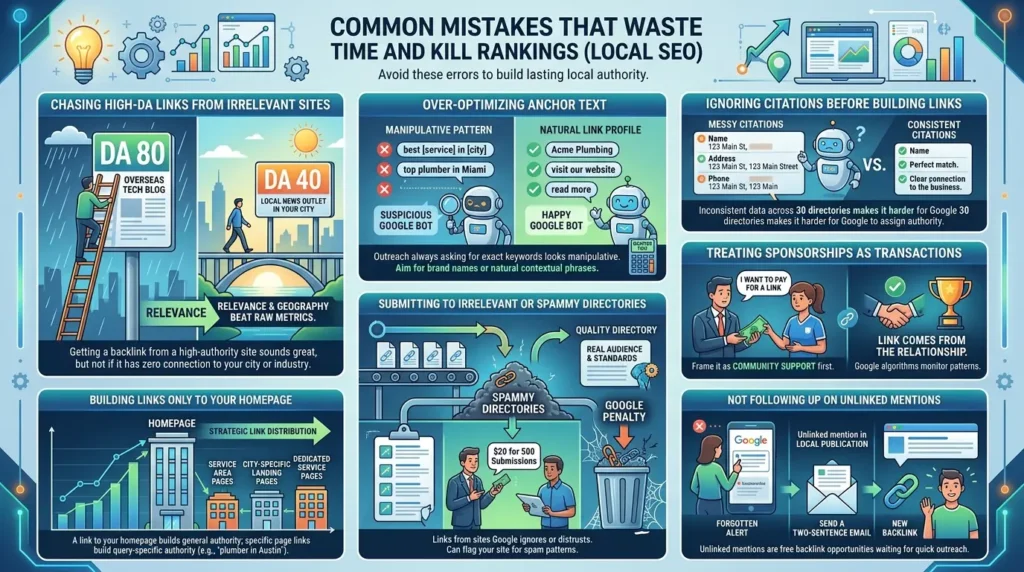
Chasing high-DA links from irrelevant sites
Getting a backlink from a domain with a domain authority of 80 sounds impressive, until that domain is a tech blog based overseas with zero connection to your city or industry. A link from a DA-40 local news outlet in your city is worth dramatically more. Relevance and geography beat raw metrics.
Over-optimizing anchor text
If your outreach always asks for “best [service] in [city]” as the anchor, you’re creating a pattern that looks manipulative. Aim for most links to use your brand name or a natural contextual phrase. The calculator above helps you monitor this.
Ignoring citations before building links
Earning a great link from a local news article won’t help much if your NAP data is inconsistent across 30 directories. Google needs to correctly assign that authority to your business entity, and messy citations make that harder.
Submitting to irrelevant or spammy directories
Spending $20 on Fiverr for “500 directory submissions” creates links from sites Google either ignores or actively distrusts. Worse, some of those submissions might flag your site for spam patterns. Focus on quality directories with real audiences and real editorial standards.
Building links only to your homepage
If you have service area pages, city-specific landing pages, or dedicated service pages, those pages need links too. A link to your homepage builds general authority; a link to your “plumber in Austin” page builds authority for exactly that query. Be strategic about which pages you point links toward.
Treating sponsorships as transactions
If you reach out to a local youth league and your opening message is “I want to pay for a link,” that’s going to land awkwardly. Frame it as community support first. The link comes from the relationship, not the transaction. Organizations can tell the difference, and so can Google’s algorithms when they see patterns of purely transactional link acquisition.
Not following up on unlinked mentions
Most businesses set up a Google Alert once and forget about it. Check it regularly. Unlinked mentions in local publications are free backlinks waiting for a two-sentence email.
Risk Management: Anchor Text, Link Velocity, and What to Avoid
One of the more nuanced aspects of local link building is controlling the pace and pattern of how you acquire links. Google’s spam policies are clear that manipulative link schemes, including buying links or participating in link networks, can result in penalties that are genuinely difficult to recover from.
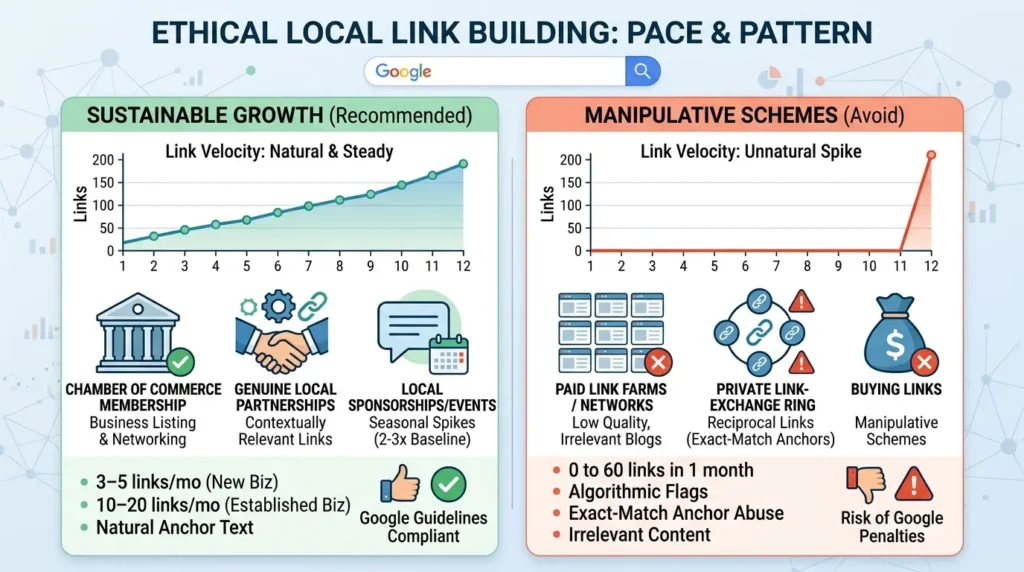
For link velocity: a brand new business or website that suddenly acquires 60 links in a single month raises algorithmic flags, especially if there’s no corresponding increase in brand searches or social mentions. A healthy, sustainable pace looks like:
- New businesses: 3–5 quality links per month
- Established businesses: 10–20 quality links per month
- Active campaigns (sponsorship season, event launches): up to 2–3x normal for 2–4 weeks, then return to baseline
For paid links: there’s a difference between paying for a chamber membership (which comes with a business listing and networking benefits, not just a link) and paying a link farm to add your URL to 200 random blogs. The former is completely fine and widely practiced. The latter is a violation of Google’s guidelines and the links are likely either ignored or harmful.
For reciprocal links: two businesses linking to each other isn’t inherently a problem if there’s a genuine relationship and the links are contextually relevant. A law firm linking to a financial advisor they regularly refer clients to is natural. Twelve businesses in a private link-exchange ring, all linking to each other with exact-match anchors, that’s a footprint.
The 2026 Local SEO Tool Stack
You don’t need to spend a fortune on tools, but a few core platforms make managing local SEO significantly more efficient.
BrightLocal is the gold standard for all-in-one local SEO management. It tracks citations, monitors review volume, visualizes rankings on a geo-grid (so you can see exactly which city blocks you dominate and which you’re losing), and identifies new local link opportunities.
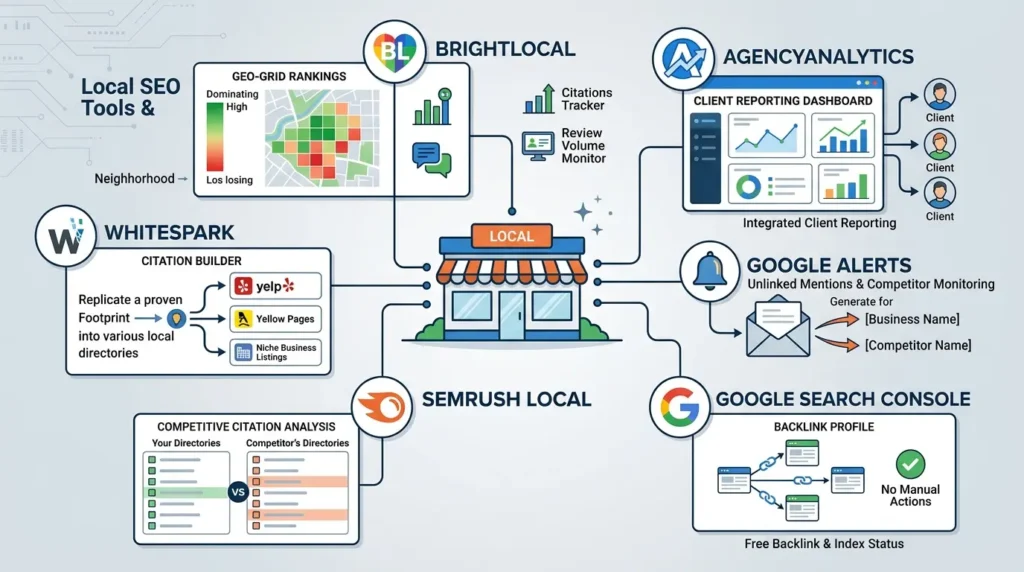
Whitespark specializes in citation building and niche directory discovery. Their citation builder is particularly useful for businesses expanding into new locations, you can replicate a proven citation footprint quickly.
Semrush’s Local module gives you competitive citation analysis. Enter a competitor’s business name and you’ll see every directory they’re listed in, including ones you may have missed.
Google Search Console is free and should always be running. It shows your current backlink profile, which pages are earning links, and flags any manual actions.
Google Alerts is also free and essential. Set alerts for your business name, variations, and your key competitors’ names. It’s how you catch unlinked mentions before they go cold.
For agencies managing multiple clients, AgencyAnalytics integrates all of the above into a single reporting dashboard that clients can actually understand.
Conclusion: Local Authority Is Earned, Not Bought
The core truth about local SEO backlinks in 2026 is this: the businesses that dominate local search aren’t the ones with the most links. They’re the ones with the most relevant links, the most consistent entity presence, and the deepest roots in their community’s digital ecosystem.
That’s actually good news. You don’t need a massive budget. You don’t need to outspend your competitors. You need to be systematic, patient, and genuinely involved in your local community, online and off.
Start with your foundation. Fix your citations. Optimize your Google Business Profile. Then work your way up the Local Link Ladder: chambers and associations, sponsorships, content assets, and eventually digital PR. Each rung makes the next one easier. Each new link makes your business a little more prominent, a little more trusted, and a little harder for Google to ignore.
The businesses that win local search don’t get there by gaming the algorithm. They get there by becoming genuinely hard to overlook in their market.




[…] Read the Full Article → […]
[…] Read the Full Article → […]
[…] Read the Full Article → […]