
Here’s how most teams make this decision: someone reads a benchmark, or watches a conference talk, or their CTO forwards a blog post. Then they pick a format and spend the next two years living with the consequences.
The format wars between Apache Iceberg, Delta Lake, and Apache Hudi have produced more heat than light. Benchmarks are cherry-picked. Vendor comparisons are written by vendors. And the engineers actually running these systems in production are too busy keeping pipelines alive to write long blog posts about it.
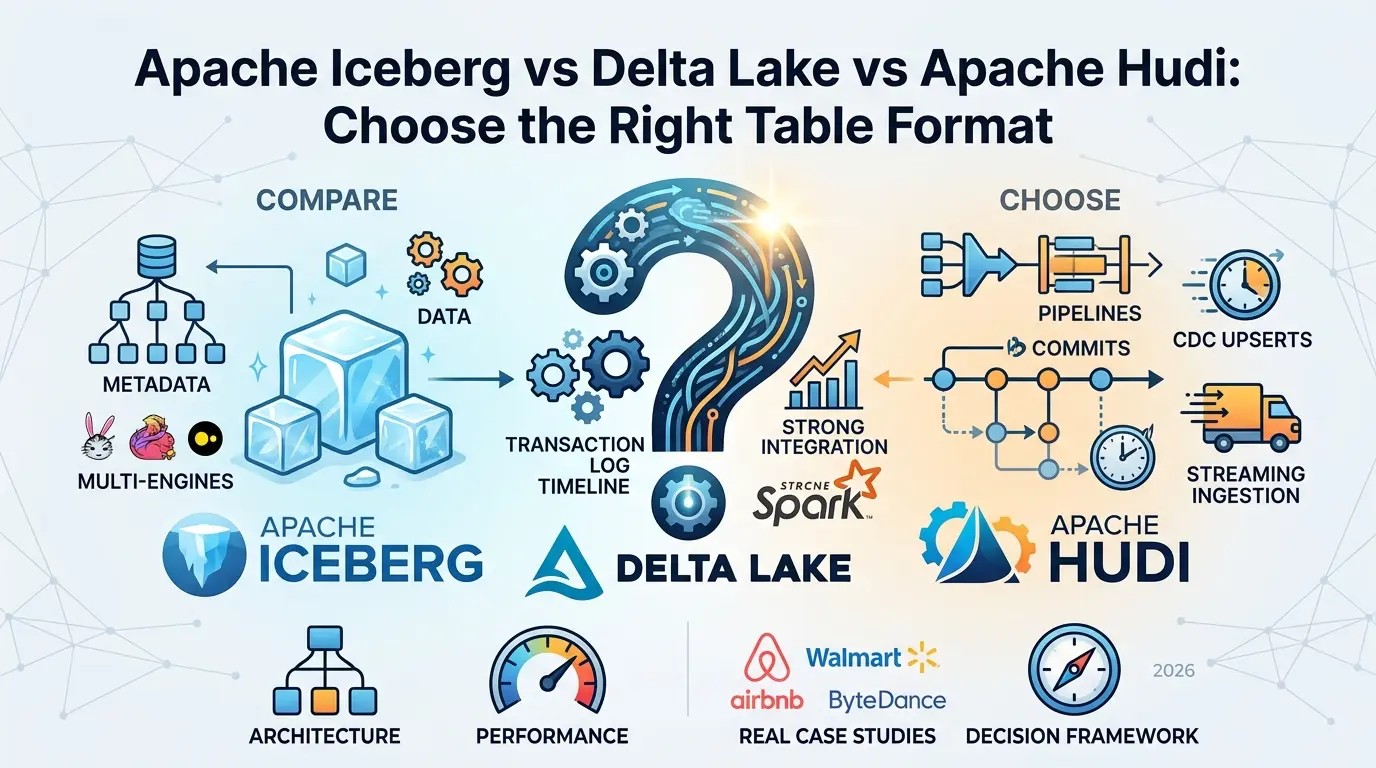
2026 Lakehouse Formats
This guide is different. No feature matrices pretending all rows matter equally. No triumphant declarations that one format “won.” What you’ll find instead is an honest analysis of how each format is architecturally different, where those differences actually matter in real production environments, and a framework for making the right call based on your specific workload, not someone else’s keynote.
• The architectural decisions that separate these three formats, and why they matter more than feature lists
• The $2 billion Databricks acquisition that effectively ended the format war
• When Iceberg’s multi-engine neutrality is decisive vs. when it doesn’t matter
• Why Hudi is still the right answer for specific workloads, even in 2026
• Real production case studies from Airbnb, Walmart, ByteDance, and Comcast
• The interoperability layer that means you don’t have to pick just one
• Team skill requirements and migration paths, the two things nobody talks about
• A workload-first decision framework with no vendor bias
The Phone Book Problem: Why Table Formats Exist at All
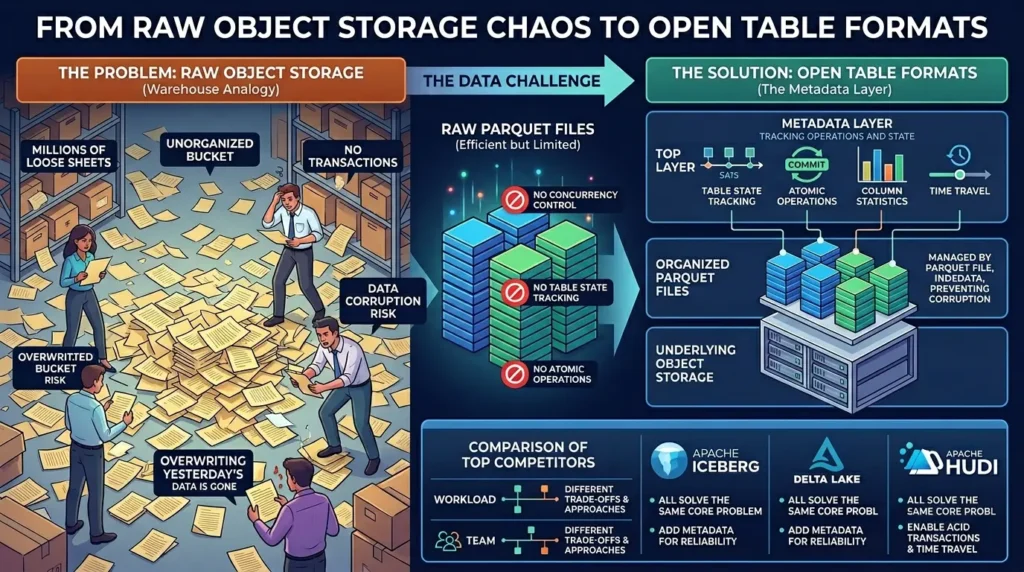
Imagine you have a city’s entire phone directory stored as millions of loose sheets of paper scattered across a warehouse floor. You know the data is in there somewhere. You just have no idea where, no way to update it safely, and no guarantee that someone else isn’t changing the same page while you’re reading it.
That’s what a raw object storage bucket looks like to a data team. Parquet files are extraordinarily efficient at storing and reading columnar data. But Parquet itself has no concept of transactions, no way to track which files represent the current state of a table, no mechanism for concurrent writers to avoid corrupting each other’s work, and no time travel,if you overwrite yesterday’s data, it’s gone.
Open table formats solve this by adding a metadata layer on top of the raw files. This layer tracks which files belong to which table state, records every change as an atomic operation, maintains column statistics for query pruning, and enables time travel by preserving a history of previous states.
Apache Iceberg, Delta Lake, and Apache Hudi all solve the same core problem. The difference is in how they solve it, and those differences create real tradeoffs that matter for specific workloads and team configurations.
Three Formats, Three Origin Stories, Three Philosophies
Before any benchmark or feature comparison, you need to understand why each format was built, because the origin story is the design philosophy.
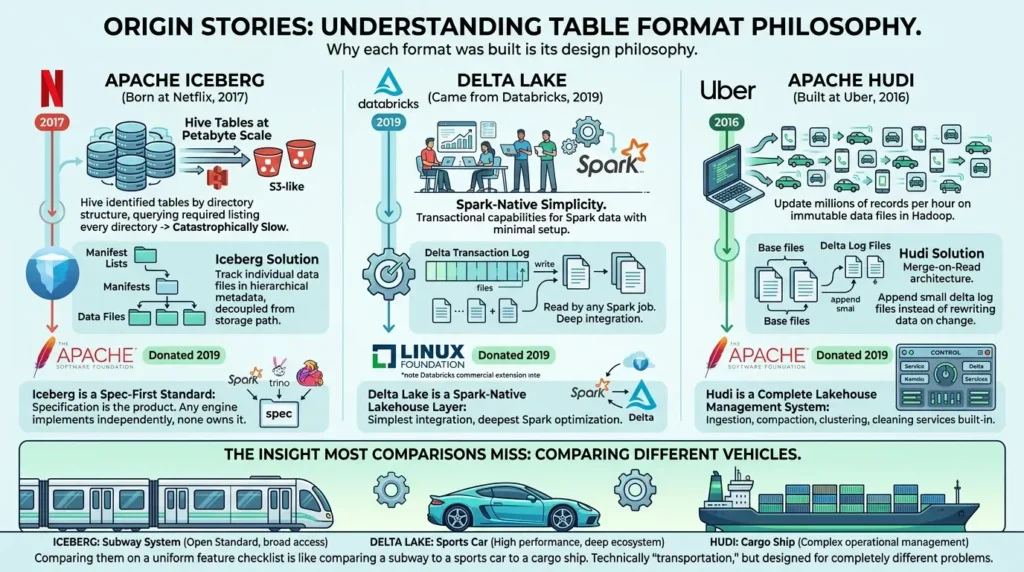
Apache Iceberg was born at Netflix in 2017 when engineers Ryan Blue and Daniel Weeks reached a breaking point with Hive tables at petabyte scale. Their core insight: Hive identified tables by directory structure, which meant querying required listing every directory in every partition, catastrophically slow on S3. Their solution was to track individual data files in a hierarchical metadata tree, completely decoupled from the storage path. Netflix donated Iceberg to the Apache Software Foundation in 2019, and the Apache governance model became the format’s core identity. The spec is the product, any engine can implement it independently.
Delta Lake came from Databricks in 2019, built by the same team that created Apache Spark. Their design philosophy was Spark-native simplicity: a flat transaction log stored alongside the data, readable by any Spark job, with minimal setup friction. Delta Lake was later donated to the Linux Foundation and is now under the Linux Foundation’s governance. But its deepest integration remains in the Spark ecosystem, and Databricks’ commercial implementation extends significantly beyond the open-source version.
Apache Hudi (Hadoop Upserts Deletes and Incrementals) was built at Uber in 2016 to solve a specific, painful problem: how do you update millions of ride records per hour across a massive Hadoop cluster when your data files are immutable? Uber’s engineers invented a merge-on-read architecture that appended small delta log files instead of rewriting data files on every change. Hudi was donated to the Apache Software Foundation in 2019 and has since evolved into what its community calls a “Data Lakehouse Management System”, a complete operational platform, not just a metadata specification.
| Format | Best For | Avoid If |
|---|---|---|
| Apache Iceberg | Multi-engine analytics, partition evolution, vendor neutrality, large-scale reads | You need extreme write performance for CDC-heavy workloads |
| Delta Lake | Databricks-centric stacks, simplest operations, Photon performance | You need multi-engine access without UniForm overhead |
| Apache Hudi | High-frequency CDC, streaming upserts, record-level lookups, built-in ingestion | Your team lacks dedicated platform engineering capacity |
The philosophical split:
- Iceberg is a spec-first standard: The specification is the product. Any engine can implement it, and none owns it.
- Delta Lake is a Spark-native lakehouse layer: The simplest integration, the deepest Spark optimization.
- Hudi is a complete lakehouse management system: Ingestion services, compaction, clustering, and cleaning, all built in.
The insight most comparisons miss: These three formats are not building toward the same end goal. Comparing them on a uniform feature checklist is like comparing a subway system to a sports car to a cargo ship, technically all “transportation,” but designed for completely different problems.
The Architecture Gap: Where Real Differences Live
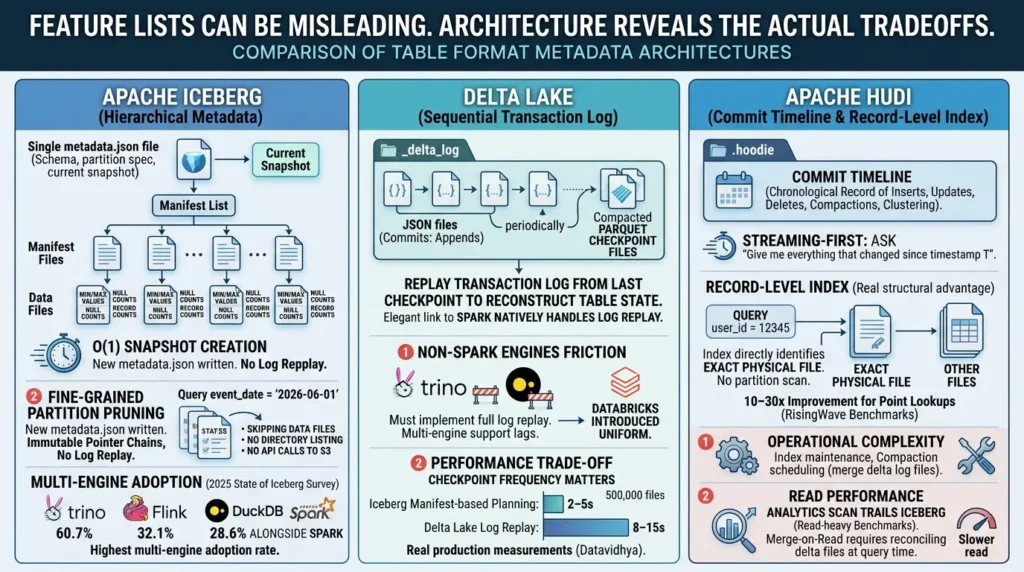
Feature lists can be misleading. Architecture reveals the actual tradeoffs.
How Iceberg Manages Metadata
Iceberg’s metadata architecture is hierarchical. At the top sits a single metadata.json file that defines the table’s schema, partition spec, and current snapshot. That snapshot points to a manifest list. The manifest list points to manifest files. Each manifest file lists individual data files alongside column-level statistics, min/max values, null counts, record counts, for every column in the table.
This design enables two things that the other formats struggle to match:
- O(1) snapshot creation: Adding a new snapshot only requires writing a new metadata.json file. The entire history of the table is preserved through immutable pointer chains, not log replay.
- Fine-grained partition pruning without directory listings: When a query includes a filter on event_date = ‘2026-06-01’, Iceberg reads the manifest file statistics and skips every data file whose date range doesn’t overlap. No directory traversal. No API calls to S3 to list partitions. The 2025 State of the Iceberg Ecosystem survey found that 60.7% of Iceberg users also use Trino, 32.1% use Flink, and 28.6% use DuckDB alongside Spark, a multi-engine adoption rate that no other format comes close to.
How Delta Lake Manages Metadata
Delta Lake uses a sequential transaction log stored in a _delta_log directory alongside the data files. Each commit appends a new JSON file. Periodically, those JSON files get compacted into Parquet checkpoint files for faster reads.
To read a Delta table, an engine replays the transaction log from the last checkpoint to reconstruct the current table state. This is elegant and simple in Spark, where the Delta library handles log replay natively. But it creates two friction points:
- Non-Spark engines must implement full log replay: Reading a Delta table in Trino or DuckDB requires understanding the entire Delta protocol. This is exactly why Delta’s multi-engine support has historically lagged Iceberg’s, and why Databricks introduced UniForm.
- Checkpoint frequency matters for performance. On a table with 500,000 files, Iceberg’s manifest-based planning completes in 2–5 seconds. Delta Lake’s log replay, even with checkpoints, can take 8–15 seconds on the same table, according to real production measurements from Datavidhya.
How Hudi Manages Metadata
Hudi maintains a commit timeline in a .hoodie directory, a chronological record of every operation: inserts, updates, deletes, compactions, clustering operations. This timeline maps directly to Hudi’s streaming-first architecture, because you can ask at any time: “Give me everything that changed since timestamp T.”
Hudi’s real structural advantage is its record-level index. When a write operation arrives for user_id = 12345, Hudi’s index tells the engine exactly which physical file that record lives in, without scanning any partition. According to RisingWave’s benchmarks, this enables 10–30x improvements for point lookups compared to Iceberg or Delta.
The tradeoff: the record-level index adds operational complexity. The index must be maintained. Compaction must be scheduled to merge delta log files back into base files. And Hudi’s analytics scan performance trails Iceberg in most read-heavy benchmarks because merge-on-read tables require reconciling delta files at query time.
| Dimension | Apache Iceberg | Delta Lake | Apache Hudi |
|---|---|---|---|
| Metadata model | Hierarchical snapshot tree | Sequential transaction log | Commit timeline + record index |
| Multi-engine support | ✅ Broadest (spec-first) | ⚠️ Strong in Spark, limited outside | ⚠️ Spark-primary, growing |
| Partition evolution | ✅ Native, metadata-only | ⚠️ Liquid Clustering (different paradigm) | ❌ Not supported |
| Upsert / CDC performance | ⚠️ Solid with CoW + deletion vectors | ⚠️ Good with Liquid Clustering | ✅ Best-in-class with MoR |
| Analytics scan performance | ✅ Excellent at scale | ✅ Excellent on Databricks/Photon | ⚠️ Trails on MoR tables |
| Governance model | Apache Software Foundation | Linux Foundation + Databricks | Apache Software Foundation |
| Operational complexity | Medium | Low (on Databricks) | High (most operational knobs) |
The $2 Billion Event That Changed Everything
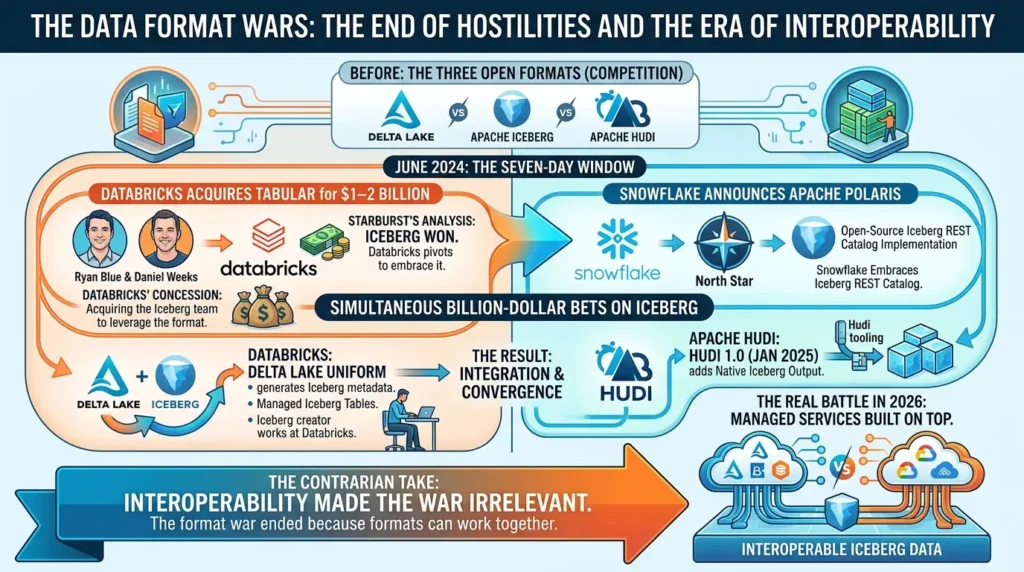
In June 2024, Databricks announced the acquisition of Tabular, the company founded by Ryan Blue and Daniel Weeks, the original creators of Apache Iceberg at Netflix, for a reported $1–2 billion.
Databricks, the company behind Delta Lake, spent up to $2 billion to acquire the people who built Iceberg. That’s not a competitive move. That’s a concession.
As Starburst’s analysis put it, the acquisition did two things simultaneously: it confirmed that Iceberg had won the format wars by proving it was worth a billion-dollar price tag, and it signaled that Databricks was pivoting from competing with Iceberg to embracing it.
The same week, Snowflake announced open-source Apache Polaris, an open-source implementation of the Iceberg REST Catalog specification. Two of the largest commercial data platforms, previously on opposite sides of the format debate, both made billion-dollar bets on Iceberg in the same seven-day window.
Delta Lake UniForm now generates Iceberg-compatible metadata alongside Delta commits. Databricks now offers Managed Iceberg Tables alongside Delta. And the Iceberg creator now works at Databricks.
Hudi’s community moved in a parallel direction: Hudi 1.0, released in January 2025, added native Iceberg format output, meaning you can use Hudi’s write-path tooling and compaction services while producing Iceberg-compatible tables. No conversion required.
The contrarian take that nobody wants to say at a conference: The format war ended not because one format was technically superior, but because interoperability made the war irrelevant. The real battle in 2026 is not between formats, it’s between managed services built on top of them.
Where Performance Actually Differs (And Where It Doesn’t)
Most benchmark articles on this topic test one workload, tune one format favorably, and present the results as universal truth. Here’s what actually differs in production.
Analytical Reads: Iceberg Leads at Scale
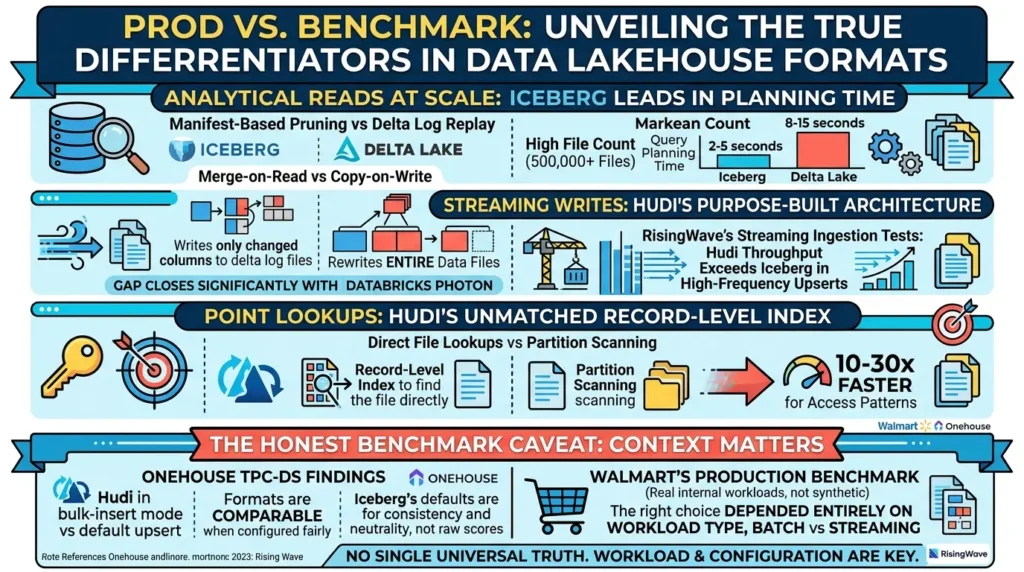
For large-scale analytical queries with selective predicates, Iceberg’s manifest-based pruning creates a measurable advantage over Delta’s log replay at high file counts. On a table with 500,000+ files, Iceberg’s query planning completes in 2–5 seconds versus 8–15 seconds for Delta. The gap closes significantly when Databricks’ Photon engine is in play.
Streaming Writes: Hudi’s Architecture Is Purpose-Built
For CDC pipelines with frequent record-level updates, Hudi’s merge-on-read architecture writes only changed columns to delta log files rather than rewriting entire data files. According to RisingWave’s streaming ingestion tests, Hudi’s write throughput exceeds Iceberg’s by a substantial margin in high-frequency upsert scenarios. Iceberg and Delta Lake both use copy-on-write by default, which rewrites entire data files on every update, expensive when only 1% of rows change per batch.
Point Lookups: Hudi’s Record-Level Index Is Unmatched
For workloads requiring specific records by key, Hudi’s record-level index enables direct file lookups without partition scanning. The difference is 10–30x for these access patterns versus Iceberg or Delta.
The Honest Benchmark Caveat
The Onehouse team ran comprehensive TPC-DS benchmarks and found that when formats are configured fairly, Hudi in bulk-insert mode rather than its default upsert mode, Delta and Hudi are comparable. Iceberg’s default settings optimize for consistency and engine neutrality, not raw benchmark scores.
Walmart ran perhaps the most honest benchmark in the public literature: they tested on two real internal production workloads instead of synthetic datasets. Their conclusion, documented on the Walmart Global Tech Blog, was that the right choice depended entirely on workload type, batch vs. streaming, rather than any single performance dimension. More on that in the case studies below.
Real-World Case Studies: How Production Teams Actually Chose
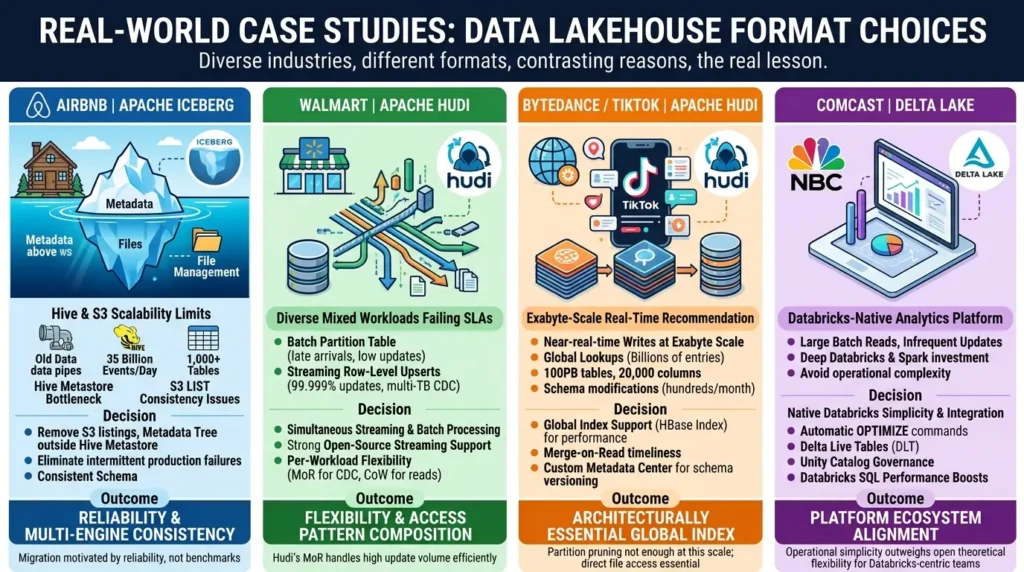
These case studies cover organizations and industries not discussed in our other Iceberg guides, each one chose a different format for different reasons, and the contrast between them is the real lesson.
Case Study 1 – Airbnb: Iceberg for Hive Migration at 35 Billion Events Per Day
Airbnb’s data warehouse had been built on Hive and was running into S3-specific scalability limits that Hive was never designed to handle.
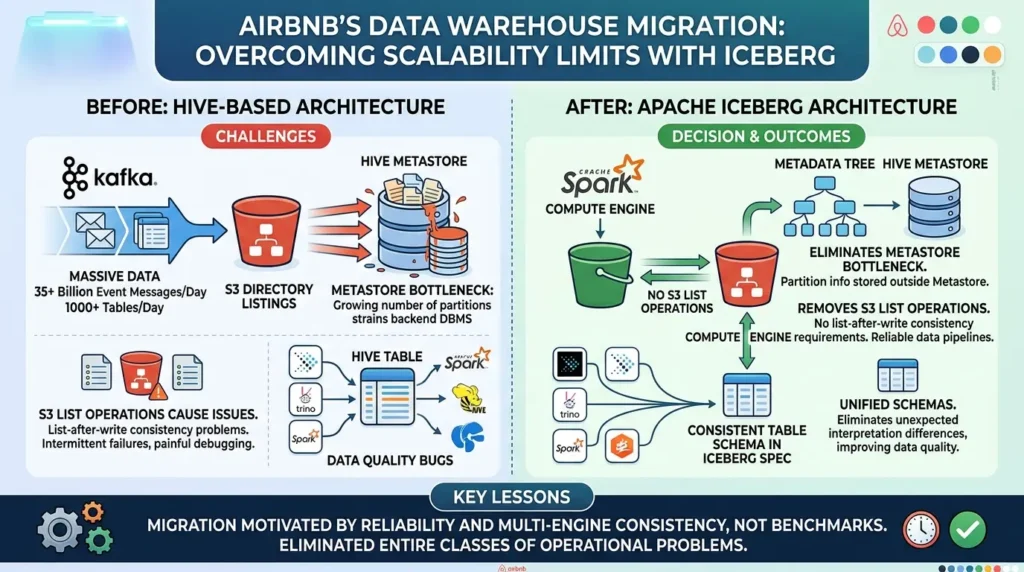
The challenge: Airbnb’s Hive-based ingestion framework was processing over 35 billion Kafka event messages and 1,000+ tables per day, landing datasets ranging from kilobytes to terabytes into hourly and daily partitions. With a growing number of partitions, Hive’s backend DBMS became a bottleneck. S3 LIST operations for large tables were creating list-after-write consistency problems that were painful to debug and impacted pipeline reliability.
The decision: Airbnb chose Apache Iceberg because it eliminated S3 directory listings entirely. Iceberg’s metadata tree stores partition information outside the Hive Metastore, removing a massive source of load. More critically, Iceberg tables don’t require S3 LIST operations, which removed the list-after-write consistency requirement that was causing intermittent production failures.
The outcome: Migrating to Spark 3 and Iceberg addressed both the Hive Metastore bottleneck and the S3 consistency problem simultaneously. The consistent table schema defined in the Iceberg spec also eliminated unexpected behavior when different compute engines interpreted Hive table schemas slightly differently, a recurring source of data quality bugs in the old architecture.
Key lesson: Iceberg’s value for Airbnb wasn’t raw performance, it was the elimination of entire classes of operational problems that Hive tables created on S3. The migration was motivated by reliability and multi-engine consistency, not benchmarks.
Case Study 2 – Walmart: Choosing Hudi After Benchmarking All Three on Real Production Workloads
Walmart ran one of the most rigorous real-world format evaluations in the public literature, and their conclusion is more nuanced than most format comparison articles acknowledge.
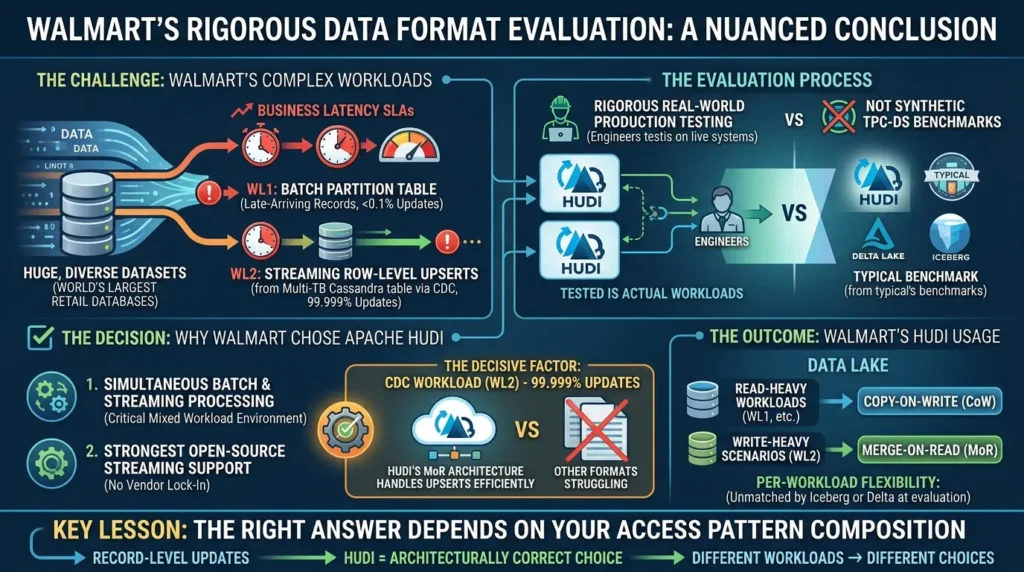
The challenge: Walmart’s data systems produce one of the largest and most diverse retail datasets in the world. Their two critical internal workloads, a batch partition table suffering from late-arriving records (WL1, with less than 0.1% updates) and a streaming row-level upsert workload from a multi-TB Cassandra table via CDC (WL2, with 99.999% updates), were both failing to meet business latency SLAs. Walmart’s engineers tested all three formats against these actual production workloads, not synthetic TPC-DS benchmarks.
The decision: After benchmarking, Walmart chose Apache Hudi for two primary reasons: it was best at enabling both streaming and batch processing simultaneously, critical to their mixed workload environment, and it offered the strongest open-source support for streaming use cases without vendor lock-in. The CDC workload (WL2), essentially all updates, essentially no inserts, was decisive. No other format handled this access pattern as efficiently as Hudi’s MoR architecture.
The outcome: Walmart uses Hudi to manage their data lake of store transactions, using Copy-on-Write tables for read-heavy workloads and Merge-on-Read for write-heavy scenarios. This per-workload flexibility was something neither Iceberg nor Delta Lake offered at the time of their evaluation.
Key lesson: Walmart’s evaluation shows that the right answer depends on your access pattern composition. A workload that is almost entirely record-level updates makes Hudi the architecturally correct choice, the same team might have chosen differently with different workload characteristics.
Case Study 3 – ByteDance / TikTok: Hudi for Exabyte-Scale Real-Time Recommendation
ByteDance built one of the most demanding data lake architectures in existence to power TikTok’s real-time recommendation engine across Douyin, Toutiao, and Xigua Video.
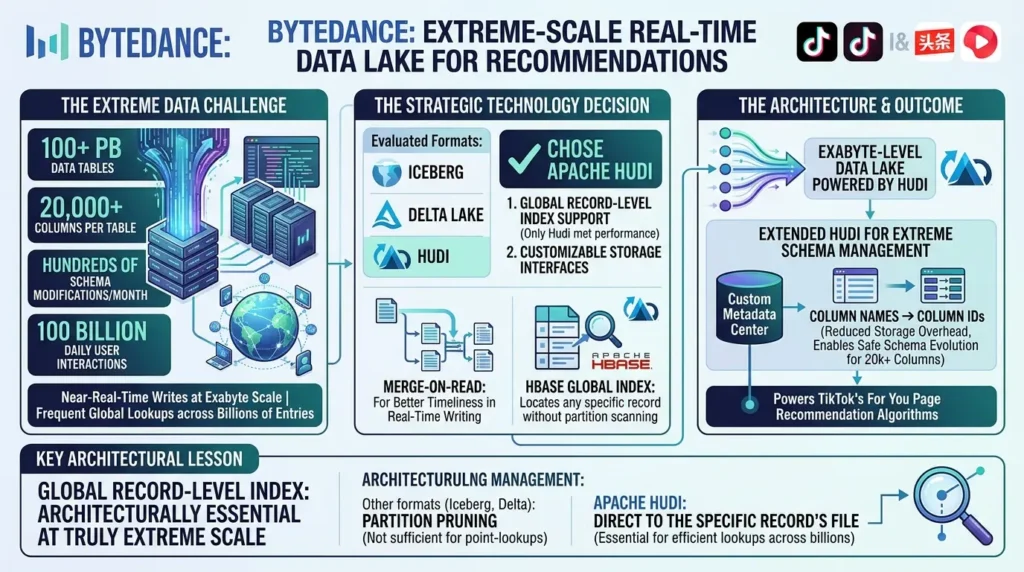
The challenge: ByteDance’s recommendation system requires near-real-time writes at exabyte scale, with frequent global lookups to find specific user or content records across billions of entries. According to ByteDance’s engineering documentation, individual tables in their system can approach 100PB in size, contain up to 20,000 columns, and require several hundred schema modifications per month. Processing spans 100 billion user interactions daily across TikTok’s global user base.
The decision: ByteDance evaluated all three formats and chose Hudi specifically for its global index support and customizable storage interfaces. For real-time writing, they selected Merge-on-Read for better timeliness. For the global index, the ability to locate any specific record without partition scanning, HBase was the only index implementation that met their performance requirements at this scale.
The outcome: ByteDance built an exabyte-level data lake powered by Hudi supporting TikTok’s For You Page recommendation algorithms. They extended Hudi’s schema management with a custom metadata center to handle schema versioning across 20,000+ columns, replacing column names with IDs to reduce storage overhead and enable safe schema evolution at scale.
Key lesson: At truly extreme scale with point-lookup requirements, Hudi’s global record-level index is not a feature advantage, it’s architecturally essential. No amount of partition pruning optimization in Iceberg or Delta replaces the ability to go directly to the file containing a specific record.
Case Study 4 – Comcast: Delta Lake for Databricks-Native Simplicity
Not every organization needs multi-engine flexibility. Comcast’s data platform story is a useful counterweight to the “always choose Iceberg” narrative.
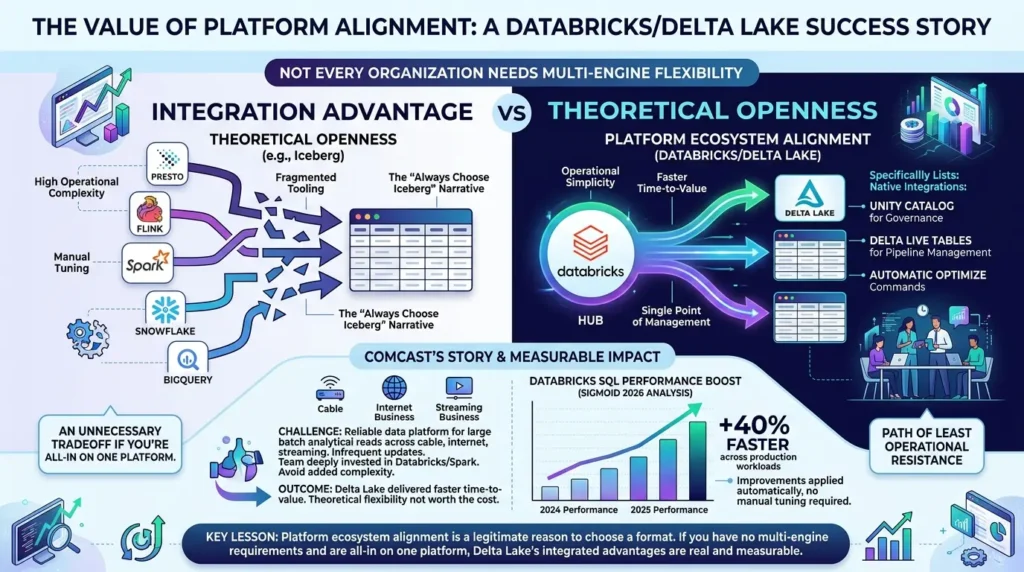
The challenge: Comcast needed a reliable data platform supporting analytics across their cable, internet, and streaming businesses, a workload characterized by large batch analytical reads, relatively infrequent updates, and a team already deeply invested in the Databricks and Spark ecosystem. Adding operational complexity for flexibility they didn’t need was not a tradeoff worth making.
The decision: With their stack centered on Databricks, Delta Lake was the path of least operational resistance. The Databricks ecosystem provided automatic OPTIMIZE commands, Delta Live Tables for pipeline management, and Unity Catalog for governance, all natively integrated. According to Sigmoid’s 2026 analysis, Databricks SQL delivered up to 40% faster performance across production workloads in 2025 compared to 2024, with improvements applied automatically, no manual tuning required.
The outcome: Delta Lake with the Databricks ecosystem delivered faster time-to-value for Comcast’s specific context. They didn’t need multi-engine interoperability, and the operational simplicity of native Databricks integration was worth more to their team than theoretical format flexibility.
Key lesson: Platform ecosystem alignment is a legitimate reason to choose a format. If your team is Databricks-centric and has no multi-engine requirements, Delta Lake’s integration advantages are real and measurable. Choosing Iceberg for its theoretical openness when you’re all-in on one platform is an unnecessary tradeoff.
What Nobody Tells You: Team Skills and Migration Paths
Two dimensions that never appear in format comparison articles but matter enormously in practice.
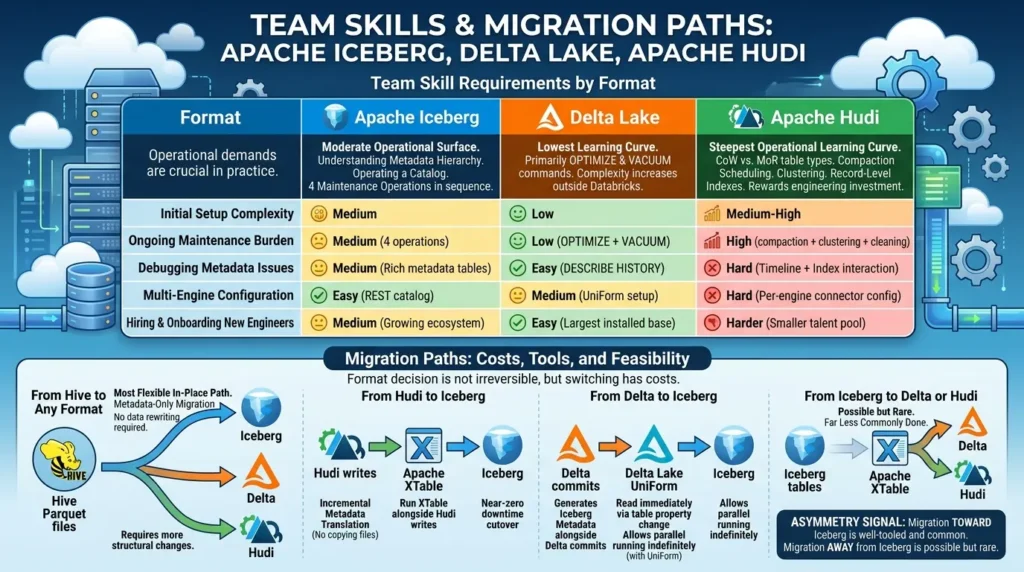
Team Skill Requirements by Format
Each format imposes different operational demands on your data engineering team.
Apache Iceberg requires understanding the metadata hierarchy, choosing and operating a catalog, and managing four maintenance operations in the correct sequence. Operational surface is moderate, for the full maintenance picture, see our complete Iceberg maintenance guide.
Delta Lake has the lowest learning curve of the three, especially within Databricks. OPTIMIZE and VACUUM are the primary maintenance commands. Complexity increases significantly outside the Databricks ecosystem.
Apache Hudi has the steepest operational learning curve. Teams need to understand CoW vs. MoR table types, compaction scheduling, clustering, record-level indexes, and their interactions. Hudi rewards engineering investment with excellent write performance, but teams without dedicated data platform engineering capacity frequently find it more complex than anticipated.
| Skill Area | Iceberg | Delta Lake | Hudi |
|---|---|---|---|
| Initial setup complexity | Medium | Low | Medium-High |
| Ongoing maintenance burden | Medium (4 operations) | Low (OPTIMIZE + VACUUM) | High (compaction + clustering + cleaning) |
| Debugging metadata issues | Medium (rich metadata tables) | Easy (DESCRIBE HISTORY) | Hard (timeline + index interaction) |
| Multi-engine configuration | Easy (REST catalog) | Medium (UniForm setup) | Hard (per-engine connector config) |
| Hiring / onboarding new engineers | Medium (growing ecosystem) | Easy (largest installed base) | Harder (smaller talent pool) |
Migration Paths – What Switching Actually Costs
The format decision is not fully reversible, but it’s not permanent either.
- From Hive to any format: Iceberg provides the most flexible in-place migration path, you can register existing Hive Parquet files as Iceberg tables via metadata-only migration, with no data rewriting required. Delta and Hudi both support Hive migration but require more structural changes.
- From Hudi to Iceberg: Apache XTable provides incremental metadata translation without copying data files. Run XTable as a sync process alongside your existing Hudi writes, then cut over reads to the Iceberg metadata. Near-zero downtime in practice.
- From Delta to Iceberg: Delta Lake UniForm generates Iceberg metadata alongside Delta commits, you can start reading your Delta tables as Iceberg immediately with a table property change. Full native migration is more involved but UniForm makes it practical to run both in parallel indefinitely.
- From Iceberg to Delta or Hudi: XTable handles this direction, but it’s far less commonly done. Most teams that chose Iceberg for multi-engine reasons find no compelling reason to migrate away.
The asymmetry is itself a signal: migration toward Iceberg is well-tooled and common. Migration away from Iceberg is possible but rare.
The Decision Framework: Choose By Workload, Not by Brand
Stop asking “which format is best?” Start asking “which format matches my specific constraints?”
The Simple Framework (No Tool Required)
Choose Apache Iceberg if:
- You use more than one query engine
- You’re on AWS, GCP, or a multi-cloud architecture
- Vendor neutrality and governance matter to your organization
- You need partition evolution as data access patterns change
- Your primary workload is large-scale analytical reads
Choose Delta Lake if:
- Your entire stack runs on Databricks
- You want the simplest possible operational model
- Photon performance is important to your SLAs
- You have existing Delta tables and no compelling reason to migrate
Choose Apache Hudi if:
- Your workload is dominated by high-frequency CDC or record-level upserts
- You need point-lookup performance via the record-level index
- You want built-in ingestion, compaction, and clustering without building them yourself
- You’re already running Hudi in production and it’s working
The Interoperability Layer: You Don’t Have to Choose Exactly One
In 2026, you can have multiple formats reading the same physical data without copying it.
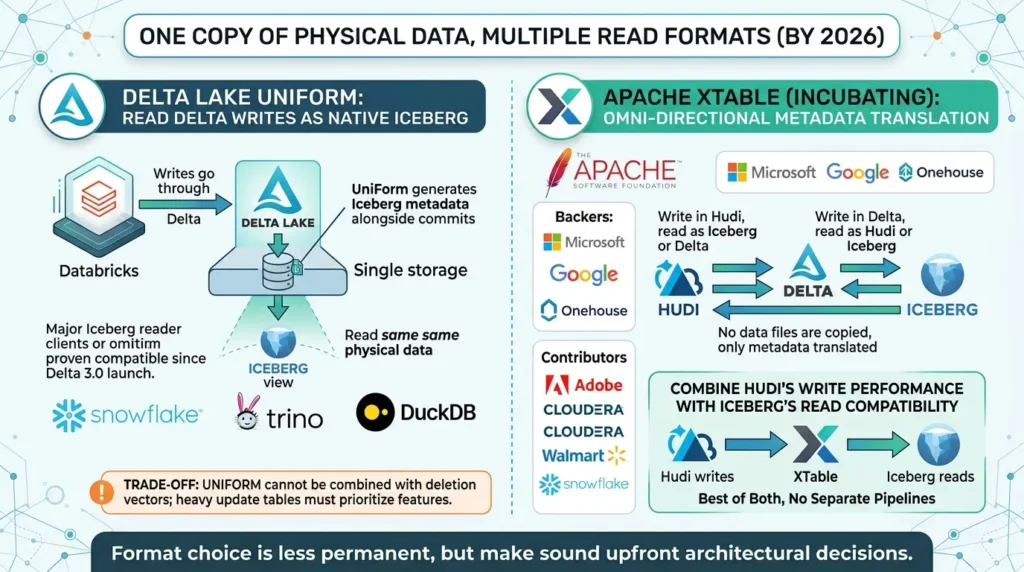
Delta Lake UniForm generates Iceberg metadata alongside Delta commits. A table written in Delta on Databricks can be read by Snowflake, Trino, or DuckDB as a native Iceberg table. Writes go through Delta. Reads come from anywhere. One notable constraint: UniForm cannot be combined with deletion vectors, so tables with heavy update patterns need to choose which feature to prioritize. Since its launch in Delta 3.0, UniForm has proven compatibility with major Iceberg reader clients.
Apache XTable (incubating at the Apache Software Foundation, backed by Microsoft, Google, and Onehouse) provides omni-directional metadata translation between all three formats. Write in Hudi, read as Iceberg or Delta. Write in Delta, read as Hudi or Iceberg. No data files are copied, only metadata is translated. According to the XTable project, contributors include Adobe, Cloudera, Walmart, and Snowflake. Some organizations today specifically combine Hudi’s write-path performance with Iceberg’s read compatibility via XTable, getting the best of both without running two separate pipelines.
Format choice is less permanent than it used to be. But don’t let “we can bridge it later” be an excuse for skipping the upfront architectural decision.
What the Data Engineering Community Actually Says
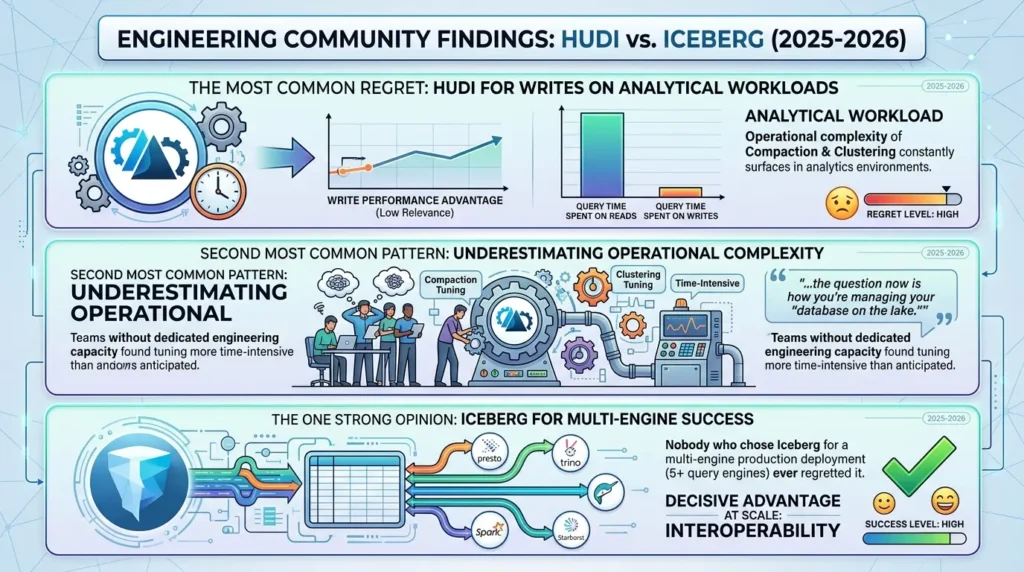
Across engineering communities in 2025–2026, several patterns emerge consistently from teams who’ve made this decision and lived with it:
- The most common regret: choosing Hudi for write performance on a primarily analytical workload: The write performance advantage doesn’t matter if most of your query time is spent on reads, and the operational complexity of Hudi’s compaction and clustering surfaces constantly in an analytics-primary environment.
- The second most common pattern: underestimating operational complexity differences: Teams that adopted Hudi without dedicated data platform engineering capacity found the compaction and clustering tuning more time-intensive than anticipated. As Kyle Weller from Onehouse put it, the format war is over, the question now is how you’re managing your “database on the lake.”
- The one strong opinion from practitioners: Nobody who chose Iceberg for a multi-engine production deployment with five or more query engines ever regretted it. The interoperability advantage is decisive at that scale.
Common Mistakes Teams Make When Choosing
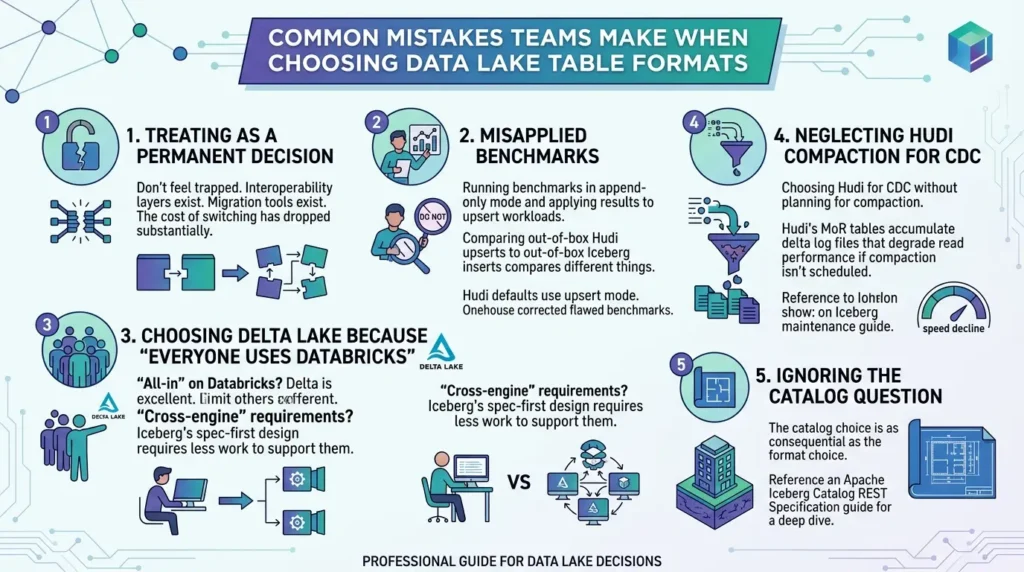
- Treating this as a permanent decision: Interoperability layers exist. Migration tools exist. The cost of switching has dropped substantially.
- Running benchmarks in append-only mode and applying results to upsert workloads: Hudi’s default settings use upsert mode. Comparing out-of-box Hudi upserts to out-of-box Iceberg inserts compares different things. The Onehouse team corrected a widely-cited benchmark that made exactly this mistake.
- Choosing Delta Lake because “everyone uses Databricks.”: If you’re all-in on Databricks, Delta is excellent. If you have cross-engine requirements, Iceberg’s spec-first design requires less work to support them.
- Choosing Hudi for CDC without planning for compaction: Hudi’s MoR tables accumulate delta log files that degrade read performance if compaction isn’t scheduled. For the full operational picture, see our Iceberg maintenance guide.
- Ignoring the catalog question: The catalog choice is as consequential as the format choice. See our Apache Iceberg Catalog REST Specification guide for a deep dive.
The 2026 Landscape: What’s Changing Right Now
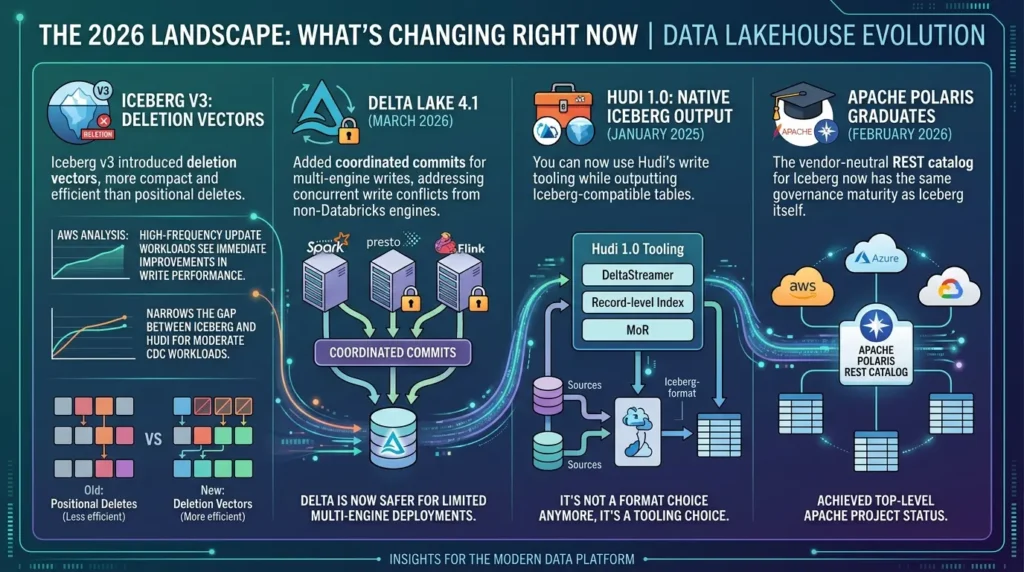
- Iceberg v3 deletion vectors: Iceberg v3 introduced deletion vectors, more compact and efficient than positional deletes. According to AWS’s analysis, high-frequency update workloads see immediate improvements in write performance. This narrows the gap between Iceberg and Hudi for moderate CDC workloads.
- Delta Lake 4.1 (March 2026): Added coordinated commits for multi-engine writes, addressing concurrent write conflicts from non-Databricks engines. Delta is now safer for limited multi-engine deployments.
- Hudi 1.0’s native Iceberg output (January 2025): You can now use Hudi’s write tooling (DeltaStreamer, record-level index, MoR) while outputting Iceberg-compatible tables. It’s not a format choice anymore, it’s a tooling choice.
- Apache Polaris graduating to top-level Apache project (February 2026): The vendor-neutral REST catalog for Iceberg now has the same governance maturity as Iceberg itself.
📋 Research Methodology
This comparison is based on:
- Official documentation from Apache Iceberg, Delta Lake, and Apache Hudi projects
- Published engineering blogs from Airbnb, Walmart, ByteDance, and Comcast engineering teams
- Independent benchmarks from Onehouse, RisingWave, and Datavidhya (cited inline)
- Community discussions across r/dataengineering, Hacker News, and Apache mailing lists
- Conference presentations from Data+AI Summit 2025 and Apache events
No vendor sponsored this comparison. All recommendations are based on architectural analysis and documented production outcomes.
Conclusion: The Format Is Less Important Than the Architecture
For most new production deployments in 2026, Apache Iceberg is the safest default. The broadest engine support, the strongest cloud vendor backing, Apache governance, and the REST catalog standard make it the lowest-risk choice for systems that need to outlast the current tool landscape.
For teams already deep in the Databricks ecosystem with no cross-engine requirements, Delta Lake with UniForm is excellent, as Comcast demonstrates. Fast, simple, and Iceberg-compatible for any downstream engine.
For workloads dominated by high-frequency CDC, record-level point lookups, or streaming-first architectures, the kind that drove Walmart and ByteDance to choose Hudi, the write-path architecture is still best-in-class. Especially now that Hudi 1.0’s native Iceberg output removes the read compatibility concern.
The format is infrastructure. Build it carefully, then focus on what actually matters: the pipelines, the data quality, and the decisions you can make because your data is reliable.
For a deeper look at how the catalog layer governs all three formats, see our guide to the Apache Iceberg Catalog REST Specification.
For a complete understanding of how Iceberg’s architecture works at the table level, start with Apache Iceberg Explained.
And for the operational discipline that keeps Iceberg tables healthy in production, the Apache Iceberg Table Maintenance guide has the full playbook.
📚 Complete Data Lakehouse Learning Path
- Apache Iceberg Explained: Architecture & Fundamentals
- Iceberg REST Catalog: Specification & Implementation
- Iceberg Table Maintenance: Compaction, Snapshots & Cleanup
- Copy-on-Write vs Merge-on-Read: Complete Trade-Off Guide
- Apache Hudi: Transactional Data Lakehouse Guide
- You are here → Apache Iceberg vs Delta Lake vs Hudi Comparison
Frequently Asked Questions
What is the differe nand Delta Lake?
_delta_log/) with JSON commits and periodic Parquet checkpoints. Iceberg supports hidden partitioning and partition evolution as metadata-only operations, while Delta Lake does not. Iceberg has broader multi-engine support (Spark, Flink, Trino, Snowflake, BigQuery, DuckDB), while Delta Lake is most optimized within the Databricks/Spark ecosystem.Which is better: Apache Iceberg or Apache Hudi?
Is Delta Lake only icks?
Can I use multiple table formats together?
What are the performance differences between Iceberg, Delta Lake, and Hudi?
Which companies use Apache Iceberg in production?
Which companies use Apache Hudi in production?
What is the future of open table formats?

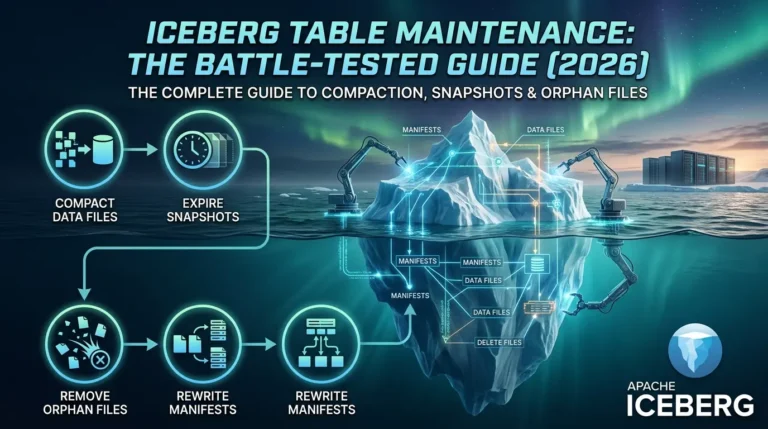

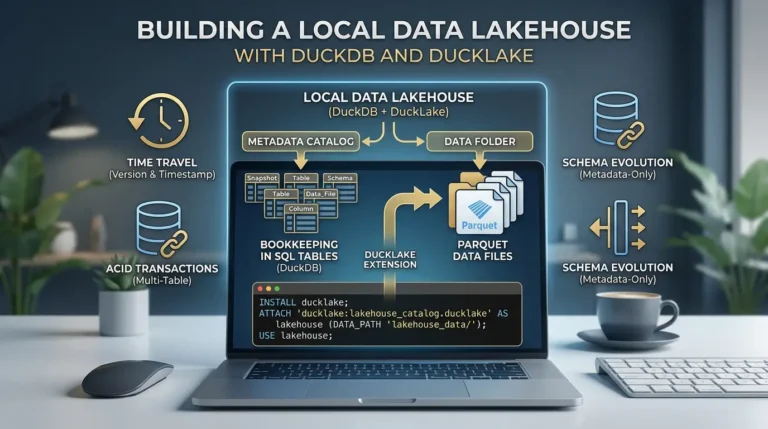



[…] Read the Full Article → […]
[…] Read the Full Article → […]
[…] Read the Full Article → […]