
The question isn’t whether AI will reshape marketing.
It already has.
Walk into any CMO’s office today and you’ll hear the same tension. Teams are stretched thin. Budgets face scrutiny. Every campaign needs proof of return before the ink dries. Meanwhile, customer expectations climb higher, they want personalized experiences, instant responses, and brands that somehow anticipate their needs before they even ask.
AI marketing reached $47.32 billion in 2025 and is projected to exceed $107 billion by 2028, according to market analysis. That’s not hype, that’s capital flowing toward measurable outcomes. 88% of marketers now use AI in their day-to-day roles, with adoption accelerating across content creation, customer segmentation, and predictive analytics.
But here’s what the market reports miss: The real story isn’t about tools. It’s about how AI changes what marketing optimizes for, how teams operate, and who wins in a world where attention has become the scarcest resource.
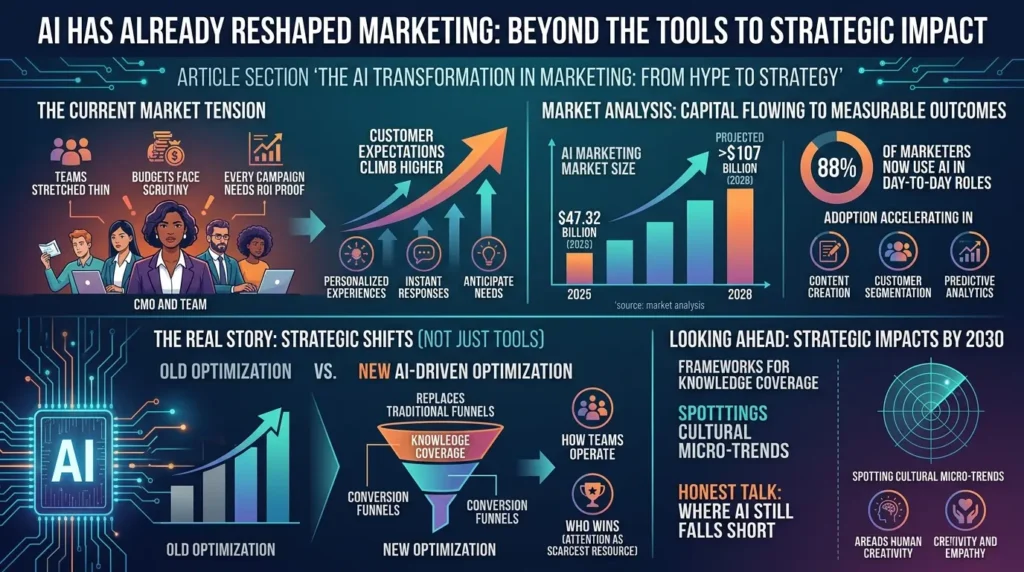
This isn’t another listicle of AI platforms. We’re going deeper, into the strategic impacts reshaping brand positioning, the real-world implementations driving ROI, and the organizational shifts coming by 2030. You’ll see frameworks for knowledge coverage instead of just conversion funnels. Examples of brands using AI to spot cultural micro-trends before competitors. And honest talk about where AI still falls short.
Let’s start where the pressure hits hardest.
📌 Executive Summary: Key Takeaways
- ✓ From Funnels to Knowledge Coverage: Successful brands are moving beyond awareness stages to fill every “information gap” in the customer journey, using AI to become the definitive source of truth in their category.
- ✓ Real ROI, Not Just Hype: Data from L’Oréal and Mastercard proves AI is driving real business outcomes—including 3x conversion rates and 30–50% operational cost reductions through hyper-personalization.
- ✓ The 2030 Workforce Shift: As AI agents take over autonomous campaign orchestration (a $52B market by 2030), marketing roles are pivoting from tactical execution to strategic oversight and creative direction.
- ✓ The “Brand Policy” Engine: With AI assistants becoming the primary search interface, brands must build “Brand Policy Engines” to ensure AI models recommend them accurately, replacing traditional SEO keywords.
What AI Actually Means for Marketing Today
Strip away the buzzwords and AI in marketing comes down to three core capabilities: processing information at scale, recognizing patterns humans miss, and adapting in real time based on new data.
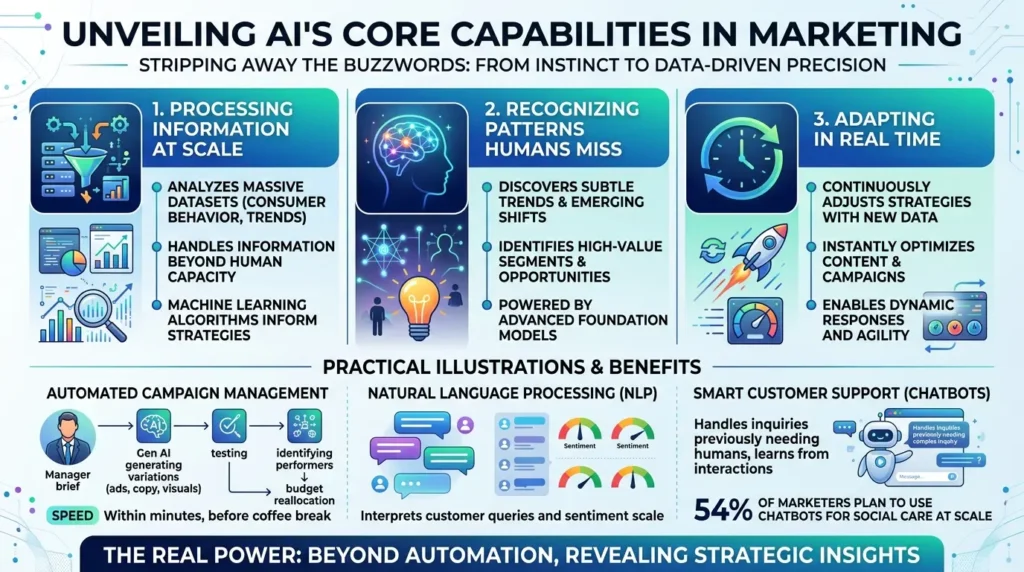
Machine learning algorithms analyze consumer behavior and market trends to inform campaigns and strategies, moving marketing from gut instinct to data-driven precision. Natural language processing interprets customer queries and sentiment across millions of conversations. Generative AI creates ad copy, visuals, and campaign variations at speeds no human team could match.
The technologies aren’t new. What changed is their combination with foundation models, large language systems trained on vast datasets, that can now understand context, generate creative content, and make decisions with minimal human intervention.
Think about what this enables practically.
A campaign manager can brief an AI system in plain language about brand voice, target audience, and goals. Within minutes, the system generates dozens of ad variations, tests them across channels, identifies top performers, and reallocates budget, all before the first coffee break ends.
Or consider customer support. AI chatbots now handle complex inquiries that previously needed human agents, learning from each interaction to improve responses. 54% of marketers plan to use chatbots at scale for social customer care, freeing human teams to focus on relationship-building and strategic accounts.
But AI’s real power shows up in what it reveals, not just what it automates.
Strategic Impacts: Beyond Efficiency Gains
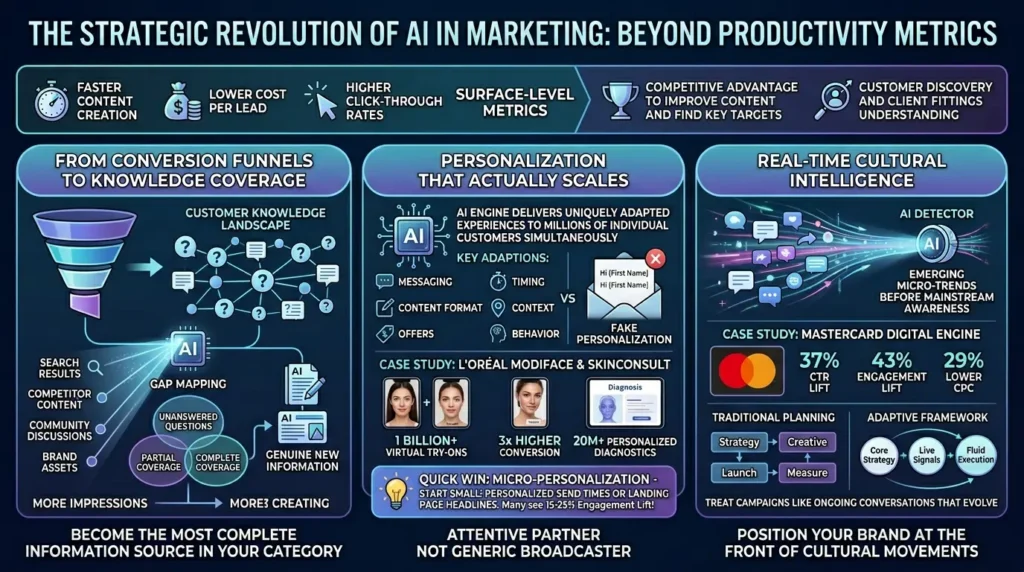
Most discussions about AI in marketing stop at productivity metrics. Faster content creation. Lower cost per lead. Higher click-through rates. Those matter, but they’re surface-level.
The deeper strategic impacts reshape how brands compete, how customers discover products, and how marketing organizations themselves evolve.
From Conversion Funnels to Knowledge Coverage
Traditional marketing thinks in funnels: awareness, consideration, conversion. AI enables a different model, treating customer education as an inventory problem.
Instead of pushing prospects through stages, think about the questions each customer has at different points in their journey. Which doubts remain unanswered? What information gaps prevent decisions? Where does your content cover ground competitors already dominate, and where do you own unique perspectives?
Generative AI has already made a huge impact on marketing and will grow dramatically more in the future, according to industry analysis. But smart teams use AI not just to create more content, they use it to map information gaps across the entire customer knowledge landscape.
Imagine an AI system that continuously scans search results, competitor content, community discussions, and your own assets. It identifies which customer questions your brand fully answers, which you partially address, and which you ignore entirely. Then it generates content specifically designed to fill those gaps, ensuring every piece adds genuine new information for your audience.
This shifts the goal from “more impressions” to “better knowledge coverage.” You’re not just optimizing for clicks. You’re becoming the most complete information source in your category.
Personalization That Actually Scales
Here’s the thing about personalization: Everyone talks about it, but most brands fake it badly.
Inserting a first name into an email isn’t personalization. Showing different homepage hero images based on browser history isn’t personalization. Those are parlor tricks.
Real personalization means adapting the entire customer experience, messaging, offers, content format, communication timing, to each individual’s context, behavior, and preferences. At scale. Across thousands or millions of customers simultaneously.
AI makes this possible through dynamic segmentation and adaptive content delivery.
59% of global marketers see AI for campaign personalization and optimization as the most impactful industry trend, according to Nielsen research. Leading implementations go far beyond basic demographic targeting.
L’Oréal’s AI-powered ModiFace and SkinConsult platforms deliver personalized beauty recommendations at scale. The system achieved over 1 billion virtual try-ons, 3x higher conversion rates, and 20M+ personalized diagnostics. Customers receive instant, customized product suggestions based on uploaded photos and skin analysis, creating experiences that feel individually crafted but operate at massive scale.
💡 Quick Win: Start With Micro-Personalization
You don’t need enterprise budgets to start. Begin by personalizing email send times based on past open behavior, or adjust landing page headlines based on referral source. Small AI-powered tweaks compound quickly—many teams see 15-25% lift in engagement from their first attempts.
The result isn’t just better metrics. It’s a fundamental shift in how customers perceive your brand—from generic broadcaster to attentive partner who understands their specific needs.
Real-Time Cultural Intelligence
Markets move fast. Trends emerge overnight. By the time your quarterly planning cycle catches up, the moment has passed.
AI gives marketing teams the ability to detect and respond to cultural shifts in real time, spotting emerging conversations before they hit mainstream awareness.
Mastercard built a proprietary Digital Engine that analyzes billions of social conversations to flag micro-trends. When trends matched company priorities, campaigns achieved a 37% lift in click-through rate and 43% lift in engagement, while cost per click fell 29%. The system didn’t just track existing topics, it identified emerging signals early enough for creative teams to develop relevant campaigns before competitors recognized the opportunity.
Think about what this enables strategically. Your brand can position itself at the front of cultural movements instead of trailing behind. You enter conversations when they’re still fresh, building authenticity that late arrivals can’t fake.
But it requires rethinking campaign planning entirely. Traditional models assume stability, you define a strategy, develop creative, launch, then measure. AI-enabled cultural intelligence demands adaptive frameworks where core strategy stays consistent but tactical execution shifts fluidly based on live signals.
The brands winning this game treat campaigns less like fixed products and more like ongoing conversations that evolve with their audience.
Real-World Use Cases Driving Measurable ROI
Theory matters less than results. Let’s examine specific implementations showing clear business impact.
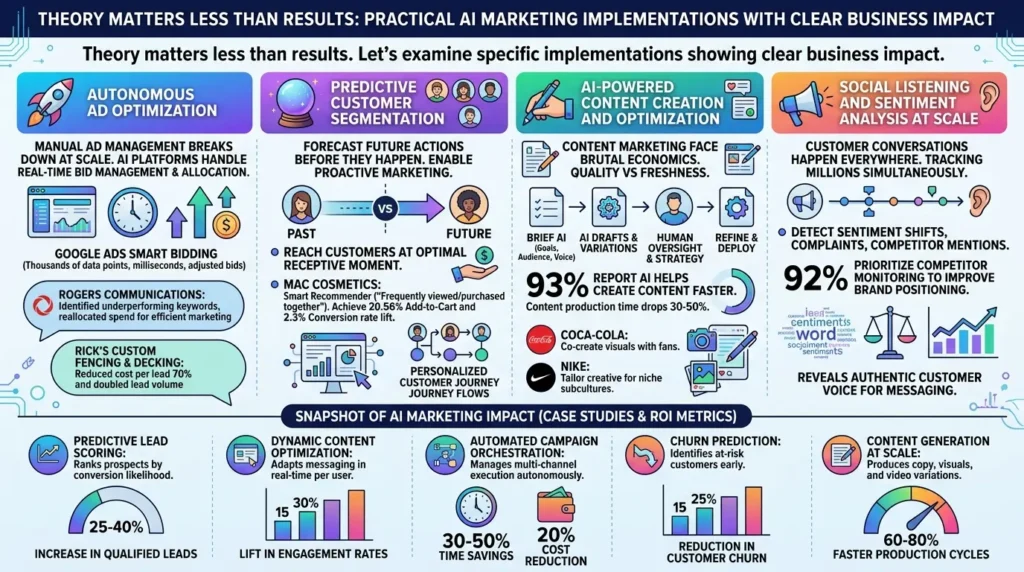
Autonomous Ad Optimization
Manual ad management breaks down at scale. Too many variables. Too many platforms. Too many creative combinations to test effectively.
AI-powered advertising platforms now handle real-time bid management, budget allocation, and creative optimization across channels simultaneously.
Google Ads’ Smart Bidding uses machine learning to set bids for every auction, analyzing signals like device, location, and time of day. The system processes thousands of data points per auction, adjusting bids in milliseconds based on predicted conversion probability.
Rogers Communications used AI-driven conversation analytics to identify underperforming keywords wasting budget. By reallocating spend from low-performers to high-impact campaigns, the company made their marketing significantly more efficient.
For Rick’s Custom Fencing & Decking, AI-powered call tracking provided granular data on which campaigns drove valuable leads. The team reduced cost per lead by 70% and doubled lead volume by using AI insights to optimize campaign targeting and creative.
The pattern repeats across industries: AI doesn’t just make ads more efficient, it reveals which efforts actually drive revenue versus which ones merely look good in vanity metrics.
Predictive Customer Segmentation
Traditional segmentation divides audiences by demographics or past behavior. AI-powered predictive models forecast future actions before they happen.
This enables proactive marketing, reaching customers with relevant messages at the exact moment they’re most receptive, rather than reacting after they’ve already taken action (or moved to competitors).
MAC Cosmetics used Smart Recommender systems showing “frequently viewed” and “purchased together” products, achieving a 20.56% add-to-cart rate and 2.3% increase in conversion rates. The AI analyzed shopping patterns to predict which products each customer would most likely want next, positioning recommendations at optimal points in the purchase journey.
Financial services firms use predictive lead scoring to identify which prospects will likely convert, allowing sales teams to prioritize high-value opportunities. Healthcare marketers predict patient needs and personalize outreach based on health history and behavior patterns.
The strategic advantage compounds over time. As these systems learn from more interactions, predictions become more accurate, creating self-reinforcing cycles where better targeting generates better data, which enables even better targeting.
AI-Powered Content Creation and Optimization
Content marketing faces a brutal economics problem: quality takes time, but audiences demand constant freshness across multiple channels.
93% of marketers report AI helps them create content faster, according to industry surveys. But speed alone doesn’t solve the challenge—you also need relevance, brand consistency, and actual audience value.
Smart implementations use AI for ideation and drafting, then apply human oversight for strategic direction and quality control.
Early adopters report content production time dropping by 30-50% thanks to AI, freeing human copywriters to focus on strategy and storytelling. The AI handles first drafts, variations for different segments, and format adaptations. Humans refine messaging, ensure brand alignment, and add the creative insights that algorithms still miss.
Coca-Cola experimented with generative AI to co-create campaign visuals with fans, while Nike used AI to tailor creative for niche subcultures. These campaigns proved AI removes technical barriers to creative production, enabling brands to market with sophistication previously requiring large agency teams.
The practical workflow looks like this: brief the AI system on campaign goals, audience, and brand voice. Review generated options. Select strong candidates. Refine and enhance with human creativity. Deploy across channels. The result isn’t replacing human marketers, it’s amplifying their impact by eliminating low-value tasks.
Social Listening and Sentiment Analysis at Scale
Customer conversations happen everywhere—social platforms, review sites, community forums, support tickets. Tracking and analyzing these discussions manually becomes impossible beyond tiny sample sizes.
AI-powered social listening tools process millions of conversations simultaneously, identifying sentiment patterns, emerging complaints, competitor mentions, and brand perception shifts in real time.
92% of business leaders prioritize competitor monitoring to improve brand positioning, according to recent research. AI tools extract competitor insights using semantic search and named entity recognition, analyzing competing brands’ content engagement, post frequency, hashtag performance, and audience response.
For crisis management, this capability proves critical. AI systems detect sentiment shifts and negative conversation spikes early enough for teams to respond before issues spiral. For product development, they surface customer pain points and feature requests that traditional market research would miss.
The strategic value extends beyond damage control. Social listening reveals how customers actually talk about problems your product solves—the exact language, emotional context, and comparison frames they use naturally. Feed this back into messaging and positioning, and your marketing resonates because it mirrors authentic customer voice instead of corporate speak.
Implementation Strategy: From Pilot to Production
Understanding AI’s potential matters less than deploying it effectively. Most organizations struggle not with choosing tools, but with integrating AI into existing workflows without disrupting operations.
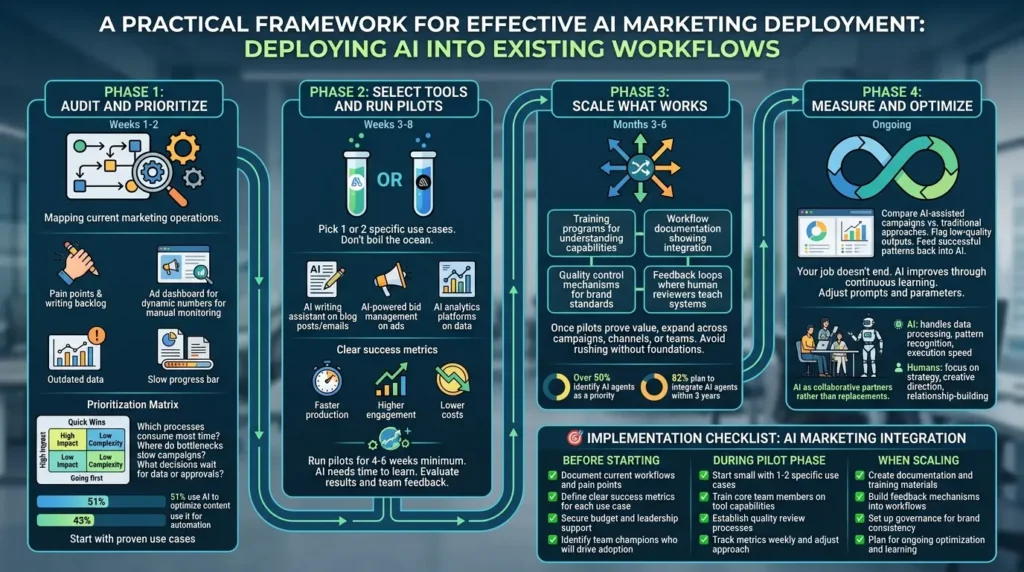
Here’s a practical framework teams can actually execute.
Phase 1: Audit and Prioritize (Weeks 1-2)
Start by mapping current marketing operations. Which processes consume the most time? Where do bottlenecks slow campaigns? What decisions require waiting for data or approvals?
List specific pain points:
- Content creation backlogs
- Manual ad performance monitoring
- Customer segmentation based on outdated data
- Campaign reporting that takes days to compile
Then prioritize by potential impact and implementation difficulty. Quick wins, high impact, low complexity—go first. These build momentum and demonstrate value, securing buy-in for more ambitious projects.
Over half (51%) of marketing teams use AI to optimize content, while 43% use it for automation. Start where proven use cases exist and vendor tools have matured.
Phase 2: Select Tools and Run Pilots (Weeks 3-8)
Don’t boil the ocean. Pick one or two specific use cases for initial pilots.
If content bottlenecks hurt most, test AI writing assistants on blog posts or email campaigns. If ad performance needs improvement, pilot AI-powered bid management on a subset of campaigns. If customer insights lag, try AI analytics platforms on existing data.
Set clear success metrics before starting. What would prove this works? Faster production times? Higher engagement rates? Lower costs per conversion?
Run pilots for 4-6 weeks minimum. AI systems need time to learn patterns and optimize. Evaluate both quantitative results and qualitative feedback from the team actually using the tools.
Phase 3: Scale What Works (Months 3-6)
Once pilots prove value, expand successful implementations across more campaigns, channels, or teams.
This requires more than just buying more licenses. You need:
- Training programs so team members understand AI capabilities and limitations
- Workflow documentation showing how AI tools integrate with existing processes
- Quality control mechanisms ensuring AI outputs meet brand standards
- Feedback loops where human reviewers teach systems to improve over time
Over 50% of organizations identify AI agents as a priority, while 82% of enterprises plan to integrate AI agents within the next three years. But rushing deployment without proper foundations leads to abandoned projects and wasted investment.
🎯 Implementation Checklist: AI Marketing Integration
Before Starting:
- ✓ Document current workflows and pain points
- ✓ Define clear success metrics for each use case
- ✓ Secure budget and leadership support
- ✓ Identify team champions who will drive adoption
During Pilot Phase:
- ✓ Start small with 1-2 specific use cases
- ✓ Train core team members on tool capabilities
- ✓ Establish quality review processes
- ✓ Track metrics weekly and adjust approach
When Scaling:
- ✓ Create documentation and training materials
- ✓ Build feedback mechanisms into workflows
- ✓ Set up governance for brand consistency
- ✓ Plan for ongoing optimization and learning
Phase 4: Measure and Optimize (Ongoing)
AI systems improve through continuous learning. Your job doesn’t end at deployment—it shifts to ongoing optimization.
Track performance metrics consistently. Compare AI-assisted campaigns against traditional approaches. Identify where AI adds clear value versus where human judgment still wins.
Feed successful patterns back into AI systems. Flag low-quality outputs so algorithms learn what to avoid. Adjust prompts and parameters based on what actually works in your specific market and audience.
Most importantly, train your team to think of AI as collaborative partners rather than replacements. The highest-performing marketing organizations use AI to handle data processing, pattern recognition, and execution speed, while humans focus on strategy, creative direction, and the relationship-building that still requires authentic human connection.
Challenges and Limitations: What AI Still Can’t Do
Let’s be honest about where AI falls short. The hype cycle obscures real limitations that teams discover only after deployment.
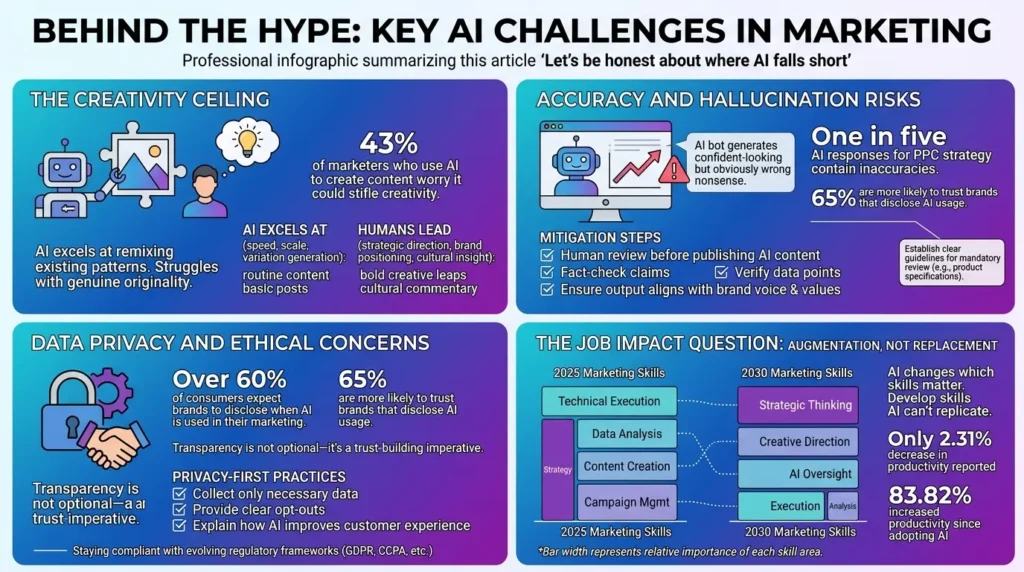
The Creativity Ceiling
AI excels at remixing existing patterns. It struggles with genuine originality.
43% of marketers who use AI do so to create content, but many worry AI could stifle creativity. The concern has merit. AI generates based on training data, combinations of what already exists. It doesn’t conceive truly novel approaches or breakthrough creative concepts.
Where does this matter practically?
For routine content, product descriptions, basic social posts, email variations, AI performs admirably. For campaigns requiring bold creative leaps or cultural commentary that challenges conventions, human strategists still lead.
The solution isn’t choosing between AI and human creativity. It’s deploying each where they excel. Use AI for speed, scale, and variation generation. Reserve human creativity for strategic direction, brand positioning, and work requiring genuine cultural insight.
Accuracy and Hallucination Risks
AI systems sometimes generate confident-sounding nonsense, “hallucinations” in industry jargon.
Recent research revealed that one in five AI responses for PPC strategy contain inaccuracies, highlighting reliability challenges across marketing applications. For brand-sensitive content or claims requiring accuracy, this presents real risk.
Practical mitigation requires human review before publishing AI-generated content. Fact-check claims. Verify data points. Ensure outputs align with brand voice and values. Yes, this adds steps. But catching one serious error before it reaches customers justifies the investment.
Teams also need clear guidelines about when AI alone suffices versus when human review is mandatory. Product specifications? Always verify. Social media engagement responses? Probably safe with spot-checking.
Data Privacy and Ethical Concerns
AI marketing depends on customer data. More data generally means better personalization and prediction accuracy. But data collection raises legitimate privacy concerns.
Over 60% of consumers expect brands to disclose when AI is used in their marketing strategies, according to consumer research. Transparency isn’t optional, it’s becoming both a regulatory requirement and a trust-building imperative.
65% of consumers are more likely to trust brands that disclose their use of AI. Smart organizations don’t hide AI usage. They frame it as enabling better experiences: “We use AI to recommend products you’ll actually find useful” rather than burying the reality in privacy policies.
Regulatory frameworks continue evolving. Gartner predicts that by 2025, 60% of large organizations will use AI to automate GDPR compliance. Staying compliant requires ongoing attention as laws like GDPR, CCPA, and emerging AI-specific regulations impose new obligations.
Bottom line: Build privacy-first practices from the start. Collect only necessary data. Provide clear opt-outs. Explain how AI improves customer experience. Organizations that treat privacy as strategic differentiator rather than compliance burden will win long-term customer loyalty.
The Job Impact Question
Probably the most sensitive challenge: AI’s effect on marketing jobs.
Some worry about how to nurture new talent and bring future marketers into the field when entry-level tasks become automated. The concern extends beyond junior roles, experienced practitioners wonder about their own relevance as AI handles more sophisticated work.
Here’s the nuanced reality: AI changes which skills matter, but doesn’t eliminate the need for skilled marketers.
Only 2.31% of respondents reported any decrease in productivity, while 83.82% reported increased productivity since adopting AI. The data suggests AI augments rather than replaces, at least so far.
But augmentation changes team composition. Organizations need fewer people for execution, more for strategy. Junior roles that provided learning opportunities (writing basic content, managing simple campaigns) disappear. Career paths that once required years of tactical work before reaching strategic roles compress dramatically.
Forward-looking marketers adapt by developing skills AI can’t replicate: strategic thinking, creative direction, ethical judgment, relationship building, and the business acumen to translate marketing into revenue outcomes. These become more valuable as AI handles technical execution.
Future Growth: Marketing in 2030
Predicting five years ahead in technology feels reckless. But clear trends point toward specific transformations already beginning.
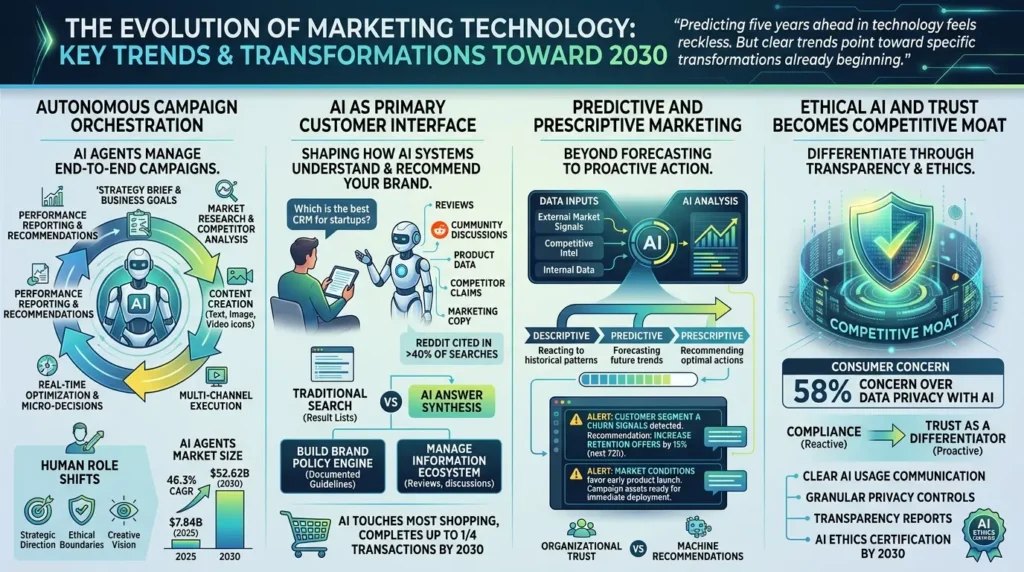
Autonomous Campaign Orchestration
By 2030, AI agents will manage entire campaign lifecycles with minimal human intervention.
The AI Agents market is projected to grow from $7.84 billion in 2025 to $52.62 billion by 2030, registering a CAGR of 46.3%. These aren’t simple automation scripts. They’re intelligent systems that plan strategies, create content, execute across channels, monitor performance, and optimize in real time, making thousands of micro-decisions that collectively drive results.
Picture a future where you brief an AI agent on business goals, brand parameters, and budget constraints. The agent researches your market, analyzes competitors, identifies opportunities, develops positioning, creates campaign assets, launches across appropriate channels, monitors engagement, adjusts approach based on response, and reports back with recommendations—all without waiting for approvals at each step.
This doesn’t mean marketers disappear. It means their role shifts entirely. Instead of executing campaigns, they set strategic direction. Instead of analyzing performance data, they make judgment calls about brand positioning and ethical boundaries. Instead of creating content variations, they develop the creative vision AI executes.
Within one to three years, AI agents will significantly transform organizational operations through hyperautomation, according to market analysis. The competitive advantage goes to organizations that adapt fastest to this new operating model.
AI as Primary Customer Interface
Search is changing. Instead of clicking through result lists, users increasingly ask AI assistants for recommendations, and those assistants pull from their training data to answer.
Reddit is the most cited domain by Large Language Models, appearing in over 40% of searches, according to platform research. This creates a new marketing challenge: Your brand’s perception gets shaped not just by your own messaging, but by every public discussion about your category across the internet.
Think about the implications. When customers ask AI assistants “What’s the best CRM for startups?” or “Which running shoes prevent injuries?”, those assistants synthesize answers from countless sources, reviews, comparisons, community discussions, your marketing copy, competitor claims. The answer they provide might mention your brand or ignore it entirely based on patterns in that training data.
By 2030, AI will touch most online shopping in some capacity, completing up to a quarter of transactions, according to retail forecasts. Marketing’s job evolves from “be found in search results” to “shape how AI systems understand and recommend your brand.”
This requires building what some call a “brand policy engine”, documented guidelines about what your brand stands for, what problems you solve, who you serve, and how you compare to alternatives. Not just style guides, but strategic frameworks that help AI systems accurately represent your positioning when they’re asked.
Organizations also need to actively manage their information ecosystem. That means participating authentically in community discussions, publishing clear comparison content, responding to reviews, and maintaining consistent messaging across all touchpoints where AI systems might learn about you.
Predictive and Prescriptive Marketing
Current AI mostly reacts to patterns in historical data. Next-generation systems will predict future behavior and prescribe optimal actions proactively.
Predictive analytics enables brands to forecast customer trends and behaviors before they happen, adjusting campaigns in real time based on streaming data from thousands of sources. But we’re moving beyond prediction toward prescription, AI systems that don’t just forecast what will happen, but recommend what you should do about it.
Imagine receiving alerts like: “Customer segment A shows early churn signals, recommend increasing retention offers by 15% for the next 72 hours” or “Market conditions favor launching the new product two weeks earlier than planned, campaign assets ready for immediate deployment.”
These systems will combine external market signals, competitive intelligence, internal performance data, and customer behavior patterns to suggest strategic moves before opportunities pass or problems escalate.
The challenge isn’t technical, the AI capabilities exist or will soon. The challenge is organizational: building cultures where marketers trust machine recommendations enough to act on them quickly, while maintaining human oversight on decisions with significant brand or ethical implications.
Ethical AI and Trust Becomes Competitive Moat
As AI proliferates across marketing, organizations that build transparent, ethical practices will differentiate meaningfully.
58% of consumers report concern over data privacy when it comes to brands using AI, but that concern comes with opportunity. Brands that clearly communicate how they use AI, what data they collect, and how customers benefit will earn loyalty others can’t match.
This goes beyond compliance. Forward-looking companies will turn privacy and ethical AI into brand pillars, publishing transparency reports, offering granular privacy controls, and openly discussing AI’s role in customer experiences.
Regulatory pressure will accelerate this. Organizations must keep pace with evolving regulations like GDPR, CCPA, and Canada’s Artificial Intelligence and Data Act, according to compliance experts. But the winners won’t just comply—they’ll exceed standards and make their ethical stance part of their marketing itself.
By 2030, expect “AI ethics certification” to become a marketing asset similar to carbon neutrality or fair trade credentials. Customers will choose brands partly based on how responsibly they deploy AI.
The Strategic Path Forward
We’ve covered a lot of ground. Strategic impacts. Real implementations. Practical frameworks. Future trajectories. Let me distill what actually matters for marketing leaders making decisions today.
AI isn’t coming to marketing. It’s already here, embedded in tools your teams probably already use, Google Ads optimization, email send time algorithms, social media recommendation engines.
The question isn’t whether to adopt AI. It’s whether you’ll deploy it strategically or let it happen haphazardly.
Start with clear objectives. What outcomes need improvement? Where do current processes waste time or resources? Which customer experiences feel generic when they should feel personalized? Don’t implement AI because competitors are, implement it to solve specific problems holding your business back.
Build human-AI collaboration into your culture from day one. The teams winning aren’t replacing marketers with machines. They’re combining human strategic thinking with AI execution speed. Creativity with data processing. Emotional intelligence with pattern recognition.
Invest in understanding, not just tools. Train your team on what AI can and can’t do. Help them develop prompt engineering skills. Create feedback loops where they improve AI outputs through thoughtful review. The competitive advantage comes not from having AI, but from using it well.
Stay grounded on limitations. AI makes mistakes. It lacks genuine creativity. It can’t navigate complex ethical questions without human judgment. Teams that acknowledge these boundaries and plan for them avoid the disappointments that come from treating AI as magic.
And remember the ultimate goal: AI should make marketing more human, not less. Use it to free your team from repetitive tasks so they can focus on the relationship-building, strategic thinking, and creative work that actually requires human insight. Use it to understand customers better so you can serve them more relevantly. Use it to scale personalization so every customer feels seen, not averaged.
The future belongs to marketers who think like strategists and work like scientists, forming hypotheses, testing approaches, learning from data, and iterating quickly. AI doesn’t replace that. It accelerates it.
The real transformation isn’t technological. It’s mindset. From “we create campaigns” to “we engineer knowledge coverage.” From “we optimize conversion funnels” to “we choreograph trust across touchpoints.” From “we produce content” to “we become the most complete information source in our category.”
That’s the shift that matters. Everything else is just tools.
Frequently asked questions (FAQs)
Can AI completely replace human marketers?
No. AI excels at data processing, pattern recognition, and execution speed, but lacks strategic thinking, genuine creativity, and ethical judgment. The most effective approach combines AI for technical tasks with humans for strategy, creative direction, and relationship building.
What’s the best way to start using AI in marketing if you’re a small business?
Start small with one specific pain point. Try AI writing assistants for content creation, AI-powered email optimization, or chatbots for customer questions. Focus on quick wins before investing in larger solutions.
How do you measure ROI from AI marketing investments?
Track metrics tied to your use case, such as production time savings, engagement improvements, conversion rates, customer acquisition costs, and forecast accuracy.
What are the biggest ethical concerns with AI in marketing?
Data privacy, transparency, algorithmic bias, and responsible use of customer information remain the primary concerns when implementing AI.
Will AI make content marketing generic and bland?
Only if it’s used without human oversight. AI works best as a drafting and research assistant while humans provide strategy, creativity, originality, and brand voice.
What skills should marketers develop to stay relevant as AI advances?
Focus on strategic thinking, creativity, emotional intelligence, business acumen, prompt engineering, and interpreting data-driven insights effectively.
How long before AI can run entire marketing departments autonomously?
AI will increasingly automate tactical work, but strategic decisions, branding, ethics, and leadership will continue to require human oversight for the foreseeable future.
What’s the difference between marketing automation and AI marketing?
Traditional automation follows predefined rules, while AI marketing can analyze patterns, adapt decisions, make predictions, and optimize campaigns dynamically.