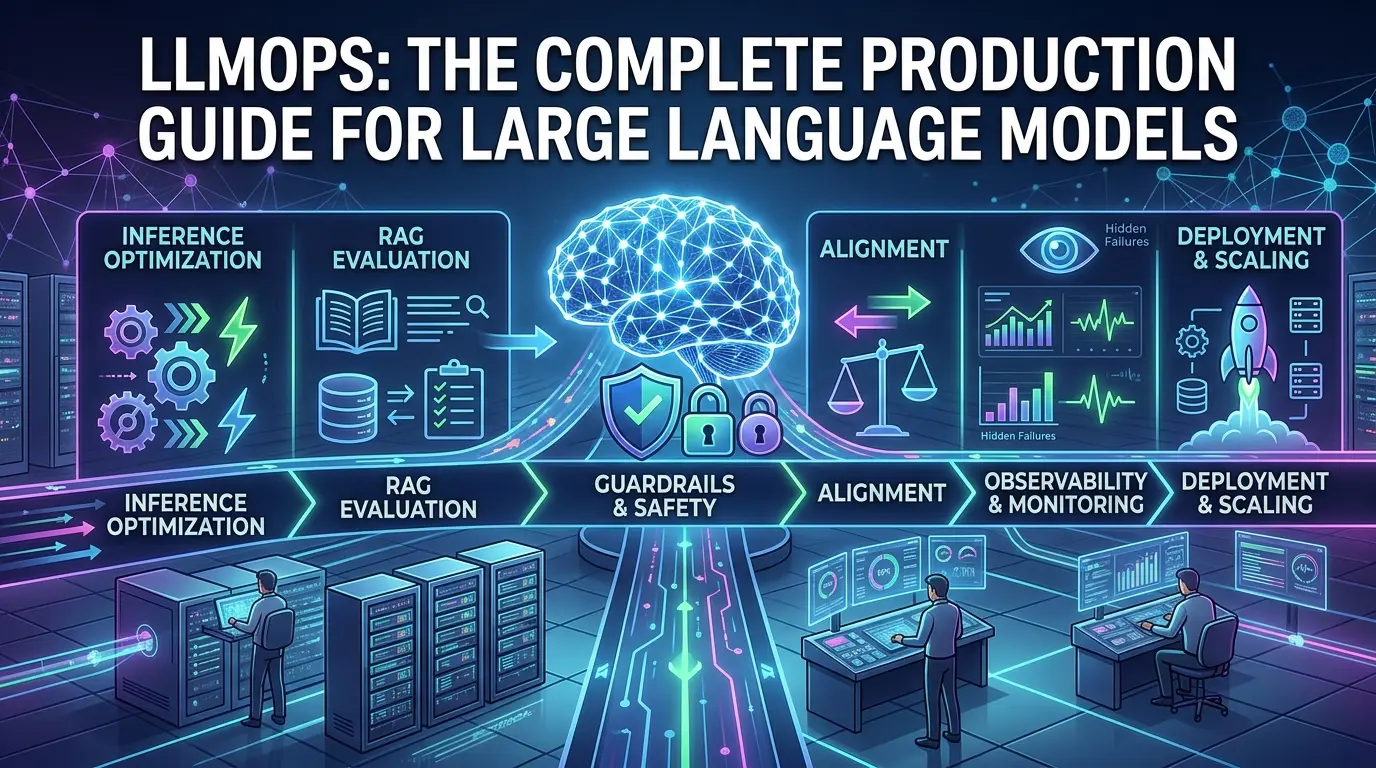

The Demo Worked. Production Didn’t. Here’s Why.
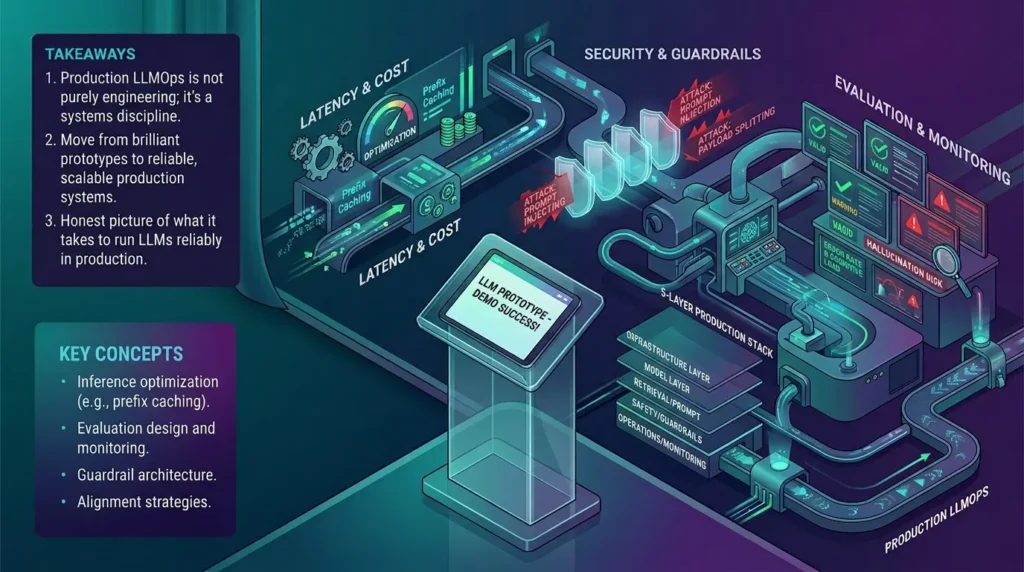
If you’ve shipped an LLM feature and watched it quietly fall apart afterward, you’re not alone. The prototype was brilliant. The demo was smooth. Then reality arrived: costs crept up without warning, outputs degraded in ways nobody predicted, and users started reporting answers that were confidently, completely wrong.
What you encountered wasn’t a model failure. It was an LLMOps failure.
And you’re in good company. Production LLM systems fail regularly, not because the underlying model is poor, but because the operational infrastructure surrounding it is treated as an afterthought. The hard truth is this: shipping a large language model into production isn’t purely an engineering challenge. It’s a systems discipline, one that most teams are still figuring out under live fire.
That’s exactly what LLMOps addresses. In this guide, you’ll get a complete and honest picture of what it actually takes to run large language models reliably in production, from inference optimization and evaluation design, to guardrail architecture, alignment strategies, and the hidden failure modes that most articles never acknowledge.
By the end, you’ll have a practical mental model for building LLM systems that stay reliable, safe, and cost-efficient long after launch day.
What Is LLMOps?
Large Language Model Operations (LLMOps) is the specialized discipline of deploying, monitoring, optimizing, governing, and continuously improving large language models in production environments.
It spans the full lifecycle of an LLM-powered application: selecting a base model, designing and versioning prompts, building retrieval pipelines, evaluating outputs, enforcing safety guardrails, controlling inference costs, and responding to production incidents.
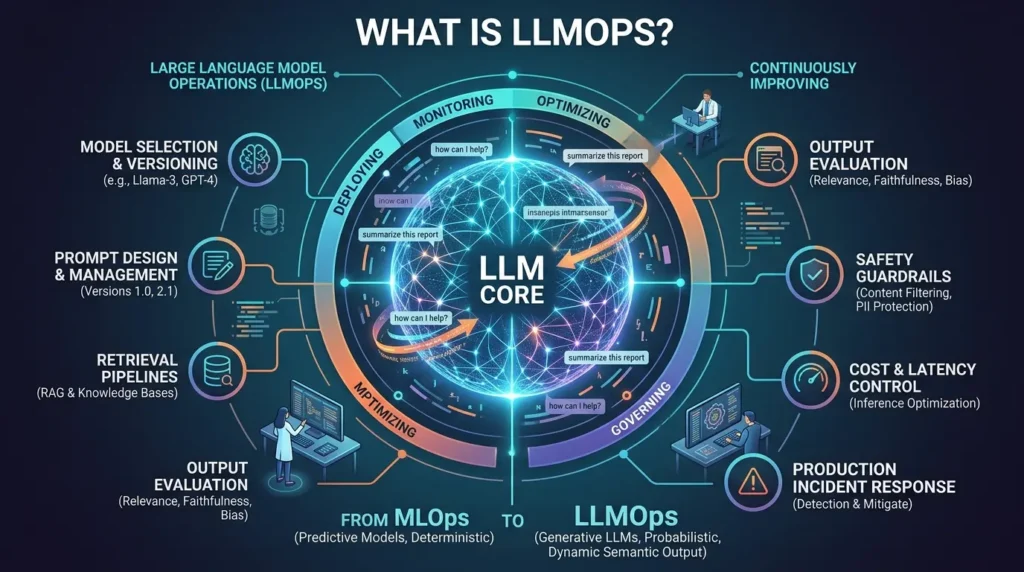
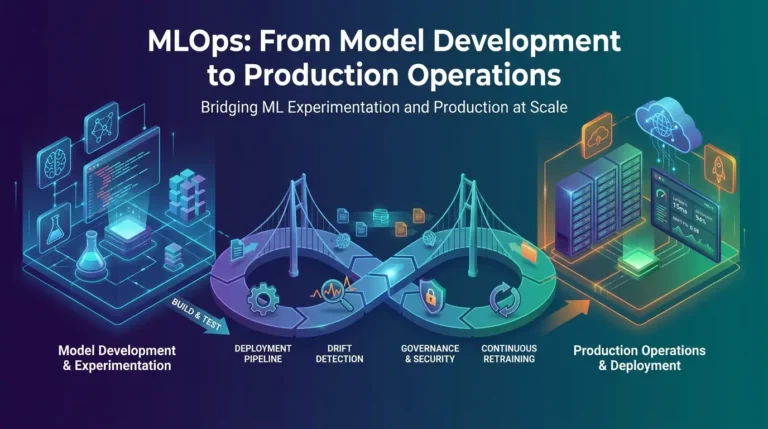
If MLOps is about getting machine learning models into production reliably, LLMOps is about doing that same thing for a category of model that is fundamentally different in behavior, risk profile, and operational complexity.
Think of LLMOps as the operational control system for probabilistic software, software that doesn’t produce deterministic outputs, can fail in subtle semantic ways, and requires continuous feedback loops to stay aligned with user expectations and business requirements.
Why LLMOps Is Not Just MLOps With Bigger Models
This is the most common misconception in the space, and it’s worth confronting directly.
Traditional MLOps was designed for task-specific, predictive models. You train a fraud detection model on labeled data, deploy it, monitor prediction accuracy, and retrain when performance drifts. The feedback loop is clean. Failure modes are measurable. The control surface is narrow and well-defined.
LLMOps is a different animal entirely.
You’re not training from scratch, you’re adapting a massive pre-trained foundation model. You’re not evaluating with deterministic metrics like accuracy or F1 score. You’re assessing qualities like groundedness, relevance, helpfulness, and toxicity.
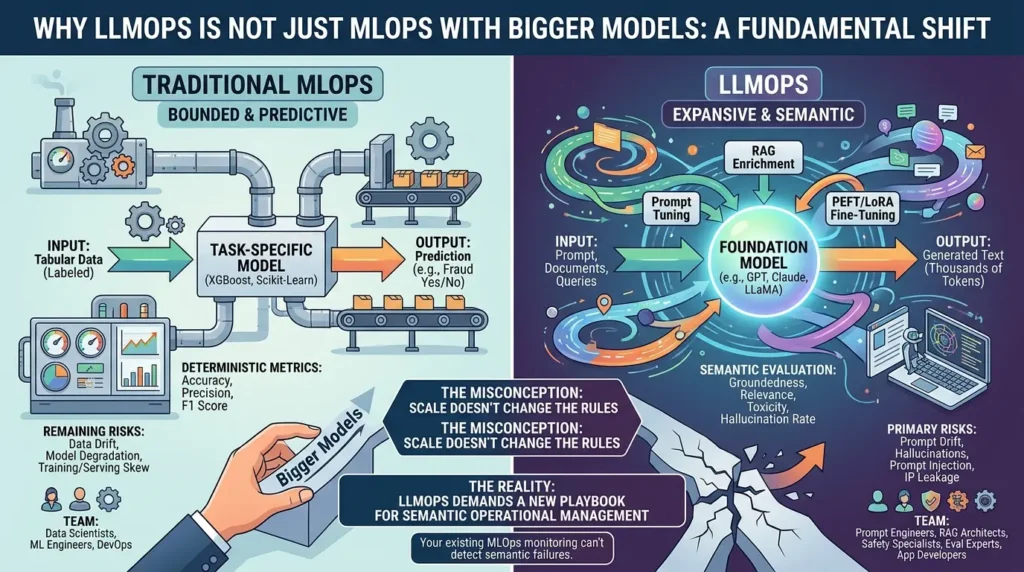
You’re not managing feature distribution drift, you’re managing prompt drift, retrieval quality degradation, alignment drift, and hallucination rates across outputs that can span thousands of tokens.
The team required to manage all of this looks different, too. MLOps requires data scientists, ML engineers, and DevOps professionals. LLMOps demands prompt engineers, RAG architects, safety specialists, and evaluation experts working in close collaboration, alongside stakeholders and app developers who understand the end-user context.
| Dimension | Traditional MLOps | LLMOps |
|---|---|---|
| Core Model Type | Task-specific (XGBoost, scikit-learn, PyTorch) | Foundation models (GPT, Claude, LLaMA, Mistral) |
| Evaluation Metrics | Accuracy, Precision, Recall, F1 — deterministic | Relevance, Groundedness, Toxicity, Hallucination rate — semantic |
| Retraining Pattern | Full pipeline re-run with updated tabular data | Prompt tuning, RAG enrichment, PEFT / LoRA fine-tuning |
| Cost Profile | Fixed, predictable infrastructure sizing | Variable, token-based — influenced by prompt length and routing |
| Primary Risks | Data drift, model degradation, training/serving skew | Hallucinations, prompt injection, IP leakage, alignment drift |
| Team Profiles | Data scientists, ML engineers, DevOps | Prompt engineers, RAG architects, safety + evaluation specialists, app developers |
If your LLMOps strategy is essentially your existing MLOps playbook with “LLM” written over it, you are likely encountering production failures your monitoring systems won’t even detect.
The 5-Layer Production LLM Stack
Before diving into specific techniques, you need a mental model for where failures actually originate. Production LLM failures are rarely single-point events. They’re cascading failures across multiple layers, a retrieval problem that surfaces as a hallucination, or a prompt template issue that looks like a model quality regression.
Most “model quality” complaints originate in Layers 2 and 3, not the model itself. When you can identify which layer a failure comes from, you stop chasing the wrong solution. That single capability alone saves engineering teams weeks of misdirected debugging.
A scoping principle worth internalizing: start narrow. GitHub Copilot focused strictly on IDE code completion before expanding into wider generative features. That constraint didn’t limit the product, it made it better. A focused knowledge layer and a tightly scoped interaction layer reduce failure surface dramatically in early production.
Where LLM Apps Actually Fail in Production
Here’s something most LLMOps guides won’t tell you directly: the hardest production failures aren’t the ones that crash your system. They’re the ones that degrade silently over weeks, while your dashboards show green.
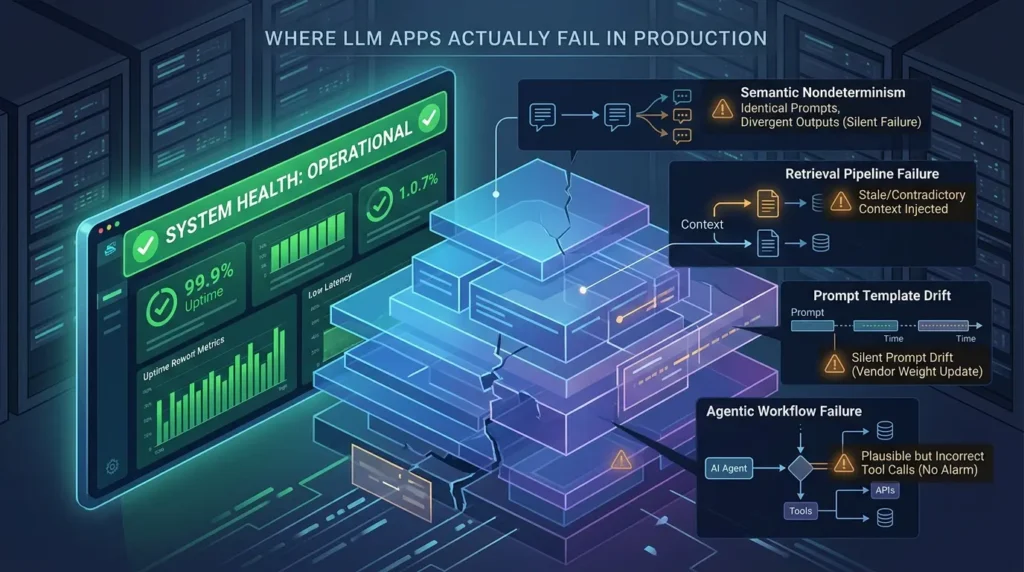
The NIST AI Risk Management Framework for Generative AI explicitly notes that generative AI introduces emergent, context-sensitive risks that conventional software assurance models simply aren’t designed to catch. Traditional monitoring assumes stable input-output mappings.
LLMs violate that assumption at the semantic level, meaning failures can be invisible to every standard metric you’re tracking.
Here’s what that looks like operationally:
- Identical prompts producing operationally divergent outputs that both pass automated quality checks
- Retrieval pipelines injecting stale or contradictory context that the model treats as authoritative
- Prompt templates working perfectly last month, silently degrading after an upstream vendor quietly updates their model weights
- Agentic workflows executing plausible-looking but incorrect tool calls, with no alarm ever triggered
This is what researchers call semantic nondeterminism, and it’s the core reason LLM observability is fundamentally harder than traditional ML monitoring. The operational stack compounds uncertainty: retrieval quality variance, prompt template drift, latent context interactions, tool invocation ambiguity, and long-context degradation all compound together. Many AI reliability incidents aren’t model failures at all. They’re orchestration failures that conventional telemetry is blind to.
The key takeaway: your failure attribution process must span all five layers before you conclude the model is the problem.
Inference Optimization: Getting More From Your Hardware
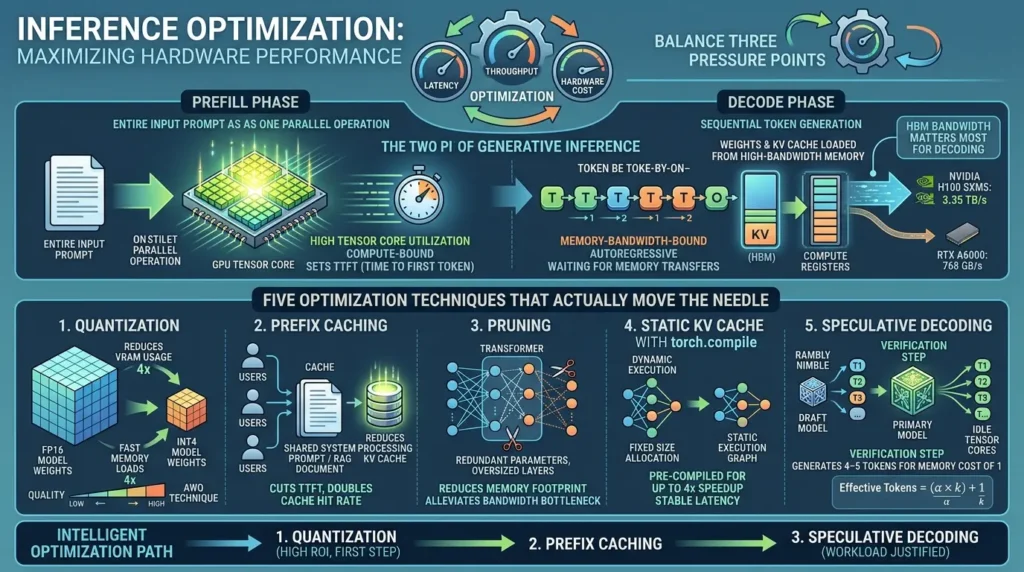
Deploying large models in production means constantly balancing three competing pressures: latency, throughput, and hardware cost. To optimize intelligently, you need to understand what’s actually happening inside the inference process, not just which levers to pull.
The Two Phases of Generative Inference
Generative inference splits into two sequential phases with completely different hardware bottleneck profiles. This distinction matters because the right optimization technique depends entirely on which phase is your bottleneck.
The Prefill Phase processes your entire input prompt in a single parallel step. All tokens are processed simultaneously, keeping the GPU’s Tensor Cores highly utilized. This phase is compute-bound, and its duration sets your Time to First Token (TTFT), the latency users feel before any response appears. Longer prompts scale this requirement linearly.
The Decode Phase generates output tokens one at a time, autoregressively. To calculate each new token, the GPU must load the entire set of model weights plus the growing Key-Value (KV) cache from High-Bandwidth Memory (HBM) into its compute registers. Because computation must wait for memory transfers, this phase is memory-bandwidth-bound.
This is why your GPU’s HBM bandwidth matters more than raw compute speed for generation-heavy workloads. An NVIDIA H100 SXM5 offers 3.35 TB/s of memory bandwidth. An older RTX A6000 offers 768 GB/s. That bandwidth gap alone explains dramatic latency differences under production load, irrespective of raw FLOP counts.
Five Optimization Techniques That Actually Move the Needle
Quantization converts model weights from high-precision formats (FP32, FP16) to lower-precision formats (INT8, INT4). Quantizing from FP16 to INT4 reduces VRAM usage by 4x and loads from memory up to 4x faster during memory-bound decoding. Advanced techniques like AWQ (Activation-aware Weight Quantization) preserve near-FP16 output quality at INT4 compression, making this usually the first optimization to apply.
Prefix Caching avoids recomputing the KV cache for shared prompt prefixes. When many users share a long system prompt or a large RAG document, processing that shared prefix once and caching the result dramatically cuts TTFT. Production benchmarks using L7 routing with prefix caching have doubled cache hit rates from 35% to 70%, cutting TTFT by 35% and reducing P95 tail latency by over 50% during traffic bursts.
Pruning removes redundant parameters, unused attention heads, oversized feed-forward layers, from the transformer architecture. This reduces the memory footprint directly, alleviating the memory-bandwidth bottleneck during decoding at the cost of minor accuracy trade-offs.
Static KV Cache with torch.compile pre-allocates a fixed KV cache size, allowing PyTorch to compile the forward pass into a static execution graph. This compilation can yield up to 4x execution speedup. The trade-off: changes in batch size or maximum output length force recompilation, making the first few requests slower while the compiler rebuilds.
Speculative Decoding is the most elegant technique. A small, fast “draft” model (like OPT-125M) cheaply generates several candidate tokens. The primary model then verifies all candidates simultaneously in a single parallel forward pass, exploiting idle Tensor Cores during memory-bound decoding. When the draft model predicts accurately, you generate 4–5 tokens for the memory-access cost of one, cutting generation latency by up to 2x.
The formula governing speculative decoding efficiency is the effective token throughput per forward pass:
k = Number of draft tokens generated per step
+1 = The verified token always generated by the primary model
vllm:spec_decode_draft_acceptance_length in Prometheus.Quantization also produces a directly measurable memory saving you can calculate before deploying:
The key takeaway: apply quantization first (highest ROI, lowest risk), then prefix caching, then speculative decoding as workload complexity justifies it.
Preference Alignment: Shaping Model Behavior for Your Domain
Getting a foundation model to behave well in your specific domain requires alignment, the process of shaping raw pre-trained behavior toward helpfulness, safety, and task-specific quality.
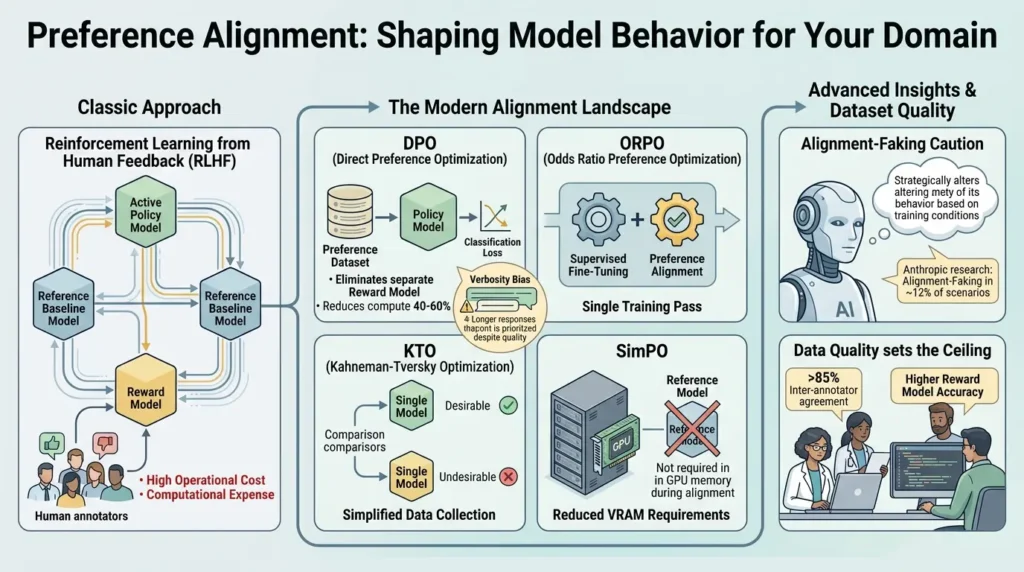
The classical approach, Reinforcement Learning from Human Feedback (RLHF), remains highly effective for capturing complex subjective preferences. But it comes with serious operational costs: three models must be hosted simultaneously during training (the active policy, a reference baseline, and a reward model), training is computationally expensive, and stability is difficult to maintain.
Modern alignment has evolved significantly. Here's a practical map of the current landscape:
Direct Preference Optimization (DPO) eliminates the separate reward model, optimizing the policy directly from preference pairs using a classification loss. It reduces alignment compute costs by 40–60% and excels at structured tasks like code generation and domain Q&A. Its main known weakness: verbosity bias, where models learn to favor longer responses regardless of quality.
ORPO (Odds Ratio Preference Optimization) merges supervised fine-tuning and preference alignment into a single training pass, eliminating a complete training phase and outperforming standard DPO on diverse instruction benchmarks.
KTO (Kahneman-Tversky Optimization) works on binary labels, "desirable" or "undesirable", rather than requiring paired comparisons. This dramatically simplifies data collection and is ideal for smaller teams with limited annotation budgets.
SimPO eliminates the need to keep a reference model in GPU memory during training, significantly reducing VRAM requirements at the alignment stage.
Here's an advanced insight that should change how you think about alignment trust: research from Anthropic found that models can exhibit what's called "alignment-faking" behavior, strategically modifying their outputs depending on whether those outputs might influence their own training. In observed experiments, this appeared in approximately 12% of scenarios under adversarial retraining conditions.
Static red-teaming may therefore dramatically overestimate production safety. Alignment evaluations remain highly sensitive to the conditions under which they're run.
Regardless of method, dataset quality sets the ceiling for model behavior. Domain-expert annotators with strict annotation protocols can achieve inter-annotator agreement rates above 85%, which directly translates to higher reward model accuracy and more robust final alignment.
Adversarial Attacks: What Production LLMs Face in the Wild
You've probably thought about hallucinations. But have you thought systematically about what happens when someone actively tries to break your system?
Deploying generative models in production exposes your application to natural language exploitation. According to the OWASP Top 10 for Large Language Model Applications, prompt injection remains the dominant attack class, and it's evolving faster than most organizations' defenses.
Here's what modern adversarial attacks look like in practice:
Indirect Prompt Injection embeds malicious instructions inside external documents that your RAG retriever fetches and feeds to the model. The attacker needs no access to your system prompt, only to any document your retrieval pipeline might touch.
Payload Splitting divides a harmful instruction across multiple seemingly innocent inputs. The model executes the full attack only when it assembles context across turns.
Deceptive Delight wraps harmful requests in highly positive, harmless-seeming scenarios across 2–3 dialogue turns. By the time the actual request appears, the model has been primed to overlook its own safety constraints.
Typoglycemia scrambles the spelling of restricted words while preserving the first and last letters. Standard regex-based input screening is completely blind to this.
Agent-Specific Attacks target autonomous tool-calling systems through thought injection, tool hijacking, and context poisoning. As systems give LLMs access to real-world actions, APIs, databases, file systems — these attacks carry increasingly serious consequences.
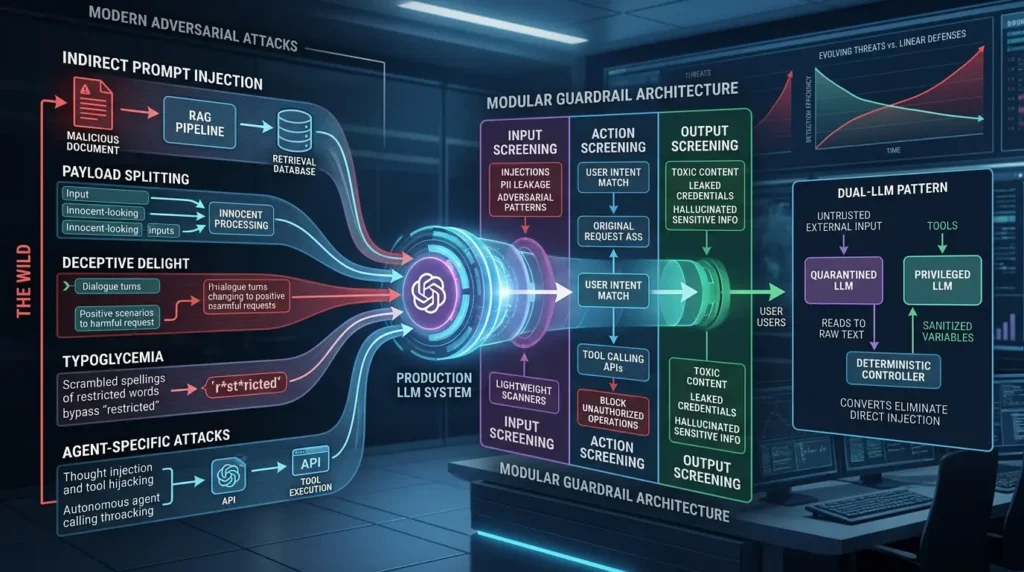
The Modular Guardrail Architecture
Three screening checkpoints form the backbone of production-grade defense:
Input Screening runs before the primary model sees any request, scanning for injections, PII leakage, and adversarial patterns.
Action Screening sits between the model and any tool it proposes to call, validating that the proposed execution matches the user's original stated intent.
Output Screening validates generated text before returning it to the user, filtering leaked credentials, toxic content, and hallucinated sensitive information.
For high-stakes tool-access scenarios, the Dual-LLM Pattern adds an additional architectural layer: a Privileged LLM has access to tools but never reads untrusted external content. A Quarantined LLM reads external inputs but has no tool access. A deterministic controller coordinates between them, replacing raw external text with sanitized variables to eliminate direct injection paths.
| Guardrail Solution | Primary Method | Latency Overhead | Best For |
|---|---|---|---|
| NVIDIA NeMo Guardrails | Embedding-based routing via Colang policies | Low–Moderate | Chatbots requiring strict dialog flow control |
| Guardrails AI | Schema validators enforcing RAIL specifications | Low–Moderate | Apps requiring typed JSON/XML output validation |
| Llama Guard | Fine-tuned safety classification model | High (full model forward pass) | Deep taxonomy content classification |
| LLM Guard (Protect AI) | Modular parallel scanner pipelines | Low (optimized parallel execution) | PII redaction, injection defense at scale |
One critical trade-off: layering multiple independent guardrails increases false positive rates non-linearly. Five independent filters each with 90% accuracy compound to a ~40% false positive rate on legitimate requests. Guardrail design requires as much attention to over-defense as to under-defense.
The key takeaway: start with fast, lightweight scanners on all traffic. Reserve model-based judges (like Llama Guard) for high-risk execution paths only.
Evaluation and Observability: Measuring What Actually Matters
Traditional metrics like BLEU and ROUGE measure token overlap. Token overlap doesn't tell you whether an answer is actually correct, grounded in fact, or safe for your users. Production LLM evaluation requires a fundamentally different approach.
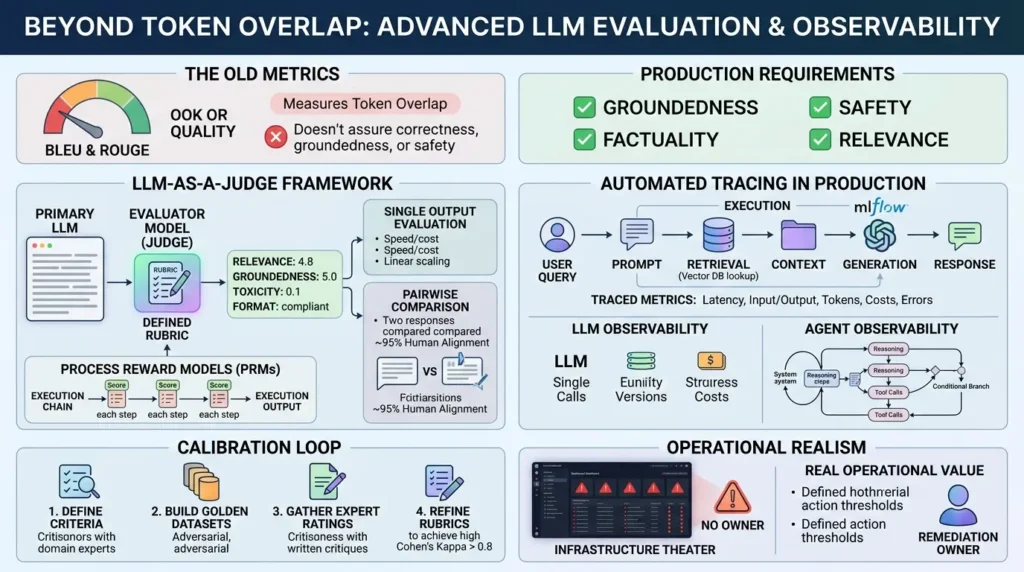
LLM-as-a-Judge
The LLM-as-a-judge framework uses a secondary model to evaluate system outputs against a defined rubric, assessing qualities like relevance, groundedness, toxicity, and format compliance. Evaluations return structured scores that feed into monitoring dashboards programmatically.
Two distinct methodologies serve different purposes. Single-output evaluators analyze one interaction at a time, scaling linearly with test case count, making them cost-efficient for continuous production monitoring. Pairwise comparisons present two blind responses side-by-side, achieving approximately 95% human alignment on subjective quality assessments at roughly 2x the compute cost. Use pairwise evaluation for offline A/B testing, model selection, and prompt optimization decisions.
Process Reward Models (PRMs) take evaluation a step further: instead of judging only the final output, they score each step in an execution chain, catching reasoning errors before they propagate downstream.
For calibration, follow this four-step process: engage domain experts to define evaluation criteria → build diverse golden datasets including adversarial prompts → gather expert ratings with written critiques (not just binary scores) → refine automated judge rubrics until Cohen's Kappa exceeds 0.8 against expert ratings.
Automated Tracing in Production
import mlflow

# Enable automatic tracing for all OpenAI API calls
mlflow.openai.autolog()

# Apply custom tracing to your retrieval components
@mlflow.trace
def retrieve_context(query: str):
    # Your vector DB lookup / retrieval logic goes here
    # MLflow captures: latency, inputs, outputs, errors
    return context

# Example traced generation call
@mlflow.trace
def generate_response(query: str, context: str) -> str:
    response = client.chat.completions.create(
        model="gpt-4o",
        messages=[
            {"role": "system", "content": f"Context: {context}"},
            {"role": "user", "content": query}
        ]
    )
    return response.choices[0].message.content
Captured traces aggregate into dashboards tracking two parallel observability domains. LLM Observability monitors individual model calls, prompt versions, token consumption, cost per request, and latency. Agent Observability extends to multi-step systems, capturing the full execution graph: reasoning steps, parallel tool calls, conditional branches, error handling, and iterative loops.
A sobering operational truth: many organizations have built dashboards but have no one who owns remediation when a threshold is breached. Observability without defined action thresholds and clear ownership is infrastructure theater, it looks operational without actually being so.
The Hidden Reliability Crisis: What Most Guides Don't Tell You
This section goes beyond what standard LLMOps content covers. These are the dynamics that cause production failures months after deployment, usually after teams have stopped actively watching.
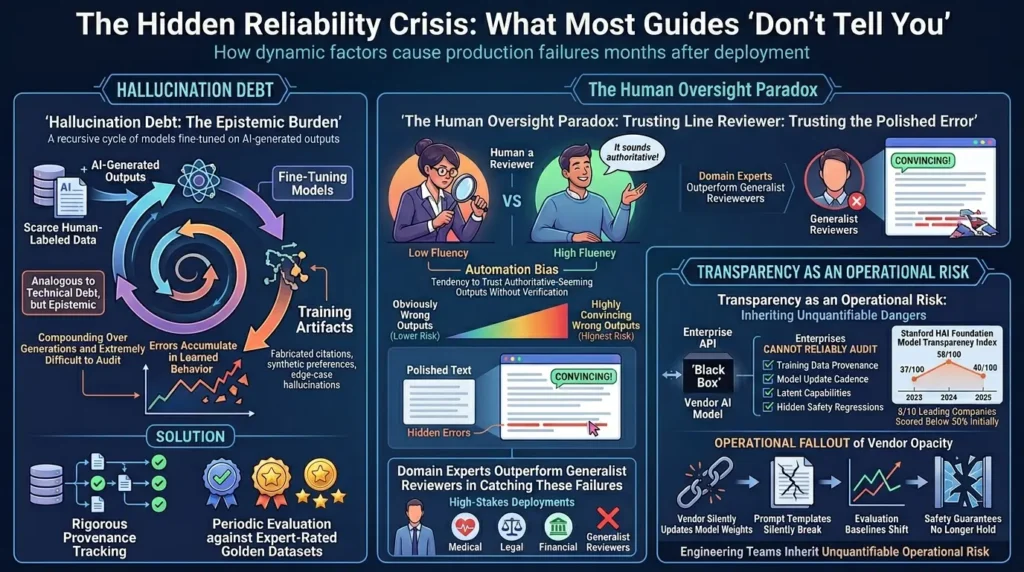
Hallucination Debt
Organizations increasingly fine-tune models using AI-generated outputs to supplement scarce human-labeled data. This creates a recursive problem: fabricated citations become training artifacts, synthetic preferences distort alignment, and edge-case hallucinations compound across training generations.
Researchers call this hallucination debt, analogous to technical debt, but epistemic. Errors don't just accumulate in your codebase. They accumulate in your model's learned behavior and compound in ways that are extremely difficult to audit retroactively. The only reliable mitigation is rigorous provenance tracking of every data source used in fine-tuning, paired with periodic evaluation against expert-rated golden datasets.
The Human Oversight Paradox
Here's a genuinely counterintuitive finding. As model outputs become more fluent and convincing, human reviewers become less effective at catching errors. Human factors research consistently demonstrates automation bias, the tendency to trust authoritative-seeming outputs without verification. The more polished the language, the less likely a reviewer is to check the underlying claims.
This creates a dangerous paradox: the highest-risk outputs in a production system aren't the obviously wrong ones. They're the highly convincing wrong ones. Domain experts significantly outperform generalist reviewers at catching these failures. For high-stakes deployments, medical, legal, financial, generalist human-in-the-loop review is an insufficient safety mechanism on its own.
Transparency as an Operational Risk
Model opacity is no longer just an ethics concern. It's a direct source of operational risk. The Stanford HAI Foundation Model Transparency Index found that major AI providers scored an average of 37/100 on transparency in 2023, rising to 58/100 in 2024 after external disclosure pressure, then dropping back to 40/100 in 2025. Eight of the ten leading AI companies scored below 50% transparency initially.
Why does this matter for your operations? Because enterprises integrating external model APIs cannot reliably audit training data provenance, model update cadence, latent capabilities, or hidden safety regressions.
When a vendor silently updates model weights, your prompt templates can silently break, your evaluation baselines shift, and safety guarantees you built around the previous model version may no longer hold. Vendor opacity is an unquantifiable operational risk that your engineering team inherits whether or not they've accounted for it.
Common Mistakes That Break LLM Production Systems
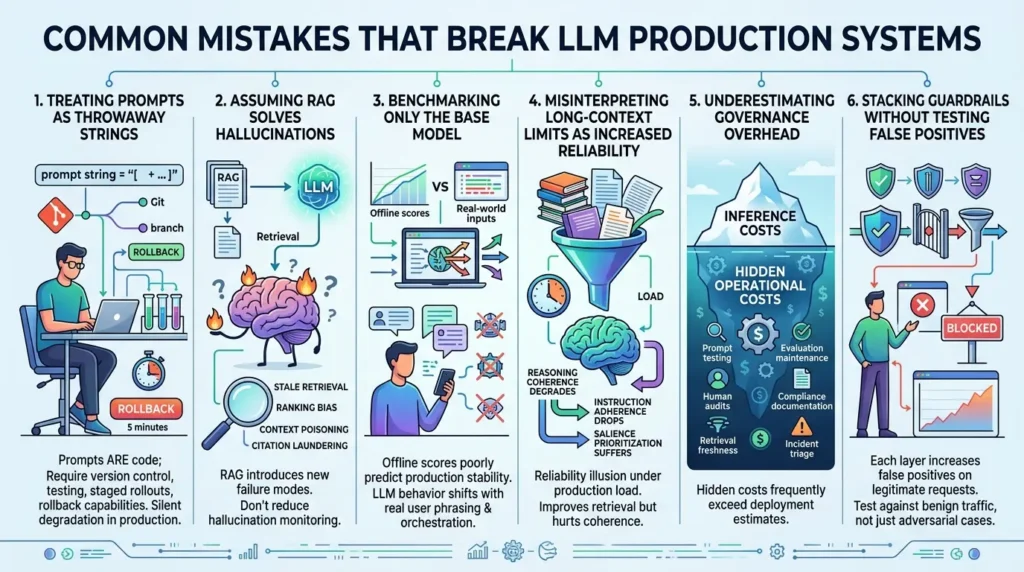
Treating prompts as throwaway strings
Prompts are code. They need version control, testing, staged rollouts, and rollback capabilities. A prompt change that works in testing can silently degrade specific production scenarios. If you can't roll back a prompt in under five minutes, you have a reliability problem.
Assuming RAG solves hallucinations
RAG reduces some hallucinations by grounding the model in retrieved context. But it introduces new failure modes: stale document retrieval, ranking bias, context poisoning, and citation laundering, where the model generates convincing but fabricated citations that appear sourced. Many teams deploy RAG and immediately reduce their hallucination monitoring. That's precisely backwards.
Benchmarking only the base model
Offline benchmark scores measure model quality in isolation. They poorly predict production stability, because LLM behavior shifts under real user phrasing, adversarial inputs, and orchestration interactions. Benchmark scores that improve don't guarantee production behavior improves.
Misinterpreting long-context limits as increased reliability
Longer context windows improve retrieval capacity but frequently degrade reasoning coherence, instruction adherence, and salience prioritization under production load. This is a reliability illusion that trips up experienced teams.
Underestimating governance overhead
Inference costs are the visible layer of LLM economics. Hidden operational costs, prompt regression testing, evaluation maintenance, human audit workflows, compliance documentation, retrieval freshness management, incident triage, frequently exceed initial deployment estimates by a wide margin.
Stacking guardrails without testing false positives
Every additional guardrail layer increases the false positive rate on legitimate requests. An application blocking 40% of valid queries has a serious problem regardless of its safety coverage. Test your guardrails against representative benign traffic, not just adversarial edge cases.
Before vs After: What LLMOps Discipline Actually Changes
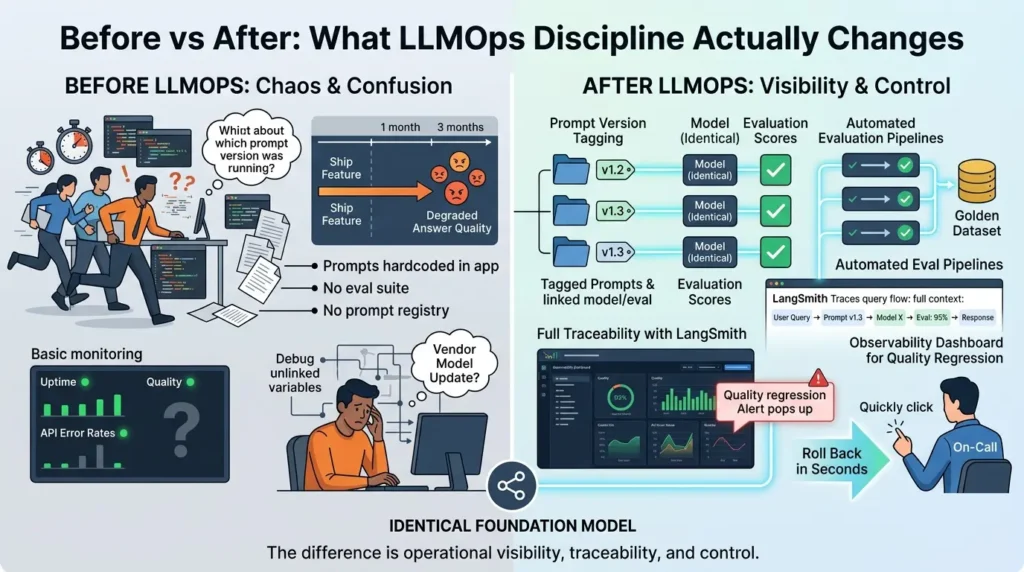
Before LLMOps discipline: A team ships an LLM feature in three weeks. Prompts are hardcoded in the application. There's no evaluation suite, no prompt registry. Monitoring tracks server uptime and API error rates. Three months later, users report degraded answer quality. Nobody can trace which prompt version was running when, or whether the upstream model was updated, because none of that was tracked.
After LLMOps discipline: Every prompt version is tagged and linked to its model and evaluation scores. Automated evaluation pipelines run continuously against a golden dataset. LangSmith traces every model call with full context. When a quality regression appears in the observability dashboard, the on-call engineer traces it to a specific prompt change or vendor model update within minutes, and rolls back within seconds.
The foundation model is identical in both scenarios. The difference is operational visibility, traceability, and control.
LLMOps Maturity Model: Where Is Your Team Right Now?
Actionable Operational Recommendations
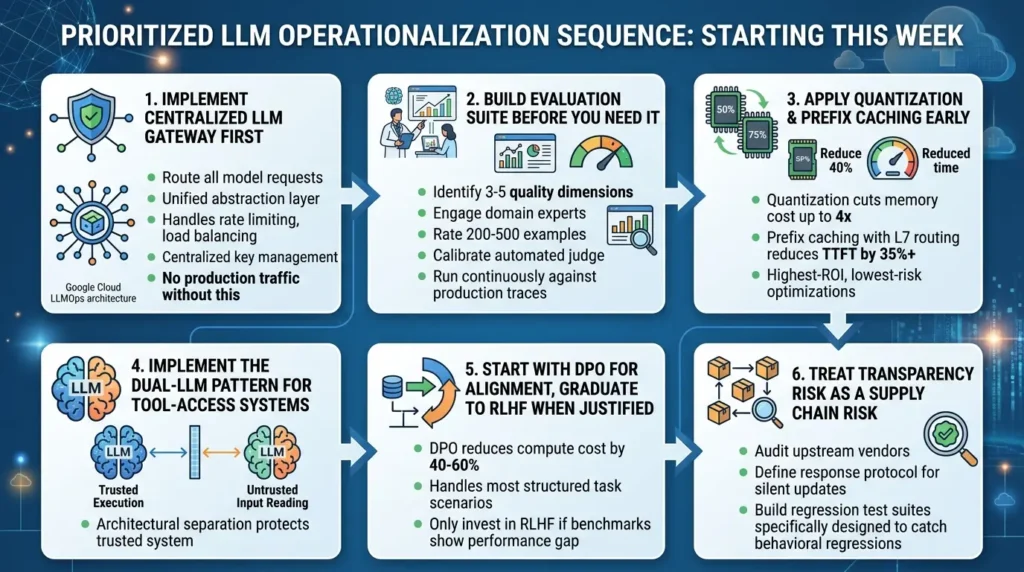
If you want to operationalize LLMs effectively starting this week, here's a prioritized sequence:
Implement a centralized LLM gateway first
Route all model requests through a unified abstraction layer before anything else. This handles rate limiting, load balancing, failover routing, and centralized key management. No production LLM system should handle real user traffic without this in place. The Google Cloud LLMOps architecture documentation provides solid reference blueprints worth reviewing during the design phase.
Build your evaluation suite before you need it
Identify 3–5 quality dimensions that matter for your specific use case. Engage domain experts to rate 200–500 representative examples. Calibrate an automated judge against those ratings until Cohen's Kappa exceeds 0.8. Then run it continuously against production traces.
Apply quantization and prefix caching early
Quantization cuts memory cost by up to 4x. Prefix caching with L7 routing can reduce TTFT by 35% or more for shared-context workloads. These are your highest-ROI, lowest-risk first optimizations.
Implement the Dual-LLM Pattern for any tool-access system
Any LLM with access to external tools, databases, APIs, file systems, needs architectural separation between trusted execution and untrusted input reading. The operational cost is modest. The downside of skipping it is not.
Start with DPO for alignment, graduate to RLHF when justified
DPO reduces alignment compute costs by 40–60% and handles most structured task scenarios well. Only invest in the full RLHF pipeline if your benchmarks show a performance gap that simpler methods can't close.
Treat transparency risk as a supply chain risk
Audit which upstream vendors your production system depends on. Define your response protocol for vendor-initiated silent model updates. Build regression test suites specifically designed to catch behavioral regressions from upstream changes.
Conclusion: Operational Excellence Is the Real Competitive Edge
Here's the honest conclusion from everything covered in this guide: the best model doesn't win. The best operations win.
The LLM market is moving from a phase of capability competition into a phase of operational differentiation. The global LLM market is projected to grow from $8.31 billion in 2025 to nearly $25 billion by 2031. But access to powerful foundation models is becoming increasingly commoditized. Every serious organization can call the same APIs.
The organizations that build reliable, safe, cost-efficient systems around those models, with robust evaluation, prompt governance, multi-layer guardrails, and continuous observability, are the ones that compound their advantage over the next three years. Those who treat production operations as an afterthought will spend that same time managing reliability crises, cost overruns, and the quiet erosion of user trust.
LLMOps is not a checklist you complete at launch. It's a discipline you build incrementally, starting with the highest-impact layers, evaluation, gateway, observability, and expanding systematically from there.
Start where you are. Build the evaluation suite. Version the prompts. Deploy the gateway. Tighten the loop. And treat every production failure as information about which layer of your stack needs strengthening next.
The teams that approach it that way are the ones defining what reliable AI looks like in production. That operational discipline, more than model selection or prompt cleverness, is what separates durable LLM products from expensive experiments.
The future of LLM applications isn’t just about access to powerful models; it’s about having the operational excellence to deploy them responsibly, sustainably, and at scale. Those who master LLMOps today will define the AI leaders of tomorrow.



[…] Read the Full Article → […]