
You’ve built something incredible. A language model that understands context, generates coherent text, analyzes sentiment. It’s powerful, but there’s a problem.
It doesn’t speak your language.
Not English or Spanish. Your business language. The jargon, the nuances, the edge cases that make your domain special. When asked about your industry’s specifics, it stumbles. Gives generic answers. Misses the mark.
This is where fine-tuning enters the picture.
Executive Summary: Key Takeaways
- Behavior vs. Facts: Fine-tuning teaches models how to speak (style, format, reasoning), not what to know. Use RAG for factual knowledge and real-time updates.
- Democratized Costs: Methods like LoRA and QLoRA have dropped training costs from $20k+ to as low as $50–$300 per run on consumer-grade GPUs.
- The RAG Hybrid Strategy: The most effective systems in 2026 combine fine-tuning (for expert reasoning) with RAG (for accessing external databases).
- Emerging 2026 Tech: DPO (Direct Preference Optimization) is rapidly replacing complex RLHF workflows for aligning models with human preferences.
- Common Pitfalls: Poor data cleaning and “Catastrophic Forgetting” are the top reasons projects fail. Data consistency matters more than volume.
What Is Fine-Tuning in Machine Learning?
Fine-tuning takes a pre-trained model and trains it further on specialized data. Think of it as continuing education for AI.
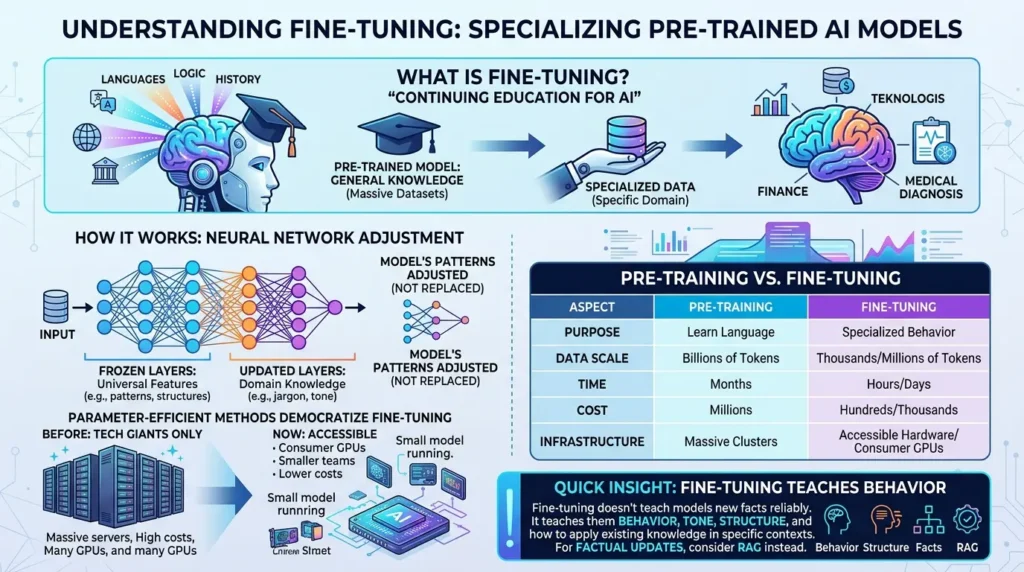
The model already knows general patterns from massive datasets. Now you’re teaching it your specific domain. Parameter-efficient methods have made fine-tuning accessible even for 70B+ parameter models on consumer GPUs, democratizing what was once reserved for tech giants.
Here’s what actually happens during fine-tuning. The model’s learned patterns get adjusted (not replaced) using your data. Early neural network layers often stay frozen because they capture universal features. Deeper layers get updated with domain knowledge. The model learns to predict what comes next in your context, not generic internet text.
Quick Insight
Fine-tuning doesn’t teach models new facts reliably. It teaches them behavior, tone, structure, and how to apply existing knowledge in specific contexts. For factual updates, consider RAG instead.
The difference between pre-training and fine-tuning? Scale and purpose.
Pre-training uses billions of text tokens to learn language itself. Takes months, costs millions, requires massive GPU clusters. Fine-tuning uses thousands to millions of tokens to learn specialized behavior. Takes hours to days, costs hundreds to thousands, runs on accessible hardware.
When Should You Fine-Tune a Model?
Not every problem needs fine-tuning. Many don’t.
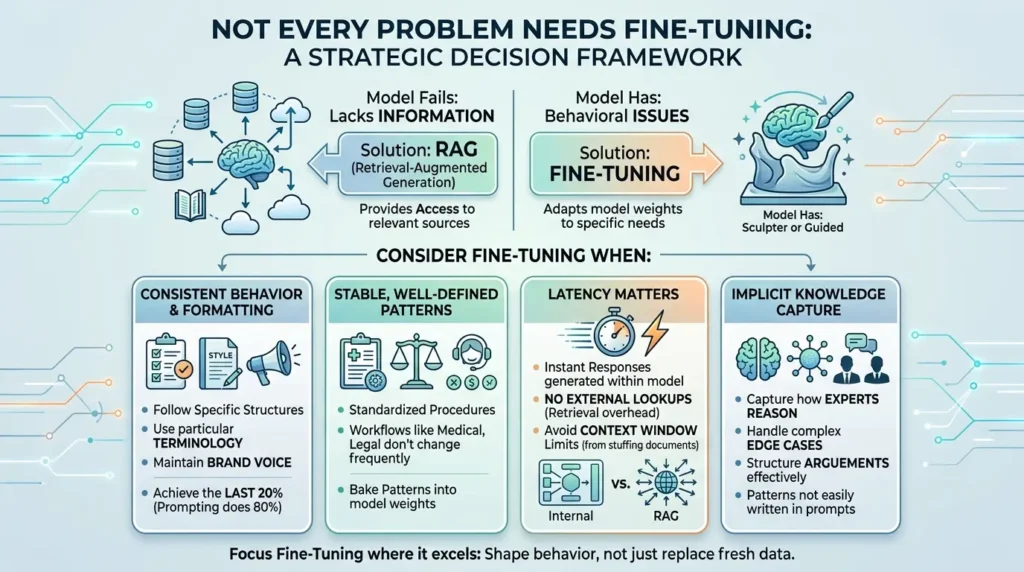
If the model fails because it lacks information, a RAG system that gives the model access to the relevant sources of information can help. On the other hand, if the model has behavioral issues, fine-tuning might help.
Consider fine-tuning when:
- Your task requires consistent behavior or formatting؛ You need every output to follow specific structures, use particular terminology, or maintain brand voice. Prompt engineering gets you 80% there. Fine-tuning gets you the last 20%.
- You have stable, well-defined patterns: Medical diagnosis workflows don’t change weekly. Legal document structures remain consistent. Customer service escalation procedures are standardized. These stable patterns benefit from being baked into model weights.
- Latency matters more than flexibility: With fine-tuned models, everything is handled within the pre-trained model, meaning responses are generated instantly without external lookups. No retrieval overhead. No context window limitations from stuffing documents into prompts.
- Your data contains implicit knowledge: Sometimes the value isn’t in explicit facts but in how experts reason, handle edge cases, or structure arguments. Fine-tuning captures these implicit patterns that are hard to articulate in prompts.
When Fine-Tuning Is a Bad Idea
Here’s what most guides won’t tell you. Fine-tuning often makes things worse.
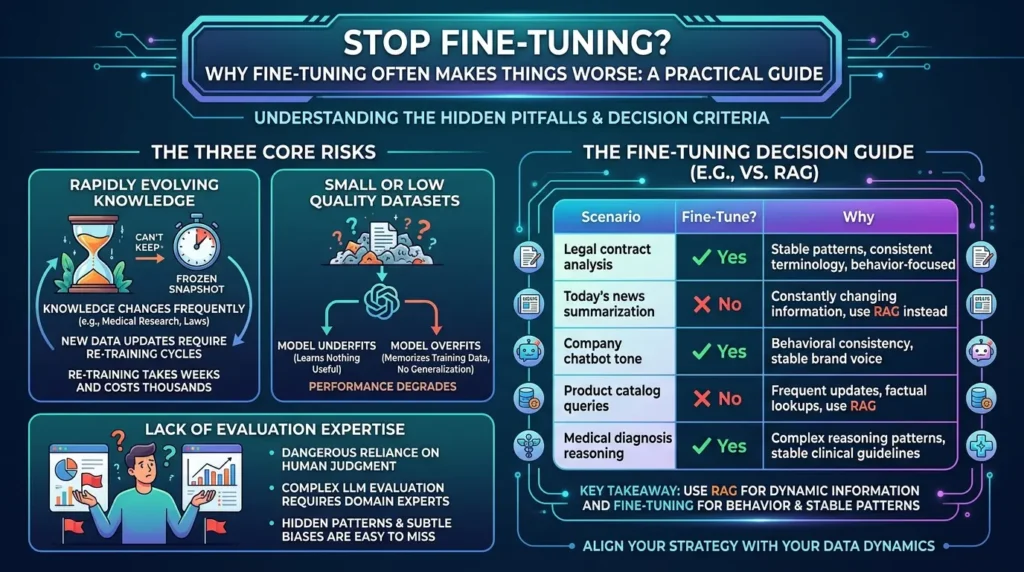
Does your knowledge change frequently? Don’t fine-tune. Maintaining a fine-tuned model proves challenging when domain knowledge evolves. If new medical research emerges or laws change, you must update the training data and re-train the model to keep it current. That retraining cycle can take weeks and cost thousands.
You’re working with rapidly evolving information? Stock prices, news, policy updates? Fine-tuning creates frozen snapshots. By the time your model finishes training, the information is outdated.
Is your dataset small or low quality? Unclean data generates noise during fine-tuning, which can significantly reduce the model’s performance. With limited examples, the model either underfits (learns nothing useful) or overfits (memorizes training data without generalizing).
You lack expertise to evaluate results? This is dangerous. The reliance on human judgment to interpret these visualizations and data points underscores the complexity of evaluating LLMs. You need domain experts to catch when the model learns the wrong patterns or develops subtle biases.
Fine-Tuning vs RAG vs Prompt Engineering
Three paths diverge in the AI woods. Which do you take?
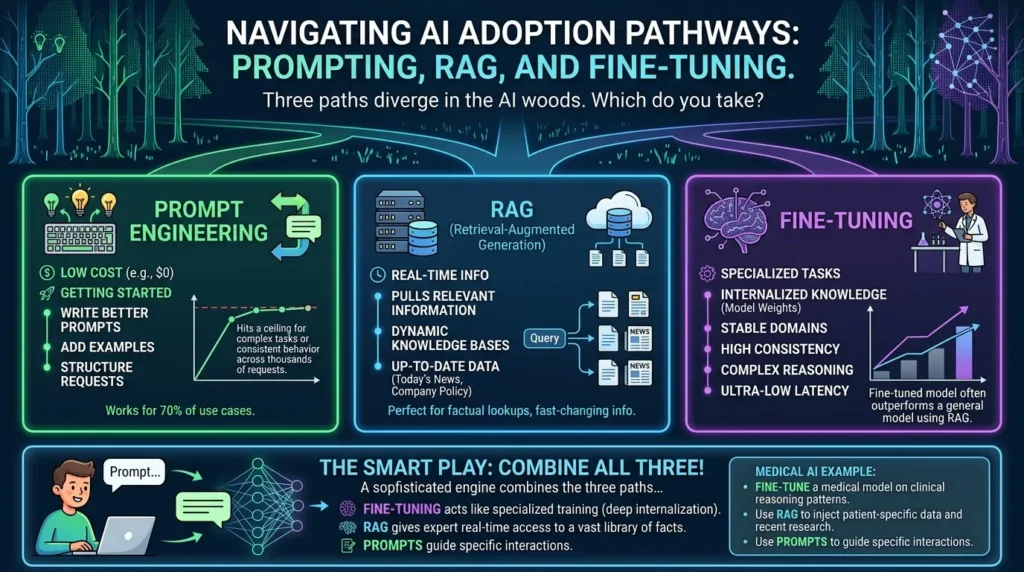
Prompt engineering costs nothing. Write better prompts, add examples, structure your requests clearly. Works for 70% of use cases. Hits a ceiling when tasks get complex or require consistent behavior across thousands of requests.
RAG (Retrieval-Augmented Generation) pulls relevant information from databases in real time. RAG excels at providing up-to-date information seamlessly. If there’s new data like today’s news or a new company policy, a RAG-based solution can immediately use it to answer questions by retrieving it. Perfect for factual lookups, dynamic knowledge bases, or when information changes faster than you can retrain models.
Fine-tuning bakes knowledge into model weights. For highly specialized tasks, a fine-tuned model often outperforms a general model using RAG because it has deeply internalized the domain’s patterns. Best for stable domains requiring consistent behavior, complex reasoning, or ultra-low latency.
The smart play? Combine them. Fine-tuning acts like specialized training, teaching the model to think and talk like a professional in your field, while RAG gives that expert real-time access to a vast library of facts.
Example: Fine-tune a medical model on clinical reasoning patterns. Use RAG to inject patient-specific data and recent research. Use prompts to guide specific interactions.
The AI Implementation Decision Tree
Choosing between Prompt Engineering, RAG, and Fine-Tuning can be confusing. Instead of guessing, follow a simple decision process.
Question 1: Does your application need access to changing facts, company documents, or real-time information?
Decision: If the answer is yes, use RAG (Retrieval-Augmented Generation). The model can retrieve up-to-date information without retraining.
Question 2: If real-time knowledge is not required, can better prompts and a few high-quality examples produce reliable results?
Decision: If yes, use Prompt Engineering. It is the fastest, cheapest, and easiest approach to maintain.
Question 3: Do you need a consistent writing style, structured outputs, specialized terminology, or domain-specific behavior?
Decision: If yes, use Fine-Tuning. This allows the model to learn patterns, tone, and behavior that prompts alone cannot reliably enforce.
Recommendation: In many production systems, the best solution is combining Fine-Tuning for behavior and formatting with RAG for up-to-date knowledge.
Key Takeaway: Use RAG for knowledge, Prompt Engineering for simple optimization, and Fine-Tuning for consistent behavior and expertise.
Understanding Parameter-Efficient Fine-Tuning
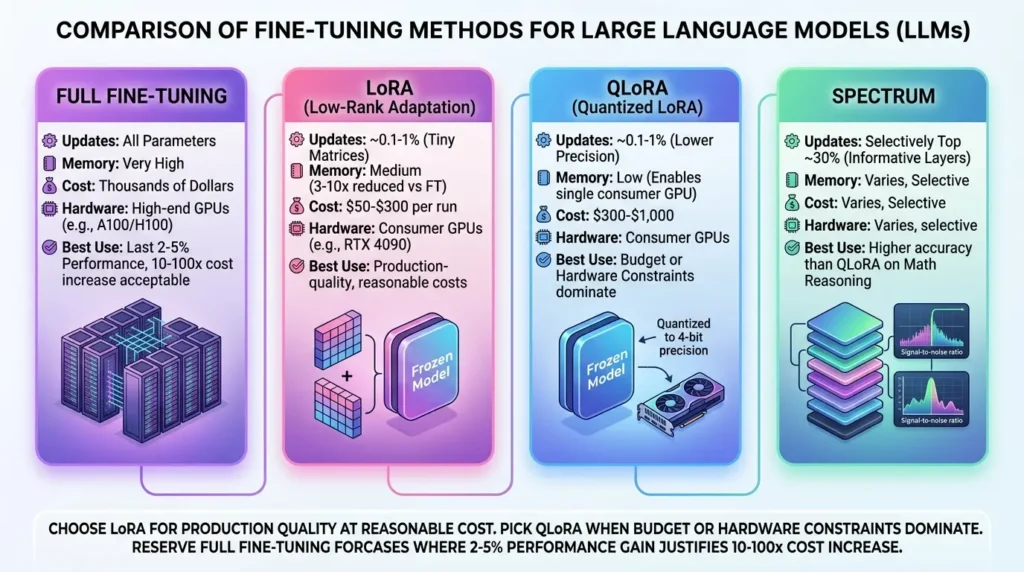
Full fine-tuning updates billions of parameters. Costs thousands of dollars. Requires high-end GPUs.
Most teams can’t afford that. Don’t need it either.
Parameter-efficient fine-tuning (PEFT) like LoRA (Low-Rank Adaptation) allows users to fine-tune 70B+ parameter models on consumer GPUs by adjusting only a small subset of parameters.
LoRA (Low-Rank Adaptation) adds small trainable matrices alongside frozen model weights. Updates these tiny matrices instead of all parameters. Based on 127 production deployments, LoRA fine-tuning costs $50-$300 per training run. Reduces memory requirements by 3-10x compared to full fine-tuning.
QLoRA takes LoRA further by quantizing the base model to 4-bit precision. QLoRA takes things further by quantizing the model and making it compatible with consumer-grade GPUs. You can fine-tune for as little as $300 to $1,000. Enables fine-tuning large models on single consumer GPUs.
Spectrum identifies the most informative layers using signal-to-noise ratio analysis and selectively fine-tunes only the top ~30%, reporting higher accuracy than QLoRA on mathematical reasoning.
Pick LoRA when you need production-quality results with reasonable costs. Choose QLoRA when budget or hardware constraints dominate. Reserve full fine-tuning for cases where that last 2-5% performance gain justifies the 10-100x cost increase.
Top Tools for Fine-Tuning in 2026
You don’t need to build training infrastructure from scratch. The open-source ecosystem has matured rapidly, offering tools that handle most of the heavy lifting.
Here are the leading fine-tuning frameworks in 2026:
Recommendation: If you’re just getting started, use LLaMA-Factory or Hugging Face AutoTrain to learn the workflow with minimal complexity.
For Production: When optimizing for performance, cost, and GPU utilization, Unsloth and Axolotl provide the most flexibility and efficiency.
Key Takeaway: Start with simplicity, then move toward more advanced frameworks as your projects and infrastructure requirements grow.
The Real Cost of Fine-Tuning
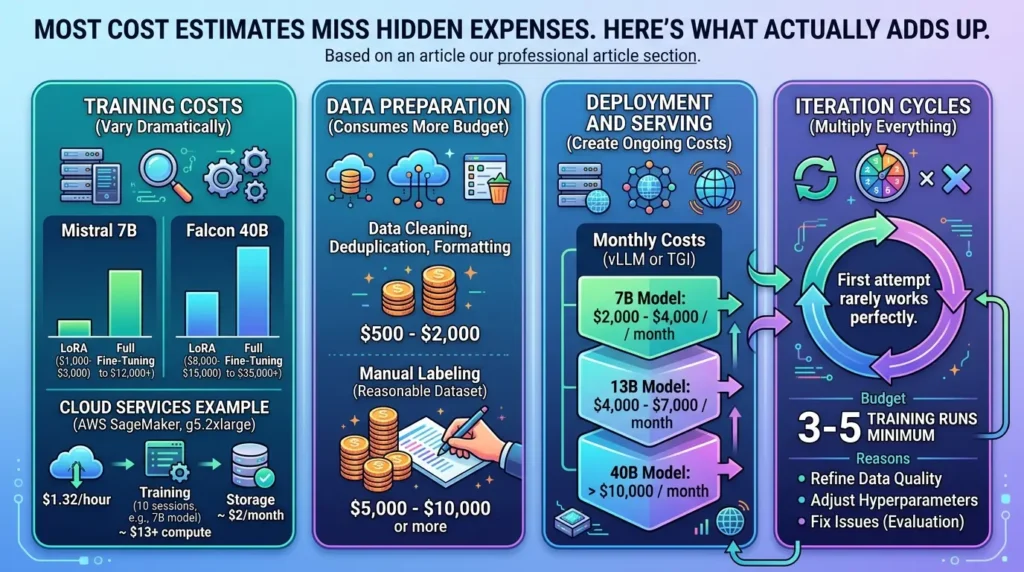
Most cost estimates miss hidden expenses. Here’s what actually adds up.
Training costs
Vary dramatically. Mistral 7B models typically cost between $1,000 and $3,000 using LoRA, or up to $12,000 with full fine-tuning. Falcon 40B is a heavyweight, potentially reaching $8,000 to $15,000 with LoRA and easily $20,000 to $35,000+ with full fine-tuning.
Using cloud services? AWS SageMaker with g5.2xlarge instances costs $1.32/hour. Training a 7B model over 10 sessions could cost $13+ in compute alone, with storage adding another $2/month.
Data preparation
Consumes more budget than expected. Cleaning, deduplication, and formatting could run you anywhere from $500 to $2,000, depending on scale. If your data needs manual labeling, expect to budget $5,000 to $10,000 or more for a reasonably sized dataset.
Deployment and serving
Create ongoing costs. A 7B model served with vLLM or TGI might cost $2,000 to $4,000 per month. A 13B model might cost $4,000 to $7,000 monthly. A 40B model will almost certainly run over $10,000 each month.
Iteration cycles
Multiply everything. First attempt rarely works perfectly. The budget for 3-5 training runs minimum as you refine data quality, adjust hyperparameters, and fix issues discovered during evaluation.
How Fine-Tuning Actually Works
Let’s pull back the curtain on the mechanics.
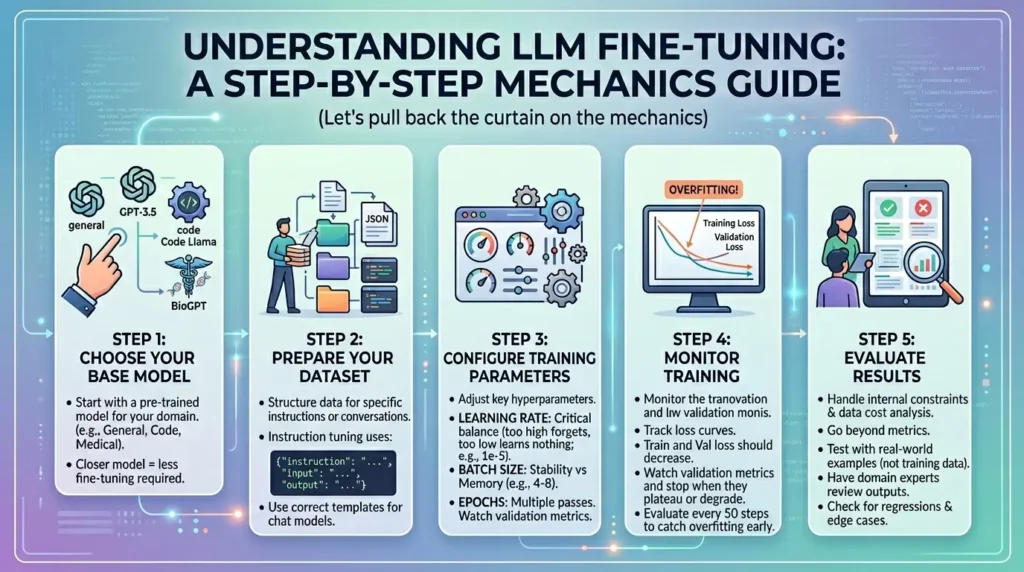
Step 1: Choose your base model
Start with a pre-trained model that already knows your domain somewhat Llama 3 (8B/70B) for general tasks. DeepSeek-Coder for programming. Meditron or BioMistral for medical applications. The open-source ecosystem in 2025/2026 offers specialized base models that drastically reduce the fine-tuning effort required. The closer the base model to your needs, the less fine-tuning required.
Step 2: Prepare your dataset
The dataset you use for fine-tuning large language models has to serve the purpose of your instruction. Format matters enormously. Each example should demonstrate the exact input-output behavior you want.
Fine-Tuning Dataset Structure
For instruction tuning, your dataset must clearly demonstrate the behavior you want the model to learn. Every example should follow a consistent structure so the model can reliably identify instructions, inputs, and outputs.
Industry Standard: Most fine-tuning pipelines use the JSONL format where each line represents one training sample.
{
  "instruction": "Classify the sentiment of this customer review.",
  "input": "The battery life is terrible, but the screen is amazing.",
  "output": "Mixed / Neutral"
}
What This Example Shows: Clear instruction + input + expected output structure for supervised learning.
Pro Tip: Consistency matters more than format choice. Whether you use JSONL, chat format, or separators like ###, keep it identical across all examples.
Common Mistake: Mixing formats inside the same dataset breaks learning patterns and reduces fine-tuning performance.
Key Takeaway: Model performance depends more on consistent structure than on dataset size.
For conversational models, use chat templates specific to your base model. Raw conversational data isn’t something you can just throw at a model. It needs structure, and more importantly, it needs the right structure for your chosen model. This was one of my first mistakes.
The Synthetic Data Shortcut (When You Lack Examples)
What if you don’t have thousands of high-quality training examples? In 2026, one of the most effective approaches is Synthetic Data Generation.
Instead of manually creating every example, teams use powerful frontier models such as GPT-4o or Claude to generate training data for smaller, more cost-efficient models.
The Idea: Let a highly capable model demonstrate the behavior you want, then use those generated examples to teach a smaller model through fine-tuning.
🔄 The Synthetic Data Pipeline
- Define the Pattern: Create a master prompt that clearly specifies the desired tone, format, reasoning style, and output structure.
- Generate at Scale: Use an API to produce thousands of input/output examples that follow the defined pattern.
- Filter & Clean: Remove repetitive, low-quality, or incorrect outputs through automated validation and quality checks.
- Fine-Tune the Small Model: Train a lightweight model such as Llama 3 8B using the cleaned synthetic dataset.
Why It Works: Synthetic data allows teams to create large, specialized datasets in days instead of weeks or months, dramatically reducing data collection costs.
Pro Tip: Always manually review a random sample of at least 10% of the generated data before training. Small quality issues can quickly scale into large performance problems.
Important Warning: The model generating the synthetic data will pass along its own biases, mistakes, and blind spots. If left unchecked, your fine-tuned model may amplify those issues.
Key Takeaway: Synthetic data is one of the fastest ways to build training datasets, but its success depends on rigorous filtering, validation, and quality control.
Step 3: Configure training parameters
Learning rate is critical. Too high and the model forgets pre-trained knowledge. Too low and it learns nothing. There are good rules of thumb for this value in LoRA / LLM fine-tuning: 1e-5 works well as a starting point.
Batch size affects stability and speed. Larger batches give smoother gradients but require more memory. Start with 4-8 if memory allows.
Epochs determine how many passes through your data. More isn’t always better. There’s probably a rule of thumb to be learned here regarding the number of epochs, the size of the model, and the size of your fine-tuning set. Watch validation metrics and stop when they plateau or degrade.
Step 4: Monitor training
Track loss curves. Training loss should decrease smoothly. Validation loss should decrease too, then flatten. If validation loss increases while training loss decreases, you’re overfitting.
Evaluation every 50 steps is frequent enough to catch overfitting early (40 checks across training), but not so frequent that it slows training.
Step 5: Evaluate results
Don’t trust metrics alone. Test with real examples that weren’t in training data. Have domain experts review outputs. Check for regressions in general knowledge. Probe edge cases.
How to Actually Evaluate Your Fine-Tuned LLM
Simply saying “test with real examples” is not enough. Modern LLM evaluation requires multiple layers of validation because no single metric can accurately measure quality, reasoning, safety, and real-world performance.
The Modern Evaluation Stack:
Why Multiple Layers Matter: A model can achieve excellent automated scores while still producing poor responses in real-world situations. Each evaluation layer catches different types of failures.
Critical Recommendation: Never skip Layer 2 (LLM-as-a-Judge). It has become the industry standard because it balances speed, cost, and evaluation quality better than traditional metrics alone.
Common Mistake: Relying exclusively on ROUGE, BLEU, or perplexity scores. These metrics are useful for monitoring trends but should never be treated as the final measure of model quality.
Key Takeaway: The most reliable evaluation strategy combines automated metrics, AI-based judging, human expert review, and dedicated safety testing to provide a complete picture of model performance.
Common Fine-Tuning Mistakes (and How to Avoid Them)
These errors destroy more fine-tuning projects than any technical issue.
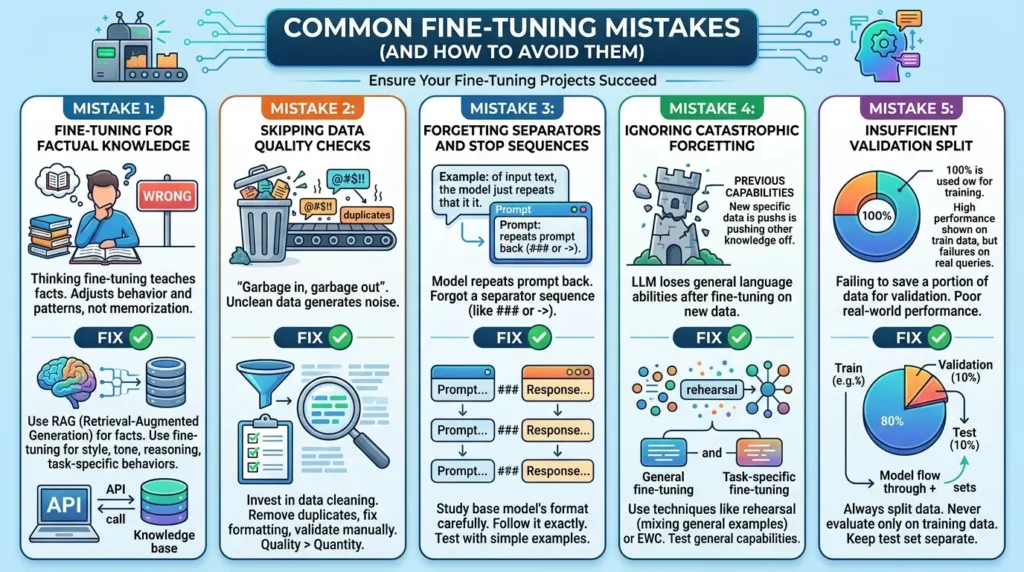
Mistake 1: Thinking fine-tuning teaches facts
Many people assume that means they can write some questions with answers about their topic and the AI model will remember those specific facts the next time it’s asked. That’s not exactly how it works. Fine-tuning adjusts behavior and reasoning patterns, not memorization.
Fix: Use RAG for factual information. Use fine-tuning for style, tone, reasoning patterns, and task-specific behaviors.
Mistake 2: Skipping data quality checks
Garbage in, garbage out has never been more true. Common issues include removing unnecessary punctuation, stopwords, and irrelevant tokens. Unclean data generates noise during fine-tuning.
Fix: Invest heavily in data cleaning. Remove duplicates, fix formatting inconsistencies, validate examples manually. Quality beats quantity.
Mistake 3: Forgetting separators and stop sequences
Is your fine-tuned model repeating your prompt back to you? You probably forgot to include a separator in your training data. A separator is a sequence of characters like ### or -> that you need to append to the end of every prompt.
Fix: Study your base model’s expected format carefully. Follow it exactly. Test with simple examples first.
Mistake 4: Ignoring catastrophic forgetting
Catastrophic forgetting arises when an LLM being fine-tuned loses part of its previously learned language capabilities upon being exposed to new data. Your model might nail your specific task but become terrible at everything else.
Fix: Use techniques like rehearsal (mixing in general examples during training) or Elastic Weight Consolidation. Test general capabilities regularly during training.
Mistake 5: Insufficient validation split
A common mistake is failing to save a portion of your dataset for validation and testing. Training a model without validating it on previously unseen data produces models that perform poorly in real-world applications.
Fix: Always split data into train, validation, and test sets. Never evaluate only on training data. Keep test set completely separate until final evaluation.
Real Example: When My Fine-Tune Failed
I fine-tuned GPT-3.5 on 2,000 customer support conversations. Training metrics looked great. Loss dropped smoothly. Then I deployed it.
Disaster: The model would start answering correctly, then suddenly switch to generic responses mid-conversation. Sometimes it would output the same canned answer regardless of context.
The problem: My training data had inconsistent formatting. Some examples used first person (“I can help you with…”), others used third person (“The system can provide…”). The model learned both patterns and randomly switched between them.
The fix: It took two weeks. I standardized all data to one voice, re-annotated 30% of examples for consistency, and added validation checks to catch similar issues.
Result: The second training run worked perfectly.
Lesson: Data consistency matters more than data volume.
Safety and Bias Concerns
Fine-tuning creates serious risks that most teams overlook until it’s too late.
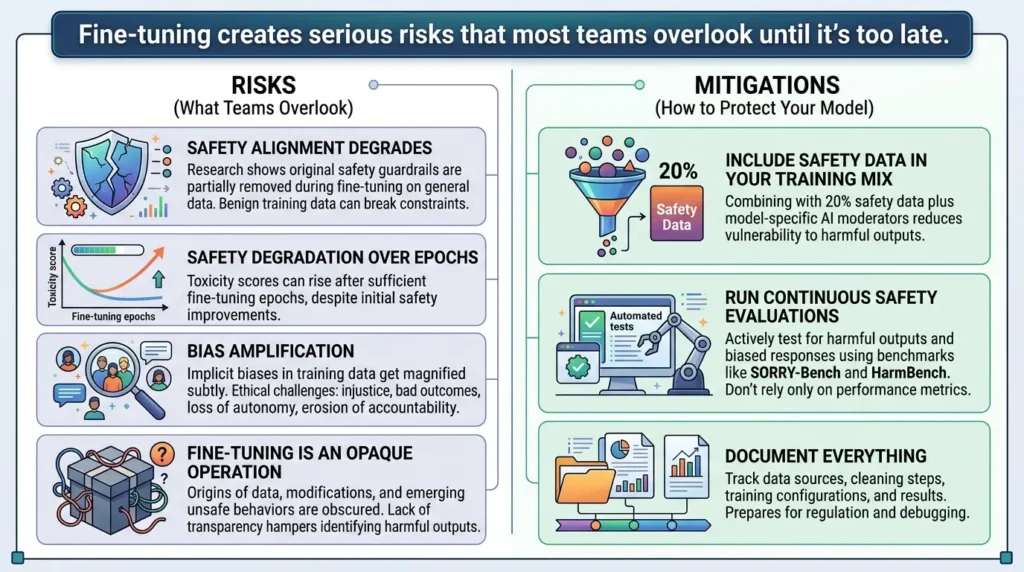
Safety alignment degrades during fine-tuning. Research shows that fine-tuning LLMs on innocuous, general-purpose datasets partially removes safety guardrails put in place via safety alignment training of the original model. Even benign training data can break safety constraints.
Fine-tuning can lead to safety degradation, with toxicity scores increasing after sufficient fine-tuning epochs, even with self-generated data that initially improves safety.
Bias amplification happens subtly. Biases in AI systems pose a series of basic ethical challenges including injustice, bad output/outcome, loss of autonomy, transformation of basic concepts and values, and erosion of accountability. Your training data might contain implicit biases that get magnified during fine-tuning.
Fine-tuning can become an opaque operation, obscuring the origins of the model’s training data, the modifications applied, and the potential emergence of unsafe or unethical behaviors. This lack of transparency hampers the identification of biases and harmful outputs.
How to mitigate these risks:
- Include safety data in your training mix. Comparing attack success rates shows that fine-tuning with 20% safety data plus model-specific AI moderators significantly reduces vulnerability to harmful outputs.
- Run continuous safety evaluations. Don’t just check performance metrics. Actively test for harmful outputs, biased responses, and safety degradation using benchmarks like SORRY-Bench or HarmBench.
- Document everything. Track data sources, cleaning steps, training configurations, and evaluation results. Regulators could require developers to submit detailed documentation specifying the data sources, model architecture modifications, and evaluation metrics employed during the fine-tuning process. Being prepared helps both compliance and debugging.
Advanced Topics: RLHF and DPO
Sometimes supervised fine-tuning isn’t enough. You need the model to learn from preferences and feedback.
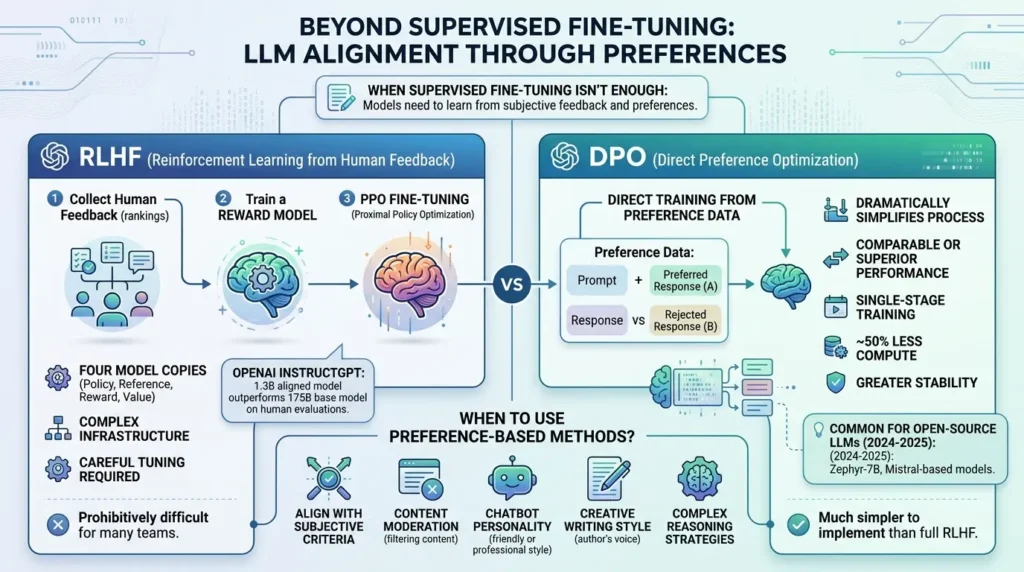
RLHF (Reinforcement Learning from Human Feedback) trains models using human preferences. OpenAI’s InstructGPT demonstrated that a 1.3B aligned model could outperform a 175B base model on human evaluations, showing the power of preference-based training.
RLHF requires four model copies (policy, reference, reward, value), complex training infrastructure, and careful tuning. Most teams find it prohibitively difficult.
DPO (Direct Preference Optimization) simplifies the process dramatically. Research from Stanford and others reports that DPO can achieve comparable or superior performance to PPO-based RLHF with single-stage training, approximately 50% less compute, and greater stability.
DPO only needs preference data (prompt plus two responses, one preferred over the other). Much simpler to implement than full RLHF. The method has become common for training open-source LLMs in 2024-2025, including Zephyr-7B and various Mistral-based models.
When to use preference-based methods? When you need to align model behavior with subjective criteria that are hard to express as supervision. Content moderation, chatbot personality, creative writing style, complex reasoning strategies—all benefit from learning from preferences rather than explicit labels.
Emerging Trends in 2026
The fine-tuning landscape is evolving rapidly. Here’s what’s changing the game.
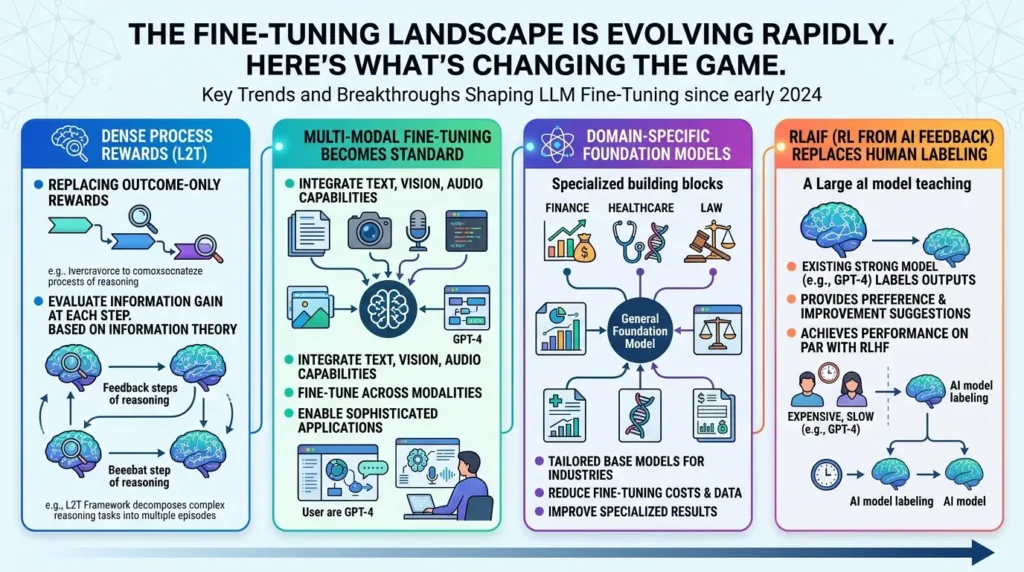
Since the beginning of 2024, the field of fine-tuning for Large Language Models has undergone a profound and systematic evolution, propelled by breakthroughs in Reinforcement Learning algorithms and the maturation of ultra-large-scale model architectures.
Dense process rewards are replacing outcome-only rewards. The L2T (Learning to Think) framework introduced a dense process reward mechanism based on information theory, decomposing complex reasoning tasks into multiple episodes and evaluating the information gain produced by the model in each step.
Multi-modal fine-tuning is becoming standard. In 2023-2024, multi-modal fine-tuning has grown in importance as models like GPT-4 and others integrate vision, text, and audio capabilities. Fine-tuning now spans across modalities, enabling sophisticated applications that process images, text, and audio jointly.
Domain-specific foundation models are emerging. Foundation models tailored to specific industries (finance, healthcare, law) are being released, which can be fine-tuned with far less data for those domains. These specialized base models reduce fine-tuning costs and improve results.
RLAIF (RL from AI Feedback) replaces expensive human labeling. In RLAIF, an existing strong model (like GPT-4) plays the role of the human labeler, labeling a dataset of model outputs with preference or improvement suggestions. Recent research found that RLAIF can achieve performance on par with RLHF.
Real-World Case Studies
Theory means nothing without results. Here are concrete examples.
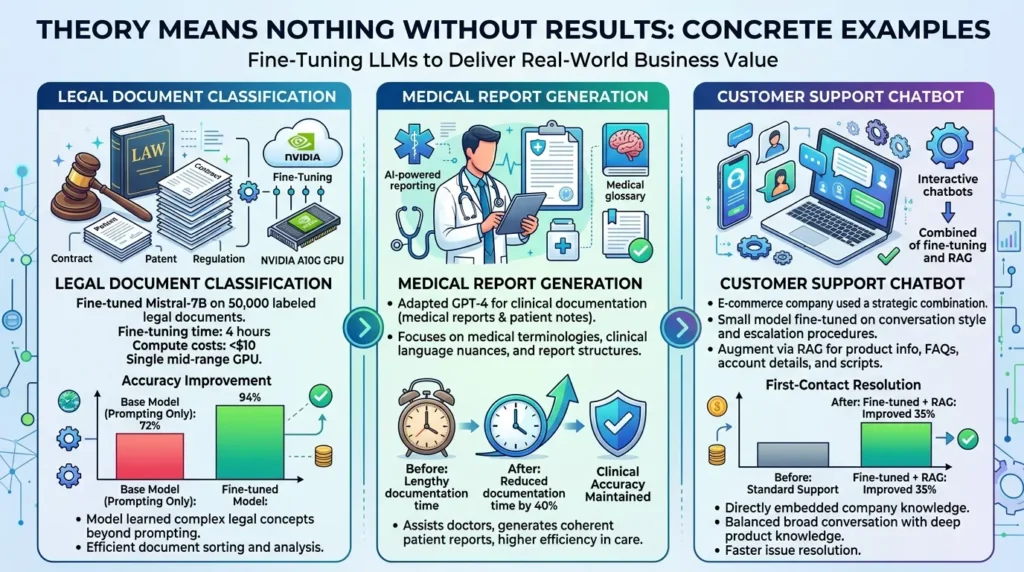
Legal Document Classification
A law firm fine-tuned Mistral-7B on 50,000 labeled legal documents. Fine-tuning the model took only four hours and cost less than $10 in compute costs using a single mid-range GPU – NVIDIA A10G – on a cloud service.
Accuracy improved from 72% (base model) to 94% (fine-tuned). The model learned to recognize complex legal concepts that couldn’t be captured through prompt engineering alone.
Medical Report Generation
A healthcare provider adapted GPT-4 for clinical documentation. Through fine-tuning on medical reports and patient notes, the model becomes more familiar with medical terminologies, the nuances of clinical language, and typical report structures, becoming primed to assist doctors in generating accurate and coherent patient reports.
Reduced documentation time by 40% while maintaining clinical accuracy.
Customer Support Chatbot
An e-commerce company combined approaches strategically. Fine-tuned a small model on conversation style and escalation procedures. Used RAG for product information and policies.
Fine-tune a small chatbot model on internal datasets to directly embed company knowledge. Augment via RAG by retrieving appropriate FAQs, account details, and scripts when needed. This balances broad conversational ability with deep company-specific knowledge. First-contact resolution improved 35%.
Practical Implementation Guide
Ready to start? Follow this roadmap.
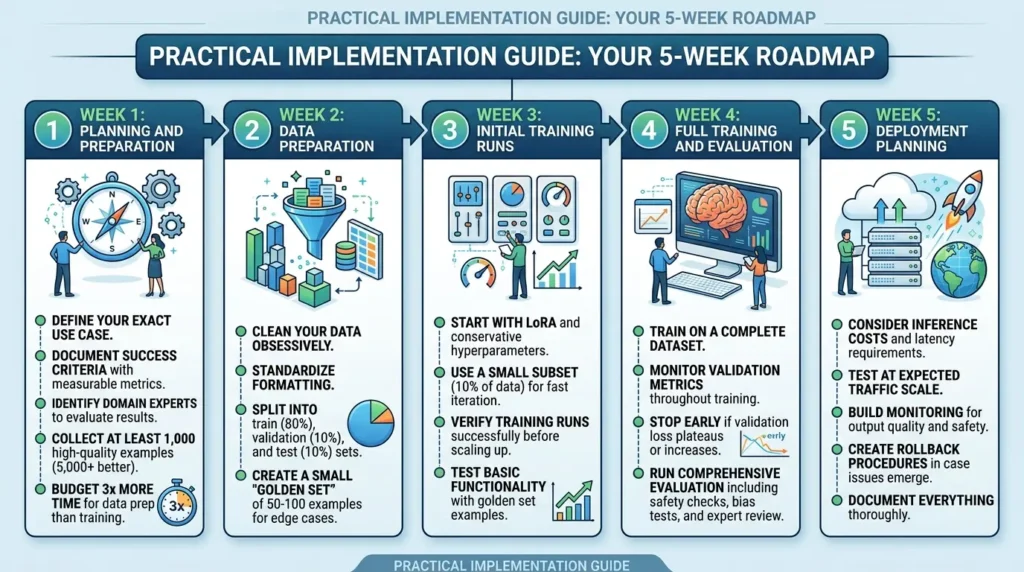
Week 1: Planning and preparation
Define your exact use case. Document success criteria with measurable metrics. Identify domain experts who can evaluate results. Collect at least 1,000 high-quality examples (5,000+ is better). Budget 3x more time for data prep than training.
Week 2: Data preparation
Clean your data obsessively. Standardize formatting. Split into train (80%), validation (10%), and test (10%) sets. Create a small “golden set” of 50-100 examples representing edge cases and critical scenarios.
Week 3: Initial training runs
Start with LoRA and conservative hyperparameters. Use a small subset (10% of data) for fast iteration. Verify training runs successfully before scaling up. Test basic functionality with golden set examples.
Week 4: Full training and evaluation
Train on a complete dataset. Monitor validation metrics throughout training. Stop early if validation loss plateaus or increases. Run comprehensive evaluation including safety checks, bias tests, and domain expert review.
Week 5: Deployment planning & Inference Optimization
A fine-tuned model is useless if it’s too slow or expensive to run in production. Before deploying, apply these inference optimization techniques to reduce costs by up to 75%:
- Quantization (AWQ / GPTQ): Compress your fine-tuned model from 16-bit to 4-bit precision for deployment. You lose less than 1% accuracy but cut memory usage and costs by 3-4x.
- vLLM or TGI: Never use standard HuggingFace pipelines for production. Use vLLM or HuggingFace TGI (Text Generation Inference) which use PagedAttention to serve 2-4x more users on the same hardware.
- LLM Caching: If users ask similar questions, cache the model’s responses at the API level to avoid paying for redundant compute.
By combining LoRA (for cheap training) + AWQ (for cheap deployment) + vLLM (for fast serving), you can run enterprise-grade AI at startup prices.
Conclusion
Fine-tuning isn’t magic. It’s a specialized tool for specific problems.
When you have stable domains, need consistent behavior, and possess quality training data—fine-tuning delivers incredible results. It transforms generic models into specialized experts. Reduces latency. Enables applications that would be impossible otherwise.
But it’s not always the answer. Changing information? RAG works better. Simple tasks? Prompt engineering suffices. Limited data or expertise? You’ll waste time and money.
The real skill isn’t in running the training loop. It’s in knowing when fine-tuning serves your needs and when alternatives work better. It’s in preparing data that teaches the right lessons. It’s in evaluating results honestly and catching problems early.
Most importantly, it’s in treating fine-tuning as part of a larger system—not an isolated optimization trick, but a strategic choice that affects costs, maintenance, safety, and user experience.
Master that perspective, and you’ll build AI systems that actually work.
Frequently Asked Questions ( FAQS )
How much data do I need for fine-tuning?
Minimum 100-500 examples for simple tasks like classification. 1,000-5,000 examples for complex generation tasks. More importantly, quality matters more than quantity, clean, diverse, representative data with 500 examples beats noisy data with 5,000 examples.
Is fine-tuning better than prompt engineering?
They solve different problems. Prompt engineering adjusts behavior per request with no setup cost but hits quality ceilings. Fine-tuning bakes consistent behavior into model weights with upfront costs but delivers superior performance. Use prompts first, fine-tune when prompts can’t meet requirements.
Can fine-tuning reduce hallucinations?
Partially. Fine-tuning can teach models to say “I don’t know” and refuse uncertain answers, reducing hallucinations. But it doesn’t reliably add factual knowledge, use RAG for that. Best approach combines fine-tuning for honest behavior with RAG for accurate information.
How long does fine-tuning take?
Depends on model size and hardware. Small models (7B parameters) with LoRA take 2-8 hours on consumer GPUs. Medium models (13B-30B) take 8-24 hours. Large models (70B+) require days. Using multiple GPUs or optimized services dramatically reduces time.
Will fine-tuning make my model worse at other tasks?
Yes, catastrophic forgetting is real. The model can lose general capabilities if fine-tuned too aggressively. Mitigate by using lower learning rates, mixing general examples into training data, and testing general capabilities regularly during training.
What’s the difference between fine-tuning and transfer learning?
Transfer learning is the broad concept of reusing learned knowledge. Fine-tuning is one specific transfer learning method that continues training a pre-trained model. Other transfer learning methods include feature extraction (freezing the model completely) and adapter modules.
Can I fine-tune with small datasets?
Yes, but carefully. Parameter-efficient methods like LoRA work with small datasets. Start with strong base models already close to your domain. Use data augmentation if appropriate. Watch for overfitting aggressively. Consider few-shot prompting as an alternative.
How do I measure fine-tuning success?
Track multiple metrics. Quantitative measures like accuracy, F1-score, or perplexity. Qualitative evaluation by domain experts reviewing real examples. A/B testing against base model or current system. User satisfaction metrics in production. Never rely on training loss alone.


[…] Read the Full Article → […]