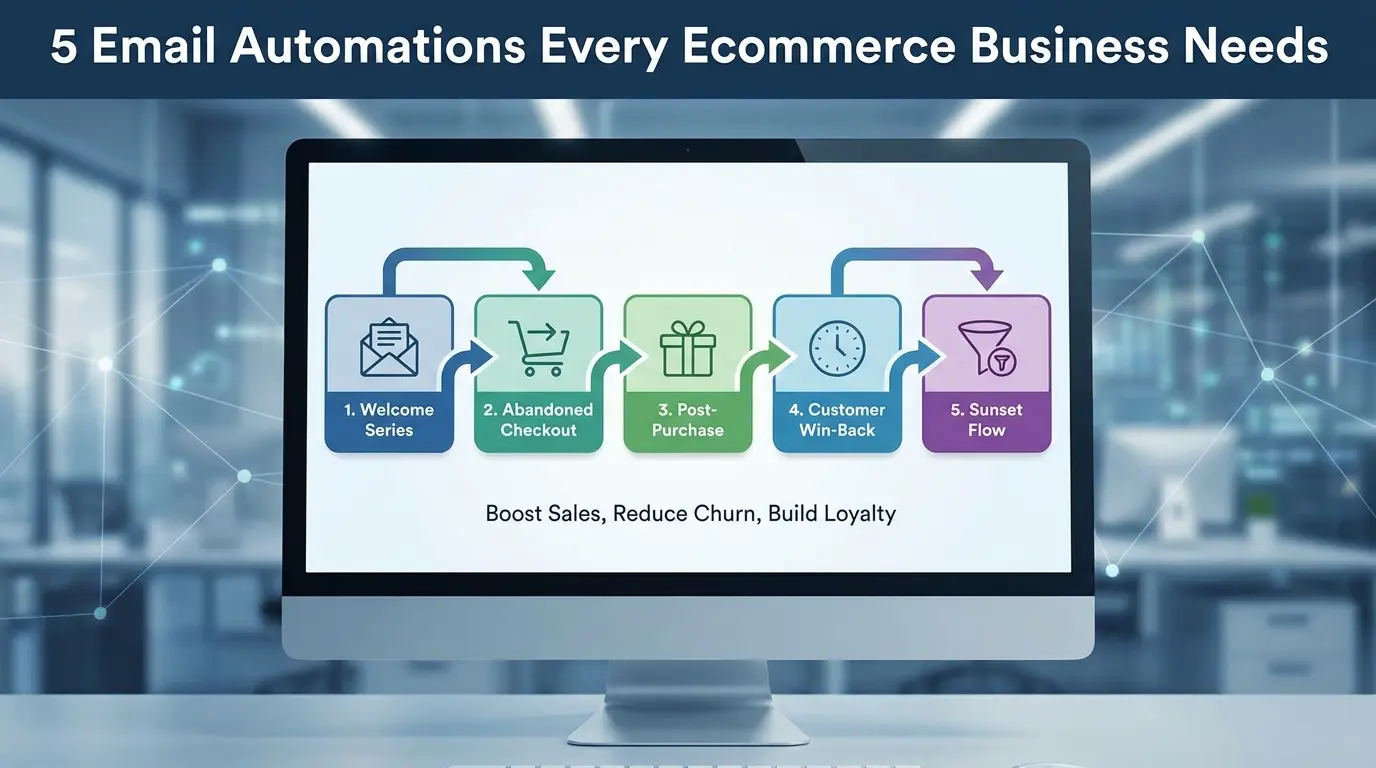

There are five email automations that every ecommerce business needs. Without these, you simply don’t have your foundation in place. People will unsubscribe. You’ll struggle to convert. Your open rates and click rates will sit well below average, and the customers you worked so hard to attract will slip away without even a gentle nudge to come back.
Sounds harsh? It’s just the reality of email marketing in 2026.
Here’s the thing though. Email is still the highest-ROI channel available to you. Email marketing generates between $36 and $40 for every dollar spent. According to Omnisend’s 2026 eCommerce Marketing Report, automated emails generated 30% of all email-attributed revenue in 2025, despite accounting for just 2% of email volume. That gap between effort and reward is extraordinary. It means a tiny slice of your emails is doing the heavy lifting, and those are your automations.
So if you’re only running one or two flows, or worse, none at all, this guide is going to change how you look at your entire email strategy.
✨ Key Takeaways
- Automations do the heavy lifting: Triggered emails generate a massive percentage of your email revenue while representing only a small fraction of total sends.
- The five core flows matter most: Welcome Series, Abandoned Checkout, Post-Purchase, Customer Win-Back, and Sunset Flow cover the entire customer lifecycle.
- Avoid discount dependency: Don’t default to discounts in abandoned cart emails. Start with helpful, human-first messaging before incentives.
- Segment post-purchase journeys: Treat first-time buyers differently from repeat customers to maximize loyalty and lifetime value.
- List hygiene protects deliverability: Sunset flows help remove unengaged users and keep your sender reputation healthy.
First, Understand the Customer Journey
Before jumping into the five automations, you need to understand the path your customer actually walks through your business. It’s not a straight line. It never is.
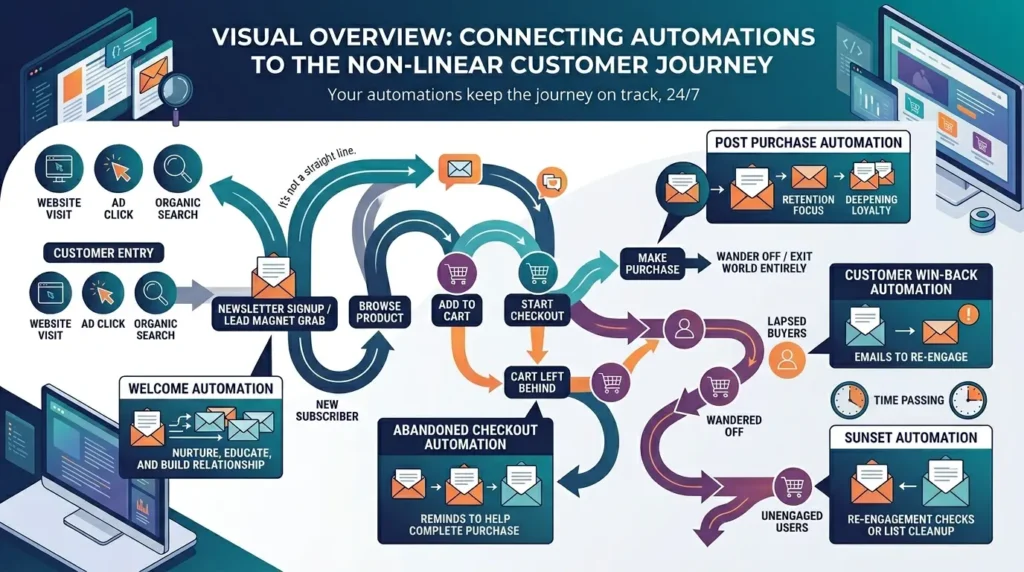
Here’s how it typically looks. A customer visits your website, maybe through an ad or organic search. They subscribe to your newsletter or grab a lead magnet. They browse a product, add something to their cart, start checkout. Then, sometimes, they buy. Other times, they wander off.
But it doesn’t stop there. After the purchase, they use the product. They might become a raving fan. They might go cold. And eventually, if nothing brings them back, they exit your world entirely.
Your email automations are what keep this journey from going off the rails at every stage. They work in the background, 24/7, nudging people toward their next step and keeping them connected to your brand, whether they made a purchase last week or haven’t opened an email in four months.
Here’s a visual overview of exactly how these five automations connect to that journey:
| Automation | Trigger Point | Goal | Minimum Emails |
|---|---|---|---|
| Welcome | New subscriber | Nurture, educate, and build a connection | 4 emails / 7–10 days |
| Abandoned Checkout | Cart left behind | Remind, assist, and convert | 2+ emails |
| Post Purchase | Order placed | Thank customers, retain them, and deepen loyalty | 5–10 min after purchase |
| Customer Win-Back | 60–90 days post-purchase | Re-engage inactive buyers | 2+ emails with urgency |
| Sunset | 90–120 days unengaged | Re-engage or remove from list | 2–3 emails / 7–10 days |
Now let’s walk through each one in detail.
Email Automation 1: The Welcome Series
This is the most important automation in your entire business. Full stop.
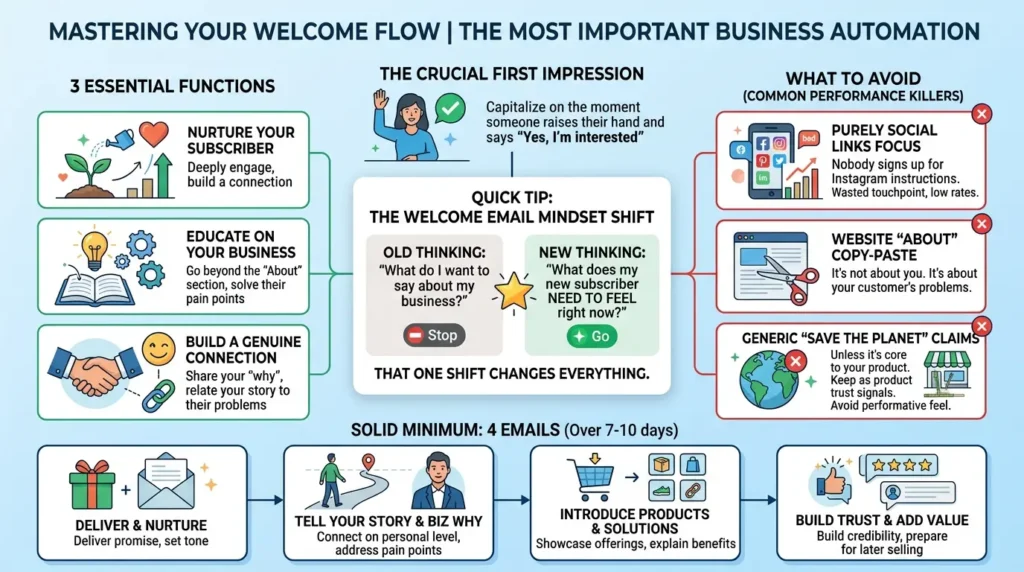
The welcome flow sits right at the start of the customer journey, the moment someone raises their hand and says “yes, I’m interested.” That’s an incredibly powerful moment, and most businesses squander it. They send a single email that says “thanks for subscribing, here’s 10% off” and then wonder why their list never converts.
Your welcome series needs to do three things: nurture your subscriber, educate them on your business, and build a genuine connection. This is not the “about” section of your website repackaged as an email. You need to go deeper.
Think about your why as a business. What are the customer pain points you actually solve? What’s the personality of the brand, or the people behind it? These are the things that turn a subscriber into someone who actually looks forward to your emails.
What to avoid in your welcome series
There are a few things that consistently kill welcome email performance, and they’re more common than you’d think.
The first is an email that’s purely about your social links. Nobody signs up to an email list to be told to go follow you on Instagram. Open rates on these emails are terrible. Click rates are worse. It’s a wasted touch point.
The second is lifting your website’s “about” section word for word. It’s not about you, it’s about your customer. Even when you do need to talk about your business, you have to relate it back to them. How does your story solve their problem? How does your origin connect to what they care about?
The third one is a bit more nuanced. Talking about how you “save the planet” sounds great in theory, but ask yourself honestly: does it truly align with your product and your customer to the point that it belongs in a foundational email? For a bamboo toothbrush brand where sustainability is the entire identity of the business? Absolutely. But for a general homeware store that happens to use recycled packaging? That probably belongs on your product pages as a quiet trust signal, not front and center in your welcome flow where it can feel performative.
How many emails should your welcome series have?
There’s no magic number. Every business is different. But a solid minimum is four emails spread across 7 to 10 days. That gives you enough space to educate, tell your story, introduce your products, and build trust before you start asking for anything in return.
Email Automation 2: The Shopify Abandoned Checkout Flow
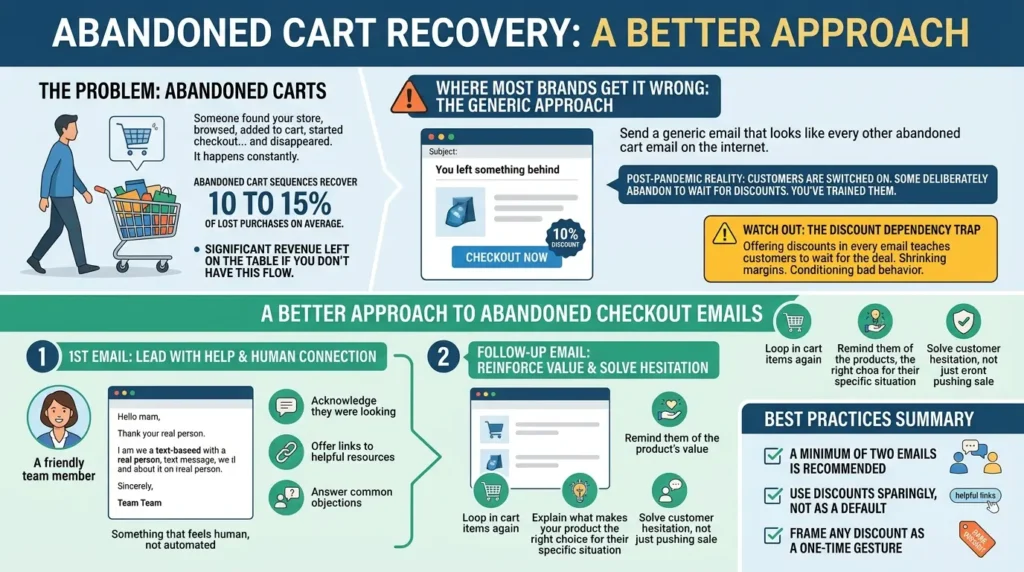
Someone found your store, browsed your products, added something to their cart, started checkout, and then disappeared. It happens constantly. Abandoned cart sequences recover 10 to 15% of lost purchases on average. That’s significant revenue you’re currently leaving on the table if you don’t have this flow running.
But here’s where most brands get it wrong.
They send a generic abandoned cart email that looks like every other abandoned cart email on the internet. Subject line: “You left something behind.” Body: a photo of the product and a big CTA button. Maybe a 10% discount attached.
Post-pandemic, customers are switched on to these tactics. Some of them will deliberately abandon their cart just to wait for the discount email. You’ve trained them to do it. And if your email looks like every other brand’s email, it won’t even register.
A better approach to abandoned checkout emails
Instead of leading with a discount, lead with help.
Start your first abandoned checkout email as a text-based message from a real person on your team. Something that feels human, not automated. Acknowledge that they were looking, offer links to helpful resources, answer common objections, explain what makes your product the right choice for their specific situation.
Then, in your follow-up email, you can loop in the cart items again and remind them of the value. Focus on solving the customer’s hesitation, not just pushing the sale.
A minimum of two emails is recommended here. And if you are going to include a discount at some point, make it the exception, not the rule, and frame it as a one-time gesture.
Email Automation 3: Post Purchase
This is arguably the most underused automation in ecommerce, and it’s a shame because it’s also one of the most powerful.
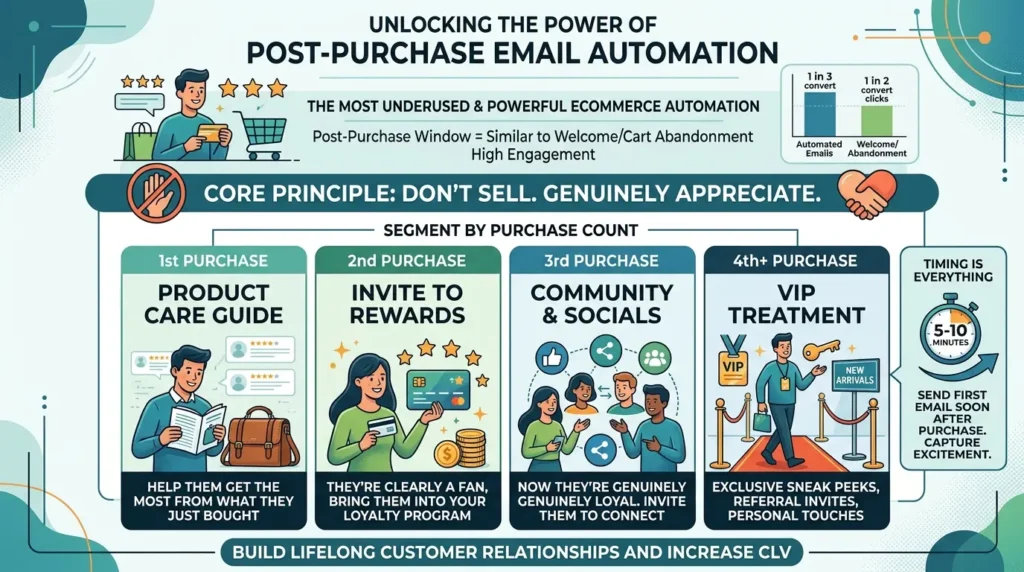
When a customer makes a purchase, they’ve just demonstrated trust in your brand. They gave you their hard-earned money. They are as engaged with you as they’ll ever be. Automated emails convert 1 in 3 people who click, and for welcome and cart abandonment emails specifically, about 1 in 2 people who click go on to make a purchase. The post-purchase window operates on similar logic. Your open rates in this flow will be some of the highest in your entire account.
So what should you actually put in these emails?
Don’t sell. Seriously. Resist the urge. Your customer just bought something. The last thing they need is you immediately trying to get more money out of them.
Instead, use these emails to make the customer feel genuinely appreciated. And here’s the key strategic layer: segment your emails by purchase count.
A first-time buyer has different needs than someone on their third purchase. They’re at different points in the relationship with your brand.
Build out unique emails for up to four or five different purchase counts. And send the first one within 5 to 10 minutes of the purchase. When someone places an order, they’re excited. Meet them at that moment.
Email Automation 4: Customer Win-Back
Every business has customers who bought once and then went quiet. That’s not a lost cause. It’s an opportunity, if you’re set up to act on it.
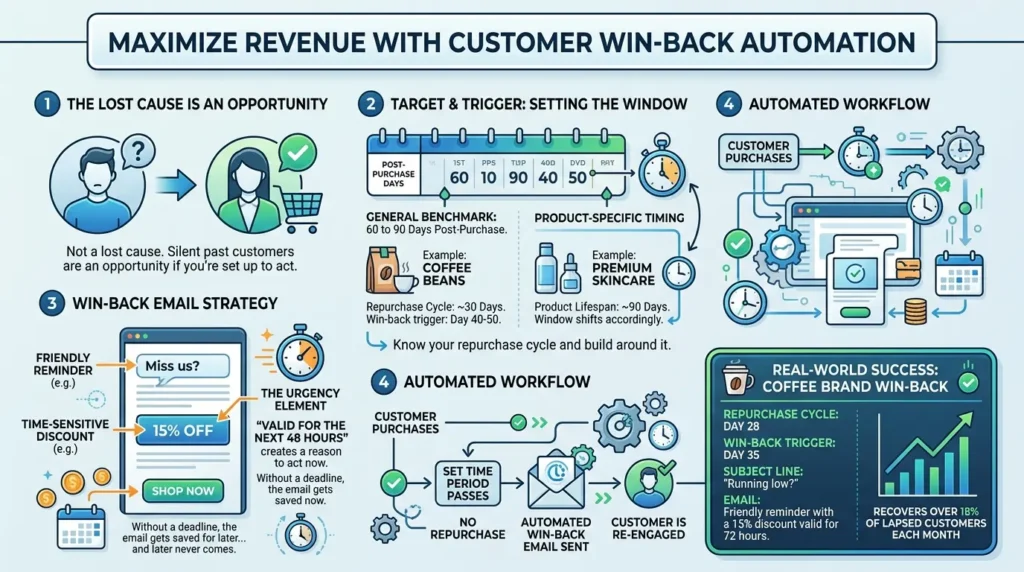
The customer win-back automation targets people who made a purchase but haven’t bought again after a set period of time. Most businesses set this window at 60 to 90 days post-purchase, but your specific number will depend entirely on your product.
If you sell coffee beans and your average customer repurchases every 30 days, you’d set your win-back flow to trigger around 40 to 50 days after their last purchase. If you sell premium skincare with a 90-day product lifespan, your window shifts accordingly. Know your repurchase cycle and build around it.
Win-back emails typically include a time-sensitive discount. The urgency element is important here. A deal that’s “valid for the next 48 hours” creates a reason to act now. Without that deadline, the email gets saved for later, and later never comes.
Email Automation 5: The Sunset Flow
This one doesn’t get talked about enough, and it’s genuinely one of the most important flows for the long-term health of your email program.
The sunset automation is designed to deal with unengaged subscribers, people who have stopped opening or clicking your emails. And the goal isn’t just to re-engage them. Sometimes, the goal is to let them go.
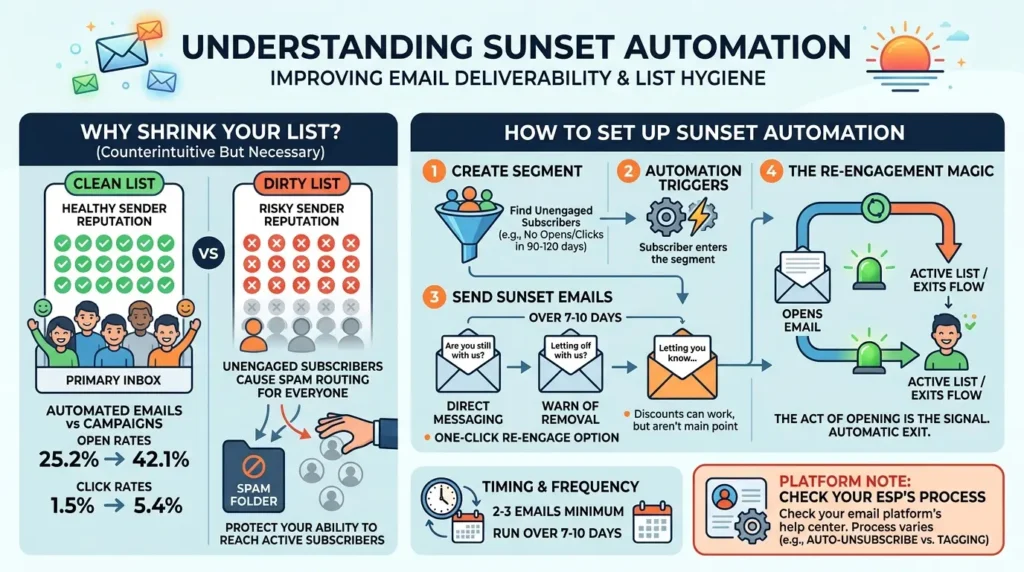
That sounds counterintuitive. Why would you want to shrink your list? Because email deliverability depends on engagement. Automated emails, compared to campaign emails, saw open rates jump from 25.2% to 42.1% and click rates increase from 1.5% to 5.4%. Email clients like Gmail and Outlook are watching what happens when your emails land in inboxes. If a large portion of your subscribers never open your messages, inbox providers start routing you to spam for everyone. Not just the unengaged people. Everyone.
Keeping a clean, healthy list protects your ability to reach the subscribers who actually want to hear from you.
How to set up your sunset automation
First, create a segment of unengaged subscribers. This is typically people who haven’t opened or clicked any of your emails in 90 to 120 days.
When someone enters this segment, the automation triggers. Your sunset emails should be direct. Tell them you’ve noticed they haven’t been engaging. Let them know you’re going to remove them from your list unless they’d like to stay. Give them an easy one-click option to re-engage.
Here’s the magic part: as soon as they open that email, they’ve re-engaged. They exit the sunset flow automatically. The act of opening is itself the signal that they still want to hear from you.
A discount can work here, but it’s not the main point. The main point is the re-engagement, the list hygiene, and protecting your sender reputation.
Run a minimum of 2 to 3 emails over 7 to 10 days. That gives people enough time to catch up on their inbox and see your message.
How the Five Automations Work Together
Here’s the visual customer journey, showing exactly how these automations connect at every stage:
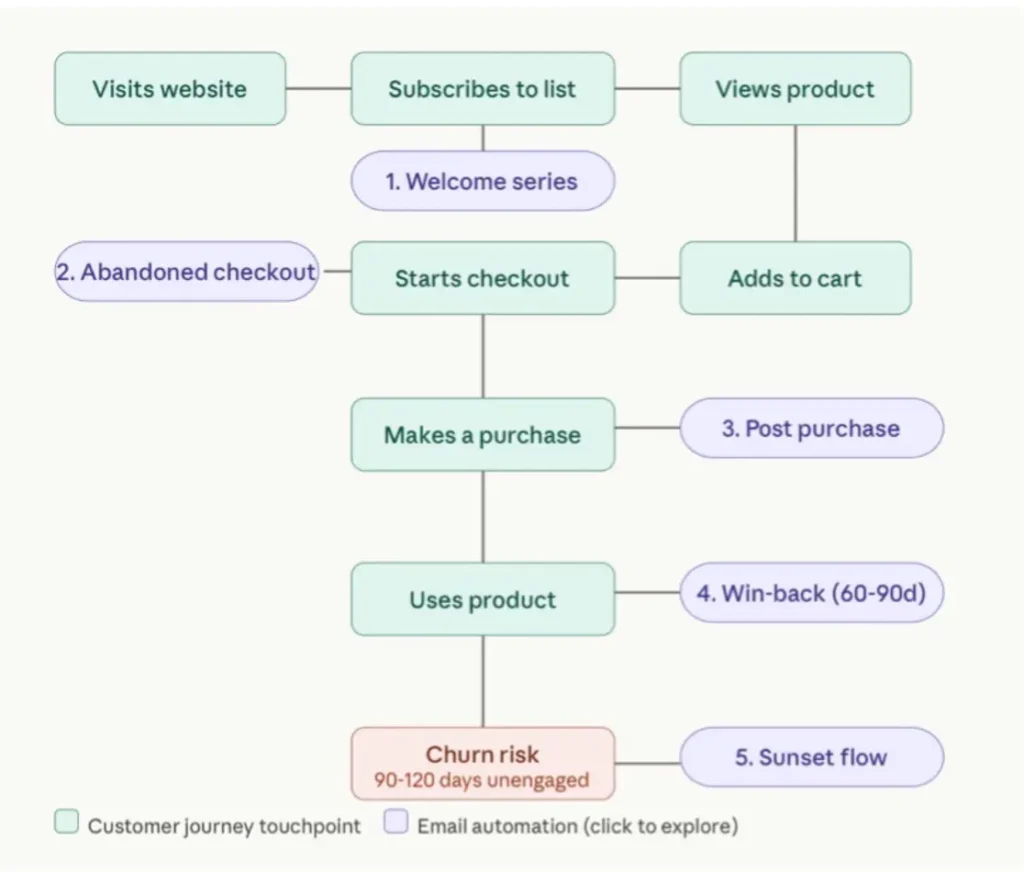
The customer journey is not linear. A subscriber might go through your welcome flow, never make a purchase, become disengaged, and move straight into the sunset automation. That’s okay. What matters is that at every stage, your subscriber feels nurtured, seen, and cared about.
That’s the whole point, really. It’s not about your business. It’s about them.
The Stats That Make the Case
Still need convincing? Let’s look at the numbers.
Using automated flows can bring your average email marketing conversion rate up to 1.71%, compared to 0.09% for standard campaign emails across all industries.
Think about that for a moment. The same audience. Completely different results. The only variable is whether the email was triggered by behavior or sent manually.
| Metric | Campaign Emails | Automated Emails |
|---|---|---|
| Average open rate | 25.2% | 42.1% |
| Average click rate | 1.5% | 5.4% |
| Conversion rate | 0.09% | 1.71% |
| Share of all email orders | 59% | 41% (from just 2% of sends) |
Sources: Omnisend 2026 eCommerce Marketing Report, Klaviyo Email Benchmarks, Flowium
Where Most Ecommerce Brands Fall Short
It’s very normal for businesses to have only a welcome series and an abandoned cart set up, and nothing else. That means the entire back end of the customer journey is unaddressed. No post-purchase follow-up. No win-back sequence. No sunset flow cleaning up the list.
The result? A leaky bucket. You’re spending money and effort to get subscribers, but there’s no system in place to retain them, re-engage them, or even remove the ones dragging down your deliverability.
If that’s where you are right now, there’s no judgment. But now you know what to build next.
Start Here: Your Email Automation Checklist
Conclusion
Email automation isn’t optional anymore. It’s the difference between a business that converts and one that constantly wonders why its metrics are flat.
These five flows, the welcome series, abandoned checkout, post purchase, customer win-back, and sunset, cover every major moment in your customer’s journey. They work around the clock so you don’t have to. And when you build them with real empathy for your customer, not just as sales tools but as genuine relationship builders, the results follow.
Start with your welcome series. Then build your abandoned checkout. Then tackle the back end. One at a time, you’ll close every gap in your customer journey and build an email program that actually earns its place in your subscriber’s inbox.


[…] Read the Full Article → […]
[…] Read the Full Article → […]