

The Hidden Crisis Inside Your Microservices
Six months after migrating to microservices, a developer merges a routine change. A week later, someone discovers that User A can see User B’s invoices. Nobody flagged it. The authorization logic lived across twelve different services, each with slightly different rules, and they’d quietly drifted apart.
Sound familiar? This isn’t a fringe scenario. It’s the default outcome when teams bolt authorization logic onto distributed systems as an afterthought.
Here’s the number that should stop you in your tracks: Broken Access Control is the #1 vulnerability in the OWASP Top 10:2025, present in 100% of applications tested. Not a handful. Every single one. And yet the way most teams approach authorization hasn’t fundamentally changed in a decade, if-else statements scattered across business logic, role checks duplicated in twenty different services, no central source of truth.
What changed? Why is authorization suddenly a distributed systems problem and not just a security checkbox? That’s exactly what we’re going to unpack. By the end, you’ll understand the architectural forces driving this transformation, the core patterns the industry has converged on, and what you should actually do about it.
- ✅ Authorization failures increasingly look like distributed consistency failures, not classic security bugs
- ✅ The CAP theorem and PACELC apply directly to access control decisions across microservices
- ✅ Google Zanzibar (2019) proved that ReBAC at scale demands purpose-built distributed infrastructure
- ✅ Sidecar/embedded PDPs deliver sub-millisecond decisions while surviving network partitions
- ✅ The OpenID AuthZEN 1.0 standard (March 2026) is finally solving the PEP-to-PDP vendor lock-in problem
- ✅ Policy as Code + CI/CD pipelines are the only sustainable governance mechanism at scale
From Monolith to Microservices: How Authorization Architecture Changed
Let’s start with a simple analogy. Imagine authorization in a monolithic app like security in a single-family house. One lock on the front door. If you’re inside, you’re trusted. You walk from room to room freely. The owner’s database, the users table, the roles table, all of them live under the same roof, connected by a single SQL JOIN. Checking “can this user edit this document?” is fast, cheap, and straightforward.
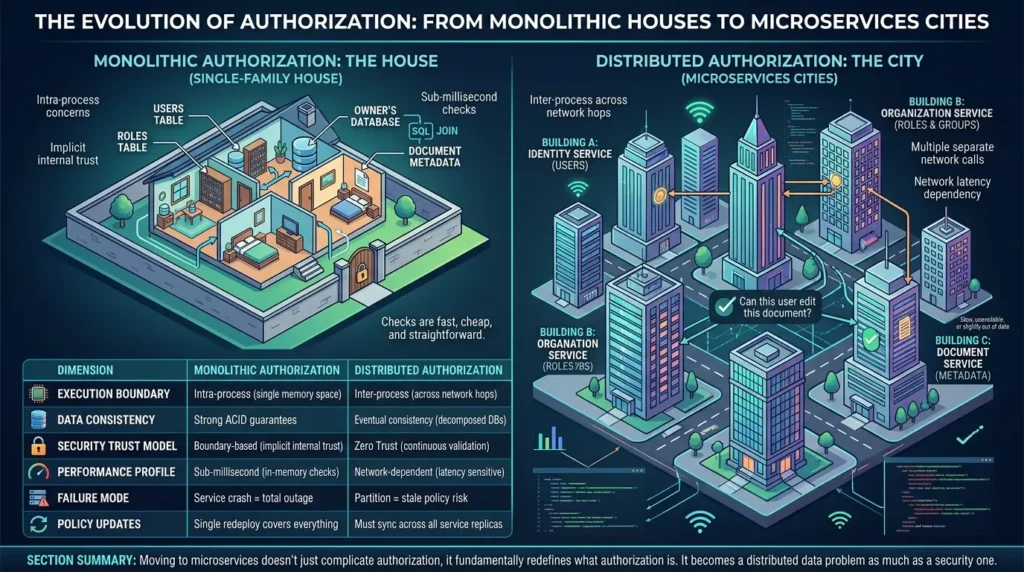
Now imagine that house gets demolished and replaced by a city of skyscrapers. Each building is its own microservice. Each has its own security system, its own database, its own staff. The users might live in Building A (Identity Service). The roles and group memberships are in Building B (Organization Service).
The document metadata is in Building C (Document Service). To answer the same “can this user edit this document?” question, you now need to make three separate network calls to three separate buildings, each of which might be slow, unavailable, or slightly out of date.
That’s the problem. And it’s not just a performance problem. It’s a fundamental architectural one.
In a monolith, authorization was an intra-process concern. Sub-millisecond checks. Strong ACID guarantees. Implicit trust within the network perimeter. When teams decompose that into microservices, every one of those assumptions falls apart simultaneously:
- Data consistency goes from ACID to eventual
- Execution goes from in-memory to across network boundaries
- Trust goes from perimeter-based to zero trust (continuous, granular validation)
- Deployment dependency goes from low to high (policies and tokens must now sync across services)
The right response to this shift is treating authorization as a distributed systems discipline, with the same rigor you’d apply to database replication, service mesh configuration, or event streaming. That’s where the industry is heading. Most teams just haven’t caught up yet.
Section summary: Moving to microservices doesn’t just complicate authorization, it fundamentally redefines what authorization is. It becomes a distributed data problem as much as a security one.
North-South vs. East-West: The Two Traffic Lanes of Distributed Security
Think about your distributed system like an airport. North-south traffic is the passenger flow from outside the terminal, external clients connecting to your services through the front door (your API Gateway). East-west traffic is everything happening inside the terminal: baggage systems talking to boarding systems, security checkpoints communicating with airlines. Internal service-to-service communication.
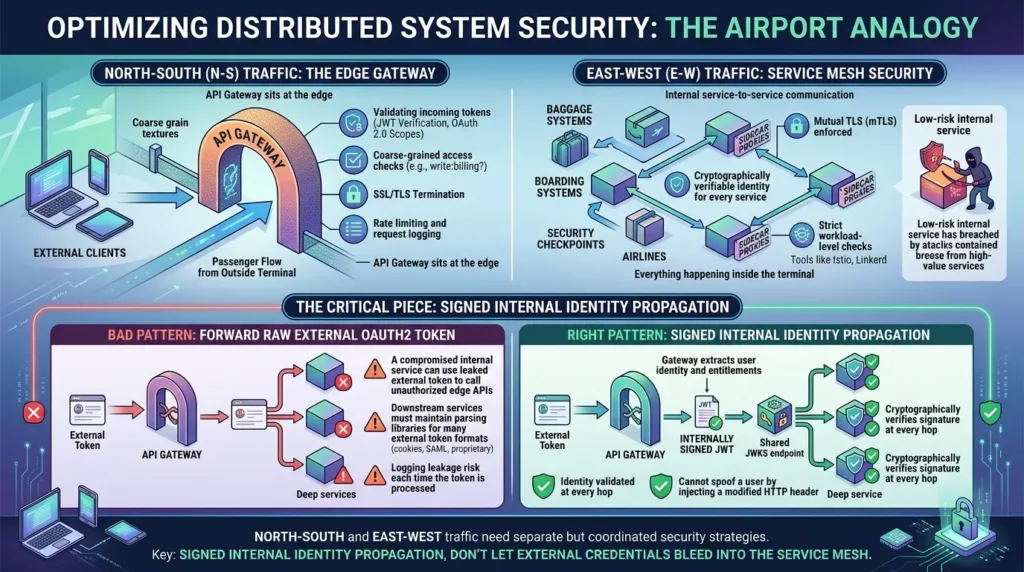
Both lanes need completely different security strategies. And most teams only think about the first one.
For north-south traffic, the API Gateway sits at the edge. It handles:
- Validating incoming tokens (JWT verification, OAuth 2.0 scopes)
- Coarse-grained access checks (does this token include write:billing?)
- SSL/TLS termination
- Rate limiting and request logging
For east-west traffic, a Service Mesh takes over. Tools like Istio or Linkerd deploy sidecar proxies next to every service, enforcing mutual TLS (mTLS) so that every service has a cryptographically verifiable identity. Even if an attacker breaches a low-risk internal service, they can’t freely roam to high-value services without passing strict workload-level checks.
There’s one more critical piece here that most guides gloss over. When the API Gateway validates an external token and forwards the request internally, how it propagates that identity matters enormously.
Forwarding the raw external OAuth2 token deep into the service mesh is a bad idea. Why?
- A compromised internal service can use that leaked external token to make unauthorized calls against other edge APIs
- Every downstream service has to maintain parsing libraries for every possible external token format (cookies, SAML, proprietary tokens)
- You create logging leakage risk every time that token passes through another service
The right pattern: the API Gateway extracts user identity and entitlement context, wraps it in an internally signed JWT (using a shared JWKS endpoint), and propagates that downstream. Each service cryptographically verifies the signature. Identity is validated at every hop. Nobody can spoof a user by injecting a modified HTTP header.
Section summary: North-south and east-west traffic need separate but coordinated security strategies. The key is signed internal identity propagation, don’t let external credentials bleed into the service mesh.
The Four Pillars of Authorization: PAP, PDP, PEP, and PIP
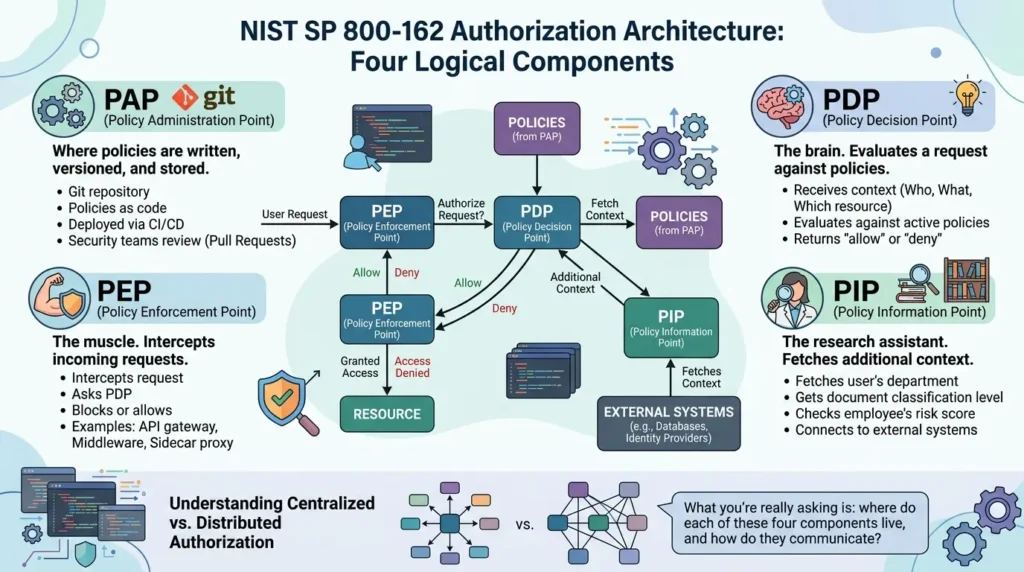
Before we dive into patterns and trade-offs, we need a shared vocabulary. NIST SP 800-162 defines four logical components that every authorization architecture should map to:
- Policy Administration Point (PAP): Where policies are written, versioned, and stored. In modern DevOps shops, this is a Git repository. Policies as code, deployed via CI/CD. Security teams can review changes like pull requests. That’s powerful.
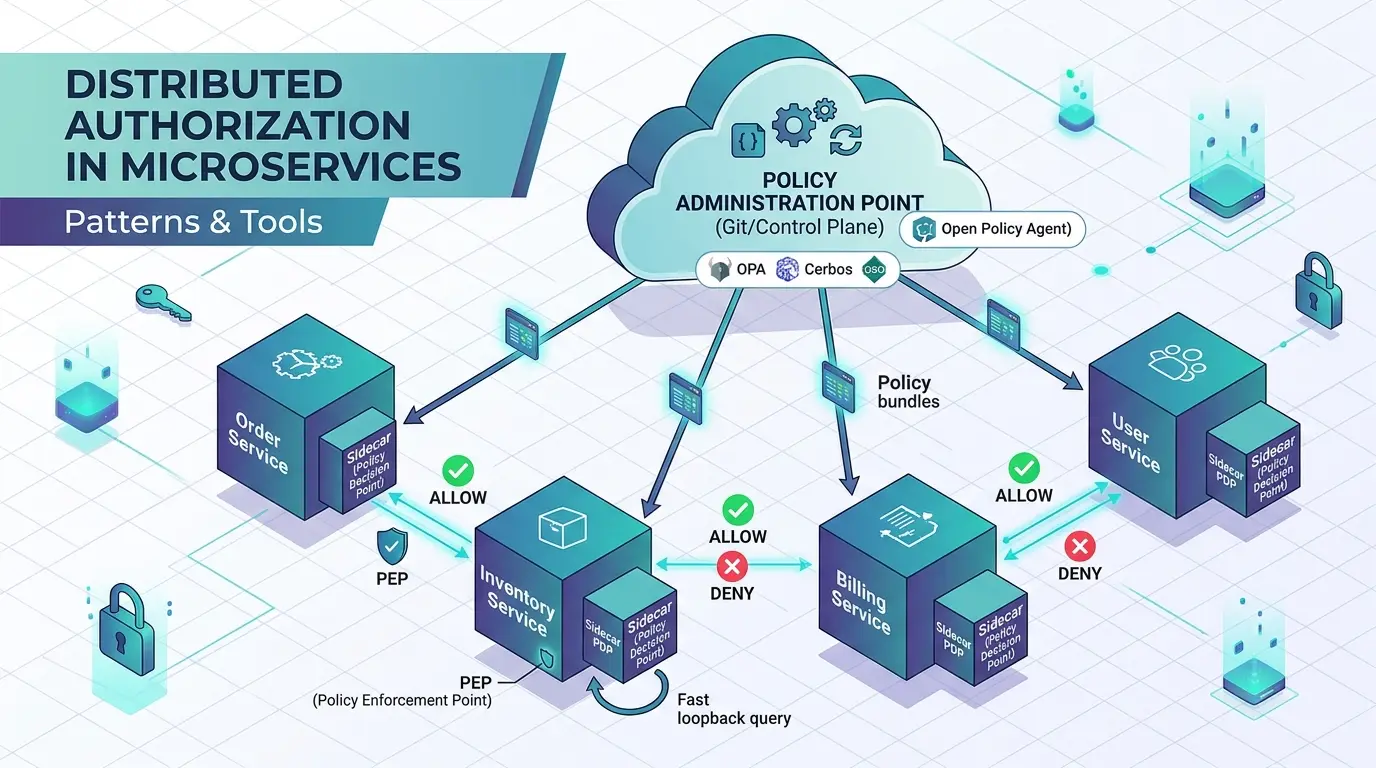
- Policy Decision Point (PDP): The brain. It receives the context of a request (who is asking, what they want to do, on which resource), evaluates it against the active policies, and returns “allow” or “deny.”
- Policy Enforcement Point (PEP): The muscle. It intercepts incoming requests, asks the PDP, and blocks or allows accordingly. This typically lives in an API gateway plugin, a middleware component, or a sidecar proxy.
- Policy Information Point (PIP): The research assistant. When the PDP needs additional context to evaluate a policy, like the user’s department, the document’s classification level, or an employee’s current risk score, the PIP fetches it from external databases or identity providers.
Understanding these four roles clarifies a lot of the confusion around phrases like “centralized authorization” versus “distributed authorization.” What you’re really asking is: where do each of these four components live, and how do they communicate?
The PACELC Blast Radius: A Quantitative Framework
Most engineers understand PACELC intuitively. Few have done the math on what it actually costs in production authorization systems. Let’s fix that.
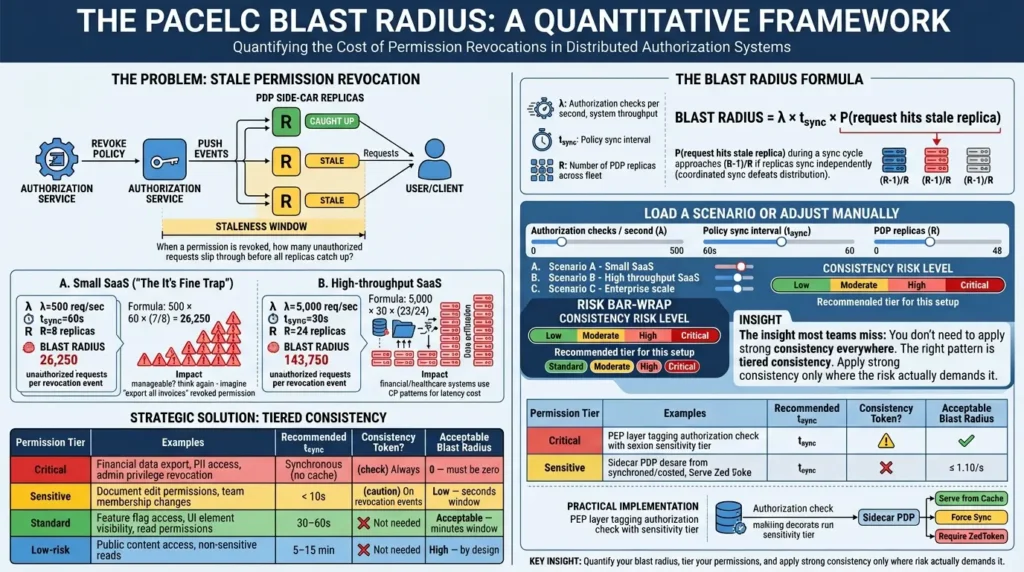
The core question: When a permission revocation happens, how many unauthorized requests can slip through before every PDP replica catches up?
The answer depends on three variables:
- t_sync — your policy sync interval (how often sidecars pull updated policies)
- R — number of PDP replicas running across your fleet
- λ — authorization checks per second (system-wide throughput)
The Blast Radius Formula:
Where P(request hits stale replica) during a sync cycle approaches (R-1)/R if replicas sync independently (which they almost always do, coordinated sync defeats the purpose of distribution).
Three real-world scenarios:
Scenario A: Small SaaS (the “it’s fine” trap):
- t_sync = 60s, R = 8 replicas, λ = 500 req/sec
- Blast radius = 500 × 60 × (7/8) = 26,250 potentially unauthorized requests per revocation event
- At 500 req/sec this feels manageable. It isn’t. If the revoked permission was “can export all user invoices”, that’s 26,250 opportunities for data exfiltration in one minute.
Scenario B: High-throughput SaaS:
- t_sync = 30s, R = 24 replicas, λ = 5,000 req/sec
- Blast radius = 5,000 × 30 × (23/24) = 143,750 potentially unauthorized requests
- This is why financial and healthcare systems use CP (consistency-first) patterns for sensitive operations, accepting the latency cost.
Scenario C: With ZedTokens / zookies (the Zanzibar approach):
- Same setup as Scenario B, but sensitive revocations include a consistency token
- The token forces any replica that hasn’t caught up to block and wait
- Blast radius for flagged operations = 0 (at the cost of added latency on those specific checks)
- Blast radius for unflagged operations = same as Scenario B
The insight most teams miss: You don’t need to apply strong consistency everywhere. The right pattern is tiered consistency, classify your permissions by sensitivity and apply different sync strategies per tier:
| Permission Tier | Examples | Recommended t_sync | Consistency Token? | Acceptable Blast Radius |
|---|---|---|---|---|
| Critical | Financial data export, PII access, admin privilege revocation | Synchronous (no cache) | ✅ Always | 0 — must be zero |
| Sensitive | Document edit permissions, team membership changes | < 10s | ⚠️ On revocation events | Low — seconds window |
| Standard | Feature flag access, UI element visibility, read permissions | 30–60s | ❌ Not needed | Acceptable — minutes window |
| Low-risk | Public content access, non-sensitive reads | 5–15 min | ❌ Not needed | High — by design |
The practical implementation: Tag each authorization check at the PEP layer with a sensitivity tier. Your sidecar PDP uses the tag to decide whether to serve from cache, force a sync, or require a consistency token. One policy engine, four different consistency behaviors, no architectural overhaul required.
Section summary: The CAP theorem isn’t just for databases, every distributed PDP is a permission state store facing the same consistency-vs-availability trade-off. But unlike databases, the cost of a wrong read isn’t a stale product price, it’s an unauthorized access event. Quantify your blast radius, tier your permissions by sensitivity, and apply strong consistency only where the risk actually demands it.
Three Authorization Patterns (And When Each One Breaks)
Now we can map the PAP/PDP/PEP/PIP framework onto three concrete deployment patterns, each with a distinct trade-off profile.
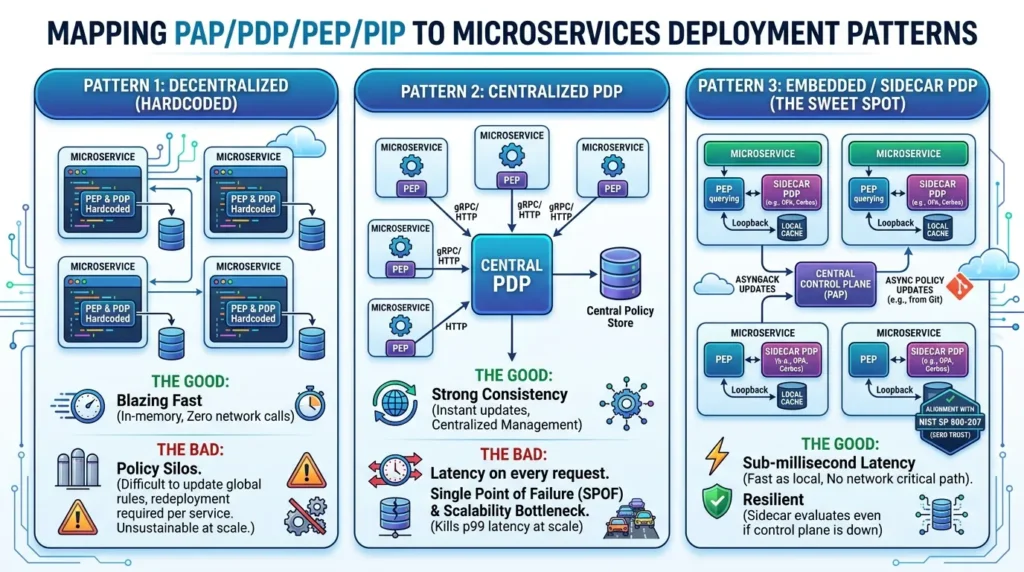
Pattern 1: Decentralized (Hardcoded in the Service)
The PDP and PEP both live inside the microservice’s source code. Permission rules are hardcoded. Data lives in the service’s local database.
The good: Blazing fast. Everything happens in memory. Zero network calls.
The bad: Policy silos. If you want to update a global access rule, you need to modify, test, and redeploy every single service that contains that logic. At ten services, that’s annoying. At fifty, it’s operationally unsustainable.
Pattern 2: Centralized PDP
Policies live centrally. Every service makes a synchronous HTTP/gRPC call to a remote PDP on every authorization check.
The good: Strong consistency. One policy change propagates to all services instantly.
The bad: That remote call adds latency on every request. And the central PDP becomes a single point of failure and a scalability bottleneck. At scale, this can kill your p99 latency.
Pattern 3: Embedded / Sidecar PDP (The Sweet Spot)
Policies are authored centrally (in a Git repository, through a PAP). They’re pushed asynchronously to local sidecar PDP engines running alongside each microservice, think OPA or Cerbos deployed as a sidecar container. The microservice queries its local PDP over a loopback interface. Sub-millisecond latency. And if the central control plane goes down, the sidecar keeps evaluating using its cached policies.
This is the approach NIST SP 800-207 (Zero Trust Architecture) implicitly pushes toward: continuous, granular, context-driven validation that doesn’t introduce critical path dependencies.
End-to-End Request Flow: From API Gateway to Sidecar PDP
The diagram below traces a single authorization decision across the full stack, from an external client request to the final allow/deny response:
Key observations:
✅ Raw OAuth2 token never enters the service mesh — converted to signed internal JWT at the Gateway
✅ Sidecar PDP call is over loopback (127.0.0.1) → sub-millisecond latency
✅ PDP returns decision metadata (version, eval time) — essential for observability
✅ Fail-mode (fail-open vs fail-closed) must be explicitly defined — never left undefined
The Real Bottleneck: Getting Data to the PDP in Time
Here’s a thing that surprises a lot of engineers: the performance bottleneck in distributed authorization usually isn’t the evaluation of the policy rules. The rules themselves evaluate quickly. The bottleneck is getting the data needed to make the decision to the PDP fast enough.
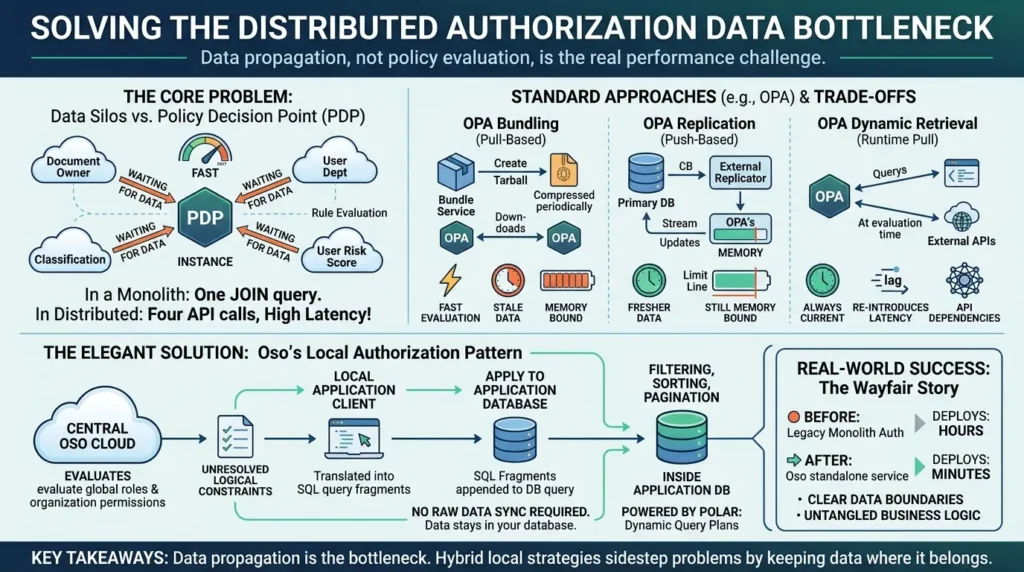
Think about it. To evaluate whether a user can edit a document, your PDP might need to know: the document’s owner, its classification level, the user’s department, and the user’s current risk score. In a monolith, that’s a single JOIN query. In a distributed system, that data lives in four different services.
Open Policy Agent (OPA) solves this through three mechanisms, each with different trade-offs:
- OPA Bundling (Pull-Based): A centralized bundle service packages policies + reference data into a compressed tarball hosted at an HTTP endpoint. OPA instances periodically download and cache it. Fast for evaluation, but the data can be stale between bundle downloads. Also limited by memory, you can’t bundle your entire customer database into OPA’s RAM.
- OPA Replication (Push-Based): An external replicator watches your primary databases for changes and streams delta updates directly to OPA’s memory store. Fresher than bundling, but still memory-bound. Can’t handle arbitrarily large datasets.
- OPA Dynamic Retrieval (Runtime Pull): OPA queries external APIs at evaluation time using http.send. Always current, but re-introduces the latency and dependency problems you were trying to avoid in the first place.
The elegant solution to this is what Oso calls the Local Authorization pattern. Instead of synchronizing all your application data to a central authorization service (which creates a dual-write nightmare and a data sync headache), Oso Cloud evaluates the parts of a policy it can handle centrally, global roles, organization-level permissions, and returns the remaining conditions as unresolved logical constraints.
The local client translates those constraints into SQL query fragments, which get appended directly to your database query. The filtering, sorting, and pagination happen inside your local database. No raw data sync required.
This is possible because Oso uses Polar, a declarative, logic-based language similar to Prolog, which can generate dynamic query plans instead of executing hardcoded database joins.
Wayfair actually proved this approach in production. They decomposed their monorepo into microservices, kept authorization in the legacy monolith initially, and found that this coupling slowed deployments to hours. During an internal hackathon, they extracted authorization into a standalone Oso-based service.
The result: deployment times dropped from several hours to minutes, with clear data ownership boundaries and no more authorization logic entangled in monolithic business logic.
Section summary: Data propagation, not policy evaluation, is the real performance challenge in distributed authorization. Hybrid local evaluation strategies like Oso’s conditional query plans sidestep the problem entirely by keeping application data exactly where it belongs: in your application’s database.
Google Zanzibar and the Rise of Relationship-Based Access Control
So far we’ve mostly talked about RBAC, Role-Based Access Control. User has the role Admin, Admin can delete resources. That works fine at a small scale. But RBAC breaks in ways that sneak up on you.
Imagine a collaborative SaaS platform. User Alice is an admin of Team Alpha’s workspace, a viewer of a shared project with Team Beta, and an editor of only three specific documents in a shared library. In RBAC, you’d need custom roles for each combination. That leads to role explosion, dozens or hundreds of roles that nobody can fully understand or audit anymore. Fine-grained authorization, paradoxically, starts to reduce explainability as it scales.
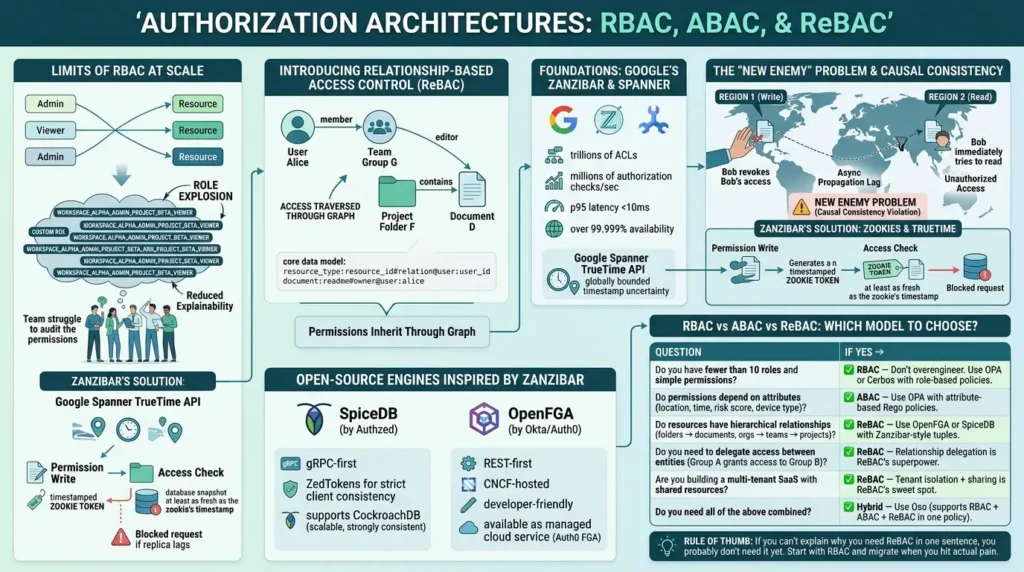
The alternative is Relationship-Based Access Control (ReBAC), where access is determined by traversing a graph of relationships between users and resources. Instead of “User has role X,” you express it as: “User Alice has an editorrelation to Document D because she is a member of Group G, which has an editor relation to Folder F, which contains Document D.”
The foundation of modern ReBAC at scale is Google’s Zanzibar paper (USENIX ATC ’19), which described the authorization system powering Google Drive, YouTube, Maps, Photos, and Cloud. The numbers are staggering: trillions of access control lists, millions of authorization checks per second, p95 latency under 10ms, and over 99.999% availability.
The core data model is elegantly simple, a relation tuple:
This means: the user alice has an owner relation to the object document:readme. Permissions inherit through the graph. If alice owns a folder, she transitively owns everything inside it. No hardcoded JOIN logic. Just graph traversal.
Solving the “New Enemy” Problem
Here’s a subtle but nasty distributed systems bug specific to authorization. Alice revokes Bob’s access to a document (write in Region 1). Bob immediately tries to access that document (read in Region 2). If Region 2’s replica hasn’t received the replication update yet, Bob gets unauthorized access, not because authentication failed, but because permission state propagated asynchronously.
This is called the New Enemy problem, and it’s a causal consistency violation. Zanzibar solves it using Google Spanner’s TrueTime API (GPS receivers and atomic clocks providing globally bounded timestamp uncertainty).
When a permission write occurs, Zanzibar generates a timestamped zookie token. Subsequent access checks that include this zookie are evaluated against a database snapshot at least as fresh as the zookie’s timestamp. If the local replica is lagging, the request blocks until it catches up.
Two prominent open-source engines inspired by Zanzibar are now widely adopted:
- SpiceDB (by Authzed): gRPC-first, uses ZedTokens for strict client-defined consistency, supports CockroachDB for horizontally scalable strongly-consistent storage
- OpenFGA (by Okta/Auth0): REST-first, CNCF-hosted, developer-friendly, available as a fully managed cloud service (Auth0 FGA)
Both implement the Zanzibar model but make different trade-offs on API design, consistency semantics, and operational complexity.
RBAC vs ABAC vs ReBAC: Which Model Should You Choose?
Before committing to ReBAC, make sure you actually need it. Here’s a practical decision framework:
Rule of thumb: If you can’t explain why you need ReBAC in one sentence, you probably don’t need it yet. Start with RBAC, design your data model with relationships in mind, and migrate when you hit actual pain.
Policy as Code: OPA, Cerbos, and Oso
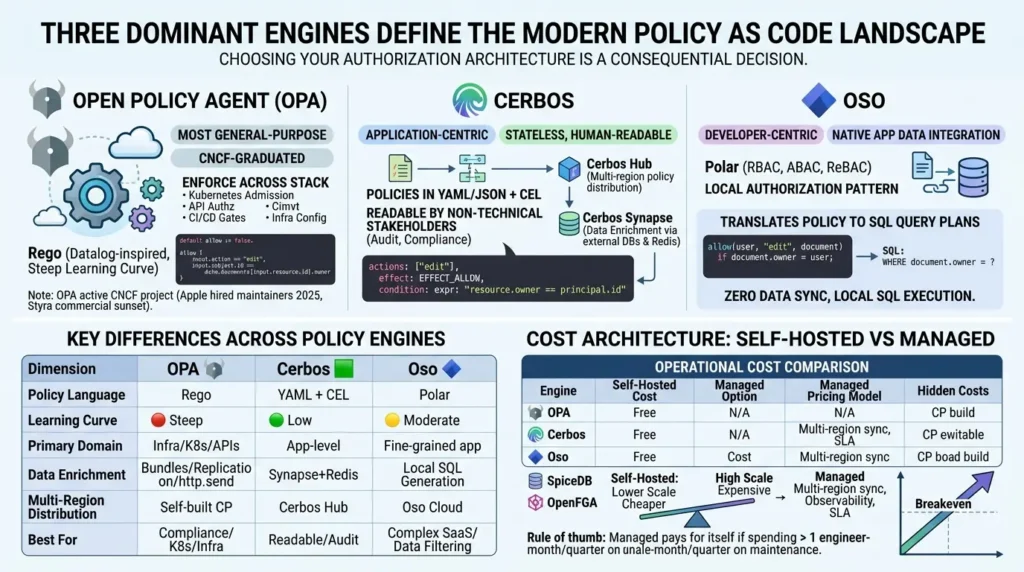
Three dominant engines define the modern Policy as Code landscape. Choosing between them is one of the most consequential decisions in your authorization architecture.
Open Policy Agent (OPA)
The most general-purpose option. OPA is CNCF-graduated and can enforce policies across the entire cloud-native stack, Kubernetes admission control, API authorization, CI/CD gates, infrastructure configuration.
Policies are written in Rego, a declarative language inspired by Datalog. Rego is powerful and expressive, but it has a steep learning curve. OPA is domain-agnostic, which means you define what “user” and “resource” mean yourself.
Worth noting: In August 2025, Apple hired OPA’s original maintainers (the founders of Styra), and Styra’s commercial OPA offering was subsequently sunset. OPA remains an active CNCF open-source project, but teams evaluating long-term enterprise support should factor this into their decision.
Rego Policy Example:
Here’s what a typical authorization policy looks like in Rego, checking whether a user can edit a document:
Notice how Rego reads almost like declarative logic, you describe what should be allowed, not how to check it. The learning curve is in the Datalog-inspired semantics, not the syntax.
Cerbos
Application-centric, stateless, and human-readable. Policies are written in YAML/JSON with conditional logic expressed via Google’s Common Expression Language (CEL). Non-technical stakeholders and audit teams can read Cerbos policies without a programming background, which is a bigger deal than most engineers initially realize.
Cerbos Hub handles multi-region policy distribution, and Cerbos Synapse enriches authorization requests with user/resource attributes fetched from external databases and cached in Redis.
Cerbos Policy Example:
The same “can user edit document” rule in Cerbos YAML, readable by non-technical stakeholders:
No programming background needed to read this. An audit team or compliance officer can review this policy and understand exactly who can do what — that’s Cerbos’s core value proposition.
Oso
Developer-centric with native application data integration. Oso’s Polar language can model RBAC, ABAC, and ReBAC in readable policy files and translate policy rules directly into SQL query plans. As discussed above, the Local Authorization pattern makes Oso particularly compelling for complex SaaS applications.
Oso Polar Policy Example:
The same rule in Oso’s Polar language, note how it generates SQL query plans automatically:
The magic: Oso doesn’t fetch all documents and filter in memory. It translates the policy into a SQL query fragment that runs inside your database, zero data sync required.
Cost Architecture: Self-Hosted vs. Managed
Before committing to an engine, factor in total operational cost, not just licensing.
The rule of thumb: Self-hosted is cheaper at low scale but expensive at high scale once you factor in engineering time to build the control plane, maintain bundle infrastructure, and handle multi-region policy distribution. Managed options flip that equation, you pay per decision, but you get multi-region sync, observability dashboards, and SLAs out of the box.
At what scale does managed become worth it? A rough breakeven: if your team would spend more than one engineer-month per quarter maintaining authorization infrastructure, a managed PDP service typically pays for itself.
The AuthZEN Standard: The Interoperability Layer That Changes Everything
Here’s a frustrating reality of the current authorization ecosystem: OPA uses Rego, Cerbos uses YAML/CEL, OpenFGA uses its own DSL, SpiceDB uses its own schema language. If you build your Policy Enforcement Points (PEPs) against one of these engines, switching to another means rewriting every authorization call in every microservice.
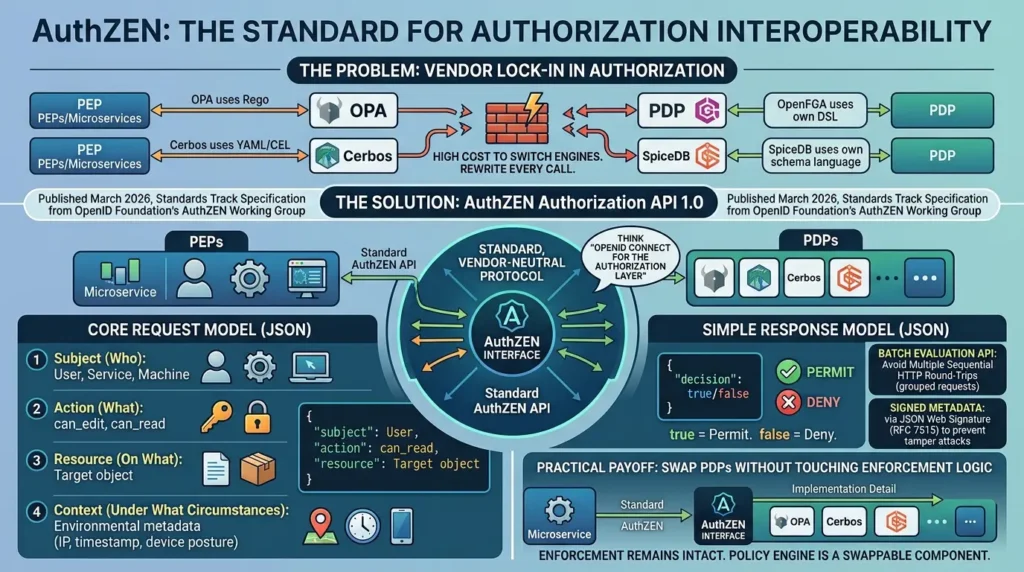
That’s real vendor lock-in. And it’s been a legitimate barrier to adoption.
The OpenID Foundation’s AuthZEN Working Group tackled this directly. Published as a Standards Track specification in March 2026, the AuthZEN Authorization API 1.0 defines a standard, vendor-neutral protocol for communication between PEPs and PDPs. Think of it as the “OpenID Connect for the authorization layer.”
The core request model is a JSON-based 4-tuple:
- Subject (Who): The user, service, or machine making the request
- Action (What): The operation being performed (can_edit, can_read)
- Resource (On What): The target object of the operation
- Context (Under What Circumstances): Environmental metadata like IP address, timestamp, or device posture
The response is beautifully simple: a JSON payload with a boolean decision field. true = Permit. false = Deny.
AuthZEN also standardizes a Batch Evaluation API (avoiding multiple sequential HTTP round-trips) and Signed Metadata via JSON Web Signature (RFC 7515) to prevent tamper attacks between PEPs and PDPs.
The practical payoff: you can swap your underlying PDP, say, from OPA to Cerbos to SpiceDB, without touching your application enforcement logic. Your PEPs speak standard AuthZEN. The PDP behind it is an implementation detail.
Common Mistakes and How to Avoid Them
Let’s be blunt about the most common ways distributed authorization fails in production, not theoretical risks, but patterns that engineers discover the painful way.
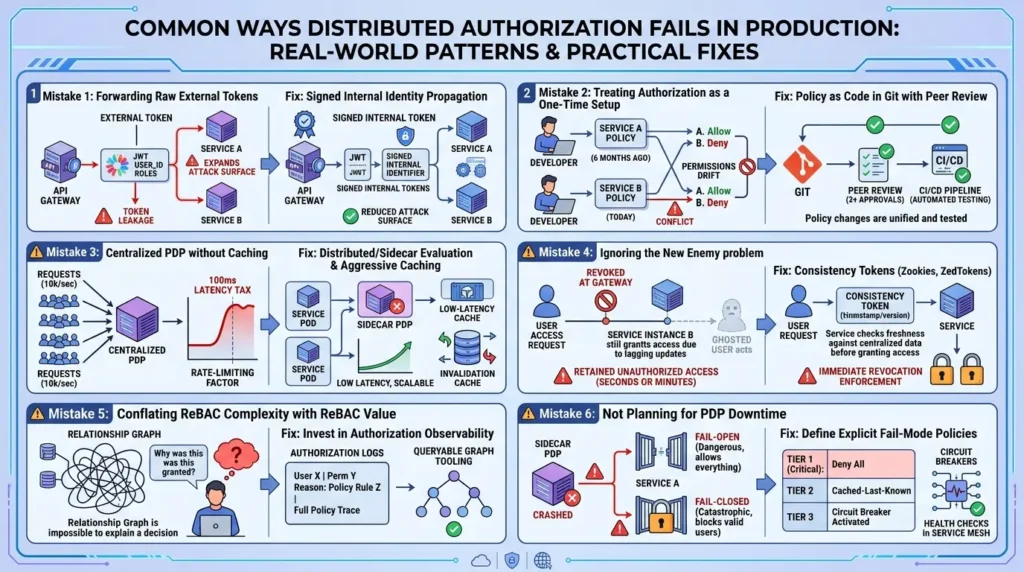
Mistake 1: Forwarding raw external tokens into the service mesh
This exposes your internal services to token leakage and expands your attack surface.
Fix: implement signed internal identity propagation at the API Gateway.
Mistake 2: Treating authorization as a one-time setup
Permissions drift as services evolve independently. A rule added to Service A six months ago may contradict a rule added to Service B last week.
Fix: Policy as Code in Git with mandatory peer review. Automated policy testing in CI/CD pipelines.
Mistake 3: Building a centralized PDP without caching
Every request pays a network round-trip tax. At 10,000 requests per second, a 100ms PDP call doesn’t just hurt latency, it can make your auth service the rate-limiting factor in your entire system.
Fix: Design for distributed/sidecar evaluation from the start, or implement aggressive caching with careful invalidation logic.
Mistake 4: Ignoring the New Enemy problem
Revoke a user’s access, and that revocation might not propagate instantly to every distributed replica. The user might retain unauthorized access for seconds or minutes.
Fix: Use consistency tokens (zookies, ZedTokens) for causally sensitive operations.
Mistake 5: Conflating ReBAC complexity with ReBAC value
Relationship graphs can grow to the point where operators can’t explain why a specific permission was granted.
Fix: Invest in authorization observability, log every decision with full policy trace information. Build tooling that makes the graph queryable, not just writable.
Mistake 6: Not planning for PDP downtime
What does your system do if the sidecar PDP crashes mid-request? Fail-open (allow everything) is dangerous. Fail-closed (deny everything) may be catastrophic for availability.
Fix: Define explicit fail-mode policies per criticality tier, implement circuit breakers, and design health check integration into your service mesh.
From the Trenches: A Real-World Authorization Incident
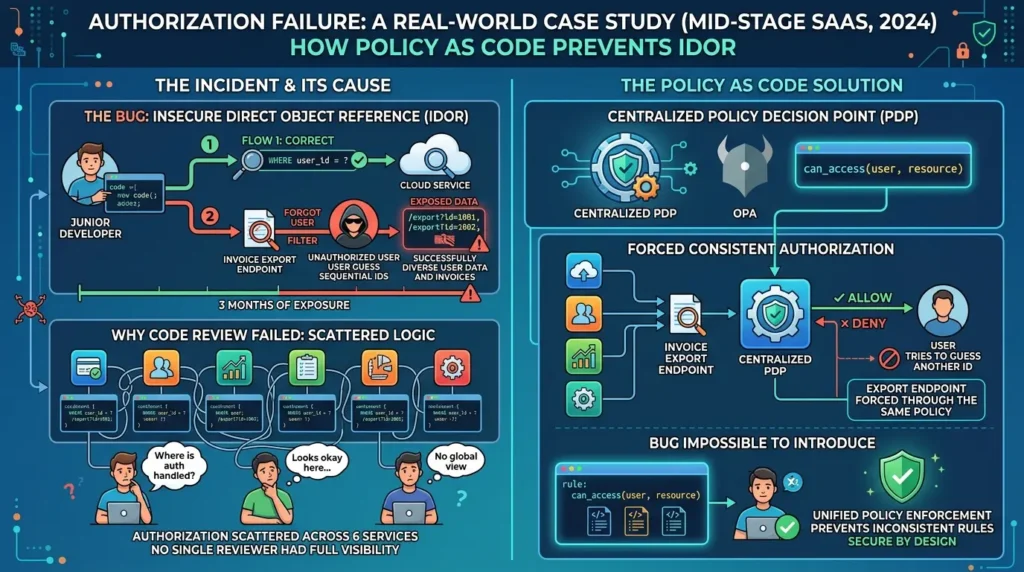
In 2024, a mid-stage SaaS company (that requested anonymity for this article) discovered that a junior developer had added a WHERE user_id = ? filter to a billing service query, but forgot to add the same filter to the corresponding invoice export endpoint. For three months, any authenticated user could export any other user’s invoices by guessing sequential IDs.
The bug wasn’t caught by code review because the authorization logic was scattered across six services, and no single reviewer had visibility into all of them.
This is exactly the kind of failure that Policy as Code prevents. With a centralized PDP and a single can_access(user, resource) policy, the export endpoint would have been forced through the same authorization check as every other resource access. The bug would have been impossible to introduce.
Testing and Observability: The Missing Discipline
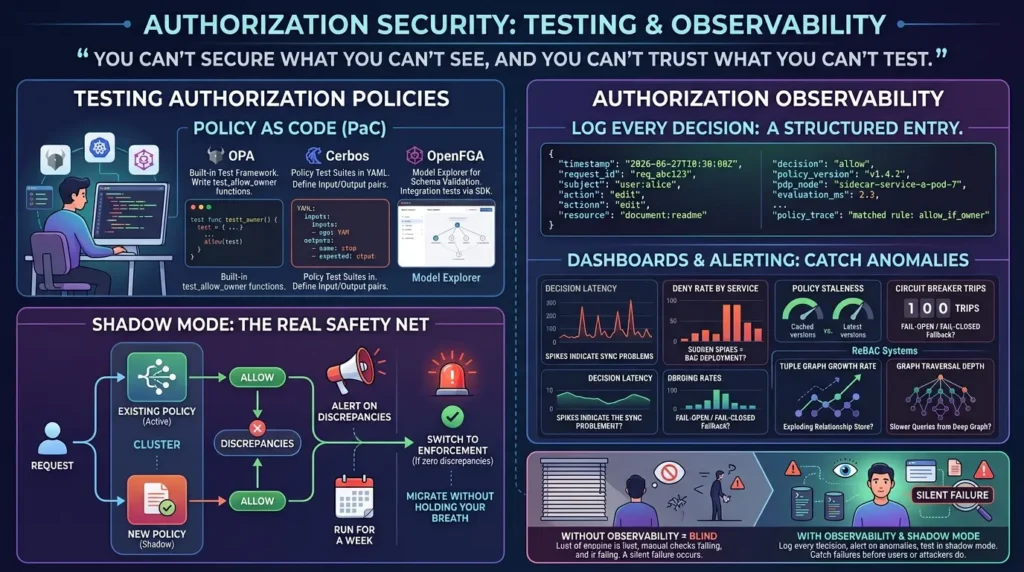
You can’t secure what you can’t see, and you can’t trust what you can’t test. Yet most teams treat authorization testing as an afterthought, a few manual checks in QA, maybe a unit test or two, and that’s it. In distributed systems, this is a recipe for silent failures.
Testing Authorization Policies
Policy as Code means you can test policies the same way you test application code. Every major engine supports this:
- OPA: Built-in test framework. Write test_allow_owner functions that assert expected decisions.
- Cerbos: Policy test suites in YAML. Define input/output pairs and run cerbos test.
- OpenFGA: Model Explorer for schema validation, plus integration tests via the SDK.
But unit tests aren’t enough. The real safety net is shadow mode: deploy your new policy alongside the existing one, log both decisions for every request, and alert on discrepancies. Run this for a week. If zero discrepancies, switch to enforcement. This is how you migrate authorization without holding your breath.
Observability: What to Log and Alert On
Every authorization decision should produce a structured log entry with these fields:
With this data, you can build dashboards and alerts for:
- Decision latency (p50, p95, p99), spikes indicate data sync problems
- Deny rate by service, sudden spikes often mean a bad policy deployment
- Policy staleness, how old is the cached policy vs. the latest version?
- Circuit breaker trips, how often is your PDP falling back to fail-open or fail-closed?
For ReBAC systems, add two more: tuple graph growth rate (is your relationship store exploding?) and graph traversal depth (are queries getting slower because the graph is getting deeper?).
Section summary: Authorization without observability is blind. Log every decision, alert on anomalies, and always test new policies in shadow mode before enforcement. This is how you catch silent failures before your users, or attackers, do.
Action Plan: Modernizing Your Authorization Architecture
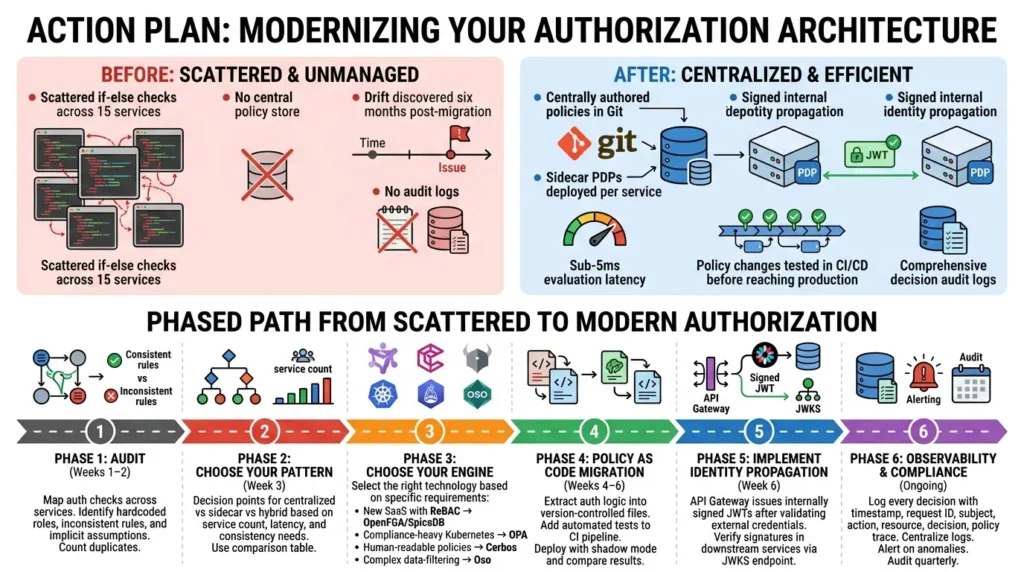
Before: Scattered if-else checks across 15 services, no central policy store, drift discovered six months post-migration, no audit logs.
After: Centrally authored policies in Git, sidecar PDPs deployed per service, sub-5ms evaluation latency, signed internal identity propagation, policy changes tested in CI/CD before reaching production, comprehensive decision audit logs.
Here’s the phased path from one to the other:
- Phase 1: Audit (Weeks 1–2): Map every authorization check across your services. Identify hardcoded role checks, inconsistent rules, and places where user context is implicitly assumed. Count how many services duplicate the same logic.
- Phase 2: Choose Your Pattern (Week 3): If you have fewer than 10 services and strong consistency requirements (financial, healthcare): centralized PDP. If you have 10+ services and latency sensitivity: sidecar PDP. If you’re a mature organization with a platform engineering team: hybrid. Use the comparison table above as your starting point.
- Phase 3: Choose Your Engine: New SaaS with ReBAC needs → OpenFGA or SpiceDB. Compliance-heavy Kubernetes environment → OPA. Teams needing human-readable policies → Cerbos. Complex data-filtering needs → Oso.
- Phase 4: Policy as Code Migration (Weeks 4–6): Extract authorization logic from application code into version-controlled policy files. Add automated policy tests to your CI pipeline. Deploy with shadow mode first, evaluate new policies in parallel without enforcement, compare results against your legacy logic.
- Phase 5: Implement Identity Propagation (Week 6): Configure your API Gateway to issue internally signed JWTs after validating external credentials. Verify signatures in all downstream services via a shared JWKS endpoint.
- Phase 6: Observability and Compliance (Ongoing): Log every authorization decision with timestamp, request ID, subject, action, resource, decision, and policy trace. Centralize logs. Alert on anomalies. Audit quarterly for policy drift.
Where This Is All Heading: 2026 and Beyond
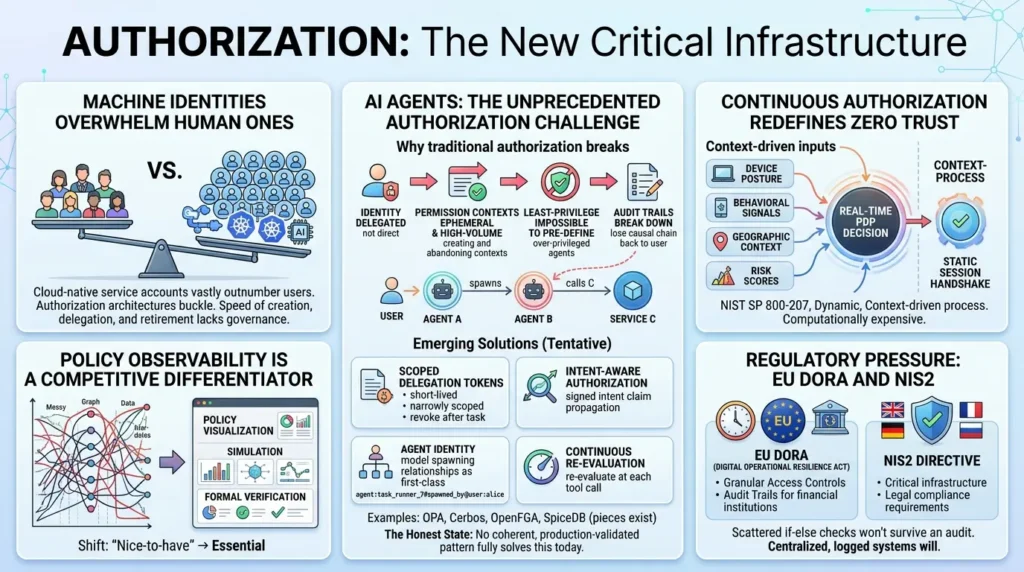
Authorization is quietly becoming critical infrastructure, on par with your database or your message queue. A few trends are accelerating this:
Machine identities are overwhelming human ones
In cloud-native environments, service accounts, CI/CD pipelines, Kubernetes pods, and AI agents vastly outnumber human users. Authorization architectures designed for human-scale identities are beginning to buckle. The governance mechanisms don’t yet exist for the speed at which machine identities are created, delegated, and retired.
AI Agents: The Authorization Challenge Nobody Is Ready For
Agentic systems are not a future concern, they are a present one. As of 2026, production deployments of autonomous AI agents are creating authorization failures that existing models were never designed to handle.
Why traditional authorization breaks for agents:
Current identity-based models assume a human initiates a session, performs some actions, and logs out. The authorization context is stable for minutes or hours. AI agents violate every one of these assumptions:
- Identity is delegated, not direct: An agent acts on behalf of a user, but with its own service identity. Who is the authoritative principal, the user who triggered the agent, or the agent’s own service account? Most systems today give inconsistent answers.
- Permission contexts are ephemeral and high-volume: A single agent task might create and abandon hundreds of permission sub-contexts per minute, spawning sub-agents, calling external APIs, reading and writing across services. Human-scale session models weren’t built for this throughput.
- Least-privilege is nearly impossible to pre-define: You don’t always know what permissions an agent will need until it’s running. Static role assignment at agent initialization leads to over-privileged agents, which is a significant blast radius if the agent is compromised or behaves unexpectedly.
- Audit trails break down: If Agent A spawns Agent B which calls Service C, traditional authorization logs show Service C receiving a request from Agent B, but lose the full causal chain back to the original user intent.
What the industry is converging on (tentatively):
- Scoped delegation tokens: Rather than assigning agents a static role, generate short-lived, narrowly scoped tokens at task initialization, tied to the specific resources and actions the task requires. Revoke them when the task completes.
- Intent-aware authorization: Attach the original user’s declared intent as a signed claim that propagates through the agent chain. PDPs can then evaluate whether a downstream action is consistent with the stated intent, not just whether the agent’s identity technically has permission.
- Agent identity graphs: Model agent spawning relationships as first-class relationships in your authorization graph (SpiceDB/OpenFGA are better positioned for this than OPA). agent:task_runner_7#spawned_by@user:alicebecomes a queryable tuple.
- Continuous re-evaluation: Unlike human sessions, agent permissions should be re-evaluated at each tool call, not just at session start. This is computationally expensive but necessary for high-risk operations.
The honest state of things: No authorization engine fully solves this today. OPA, Cerbos, OpenFGA, and SpiceDB all support pieces of it, but a coherent, production-validated pattern for agentic authorization at scale doesn’t yet exist. If you’re building agentic systems in 2026, design your authorization layer with explicit agent identity, scoped delegation, and per-action audit logging, and expect to iterate.
Continuous authorization is redefining Zero Trust
NIST SP 800-207 frames authorization as a dynamic, context-driven, continuously reevaluated process, not a session handshake at login time. This makes authorization infrastructure part of your critical runtime path, not just governance plumbing. Device posture, behavioral signals, geographic context, and risk scores all feed into the decision. That’s computationally expensive, and the industry is still figuring out how to make it sustainable at scale.
Policy observability will become a competitive differentiator
Right now, most teams can barely audit what authorization decisions were made, let alone why. As ReBAC graph complexity grows, automated tooling for policy visualization, simulation, and formal verification will shift from nice-to-have to essential.
The Regulatory Pressure: EU DORA and NIS2
Beyond technical evolution, regulation is forcing authorization into the spotlight. The EU’s Digital Operational Resilience Act (DORA), effective January 2025, requires financial institutions to demonstrate granular access controls and audit trails for all critical systems. NIS2 Directive, transposed into national law by October 2024, imposes similar requirements across critical infrastructure sectors.
For engineering teams, this means authorization is no longer just a best practice, it’s a legal compliance requirement. Scattered if-else checks won’t survive an audit. Centralized, logged, version-controlled authorization systems will.
Conclusion: Authorization Is Infrastructure Now
Here’s the contrarian truth that most security content refuses to say plainly: the hardest authorization problems today are not security problems. They’re distributed systems problems.
Stale reads. Propagation delays. Partial failures. Cache incoherence. These are the failure modes showing up in production authorization systems at scale, and they’re identical to the failure modes you’d find in a distributed database or a message queue. The mental model shift from “authorization is a security feature” to “authorization is distributed coordination infrastructure” changes everything about how you architect, operate, and observe it.
The good news: the industry has converged on proven patterns. Sidecar PDPs for local execution. Policy as Code in Git for governance. Signed internal JWTs for safe identity propagation. Zanzibar-inspired ReBAC for hierarchical permissions. AuthZEN for interoperability. These aren’t experimental ideas, they’re production-validated at some of the most demanding scale in the industry.
You don’t have to solve this at Google scale to benefit from thinking about it clearly. Whether you’re running five services or five hundred, the core principle is the same: treat authorization with the same architectural rigor you’d give to your database. Design for consistency trade-offs, plan for failure modes, invest in observability, and version your policies like code.
Start with an audit. Know where your authorization logic actually lives today. Then pick your pattern based on your real constraints, not the most impressive one you read about. The systems that get this right don’t just ship more securely. They ship faster, audit more easily, and recover from failures more gracefully.
That’s the payoff. And it compounds over time.
Ready to build or modernize your distributed authorization system? Start with a privilege audit, choose the right architecture, implement policy-as-code with CI/CD, and invest in observability and governance. The future of secure, scalable systems depends on it.
📚 References & Further Reading
Official Standards & Specifications
- OWASP Top 10: 2025 — Official OWASP vulnerability rankings.
- NIST SP 800-162 — Guide to Attribute-Based Access Control (ABAC).
- NIST SP 800-207 — Zero Trust Architecture.
- AuthZEN Authorization API 1.0 — OpenID Foundation Working Group.
Foundational Papers
- Zanzibar: Google’s Consistent, Global Authorization System — Pang et al., USENIX ATC 2019.
- Brewer’s Conjecture and the Feasibility of Consistent, Available, Partition-Tolerant Web Services — Gilbert & Lynch, ACM SIGACT News (2002).
- Consistency Tradeoffs in Modern Distributed Database System Design — Daniel Abadi, IEEE Computer (2012).
Tools & Projects Referenced
- Open Policy Agent (OPA) — CNCF Graduated Project.
- Cerbos — Open-source Policy Decision Point.
- Oso — Authorization Framework for Developers.
- OpenFGA — CNCF-hosted Relationship-based Authorization Engine.
- SpiceDB — Zanzibar-inspired Authorization Database.
Case Studies
Frequently asked questions (FAQS)



[…] Read the Full Article → […]
[…] Read the Full Article → […]