
Let me tell you something that might genuinely change the way you think about your business.
$4,700. From one email. Sent to 85 people.
That’s not a typo. That’s not some guru on a stage bragging about a course launch with a list of 100,000 people. That’s a real result from a tiny, engaged email list, and it proves something most people overlook: it’s not about how many subscribers you have. It’s about how much they trust you.
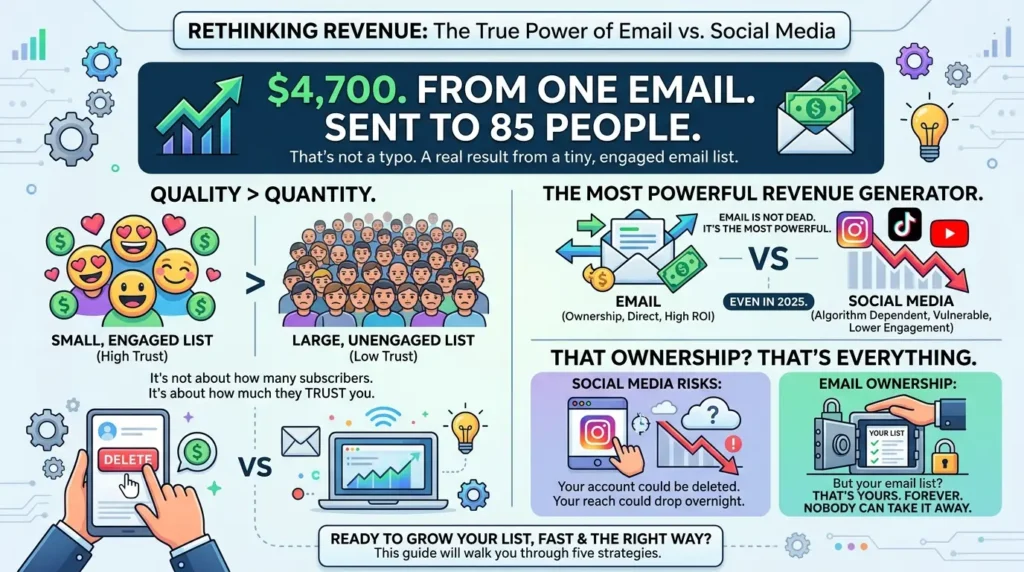
Email is not dead. Email is not “old school.” Email is, without any doubt, the most powerful revenue-generating platform available to business owners right now. Not Instagram. Not TikTok. Not even YouTube. Even in 2025, email marketing still outperforms almost every other channel because it’s personal, it’s direct, and unlike social media, you actually own your audience.
And that ownership? That’s everything.
Think about it. Your Instagram account could be deleted tomorrow. Your TikTok reach could drop to zero overnight because an algorithm updated. But your email list? That’s yours. Forever. Nobody can take that away from you.
So whether you’re brand new to email marketing or you’ve been sitting on a tiny list wondering what to do with it, this guide is going to walk you through exactly five strategies to grow that list, fast and the right way.
📊 Quick Stat That’ll Blow Your Mind
Email marketing generates an average ROI of $36 for every $1 spent. One business scaled to $1.5M in annual sales through strategic email alone. Your list is your most valuable business asset.
🔑 Key Takeaways
- Engagement Beats Volume: A tiny, high-trust email list is infinitely more profitable than a massive, disengaged one (e.g., $4,700 from just 85 subscribers).
- Optimize the Popup Delay: Trigger your website popups after 5–10 seconds instead of immediately to protect user experience and boost conversion rates.
- Leverage Pinterest for the Long Game: Treat Pinterest as a search engine to drive compounding, evergreen organic traffic to your subscriber landing pages.
- Use Waitlists & Giveaways for Rapid Growth: Leverage exclusive product drops to build hype, and run short (1-week) giveaways during business lulls to quickly capture warm leads.
- Simplify Your Landing Pages: A subscriber landing page must be short and focused. Keep the opt-in form above the fold and remove all distracting navigation links.
Before We Get Into the 5 Strategies: What Is a Landing Page (and Why You Need One)?
Most of the strategies below are going to require a landing page. So before we dive in, let’s get clear on what that actually means, because there’s a big difference between a sales landing page and a subscriber landing page.
A sales page? That’s long. It’s detailed. It sells. It persuades. It repeats the benefits over and over until the reader is convinced to buy.
A subscriber landing page is different. Much shorter. Much more focused. You’ve already dangled the carrot, whether that’s a discount, a free guide, a checklist, or a template. They’re coming to that page because they want what you’re offering. So your only job is to make signing up ridiculously easy.
Here’s what makes a great subscriber landing page:
- One clear headline that tells them exactly what they’re getting
- A brief description (two or three sentences max) that reinforces the value
- An opt-in form above the fold (meaning they don’t have to scroll to find it)
- Visuals that show what they’re actually receiving, if possible
- Zero distractions pulling their attention elsewhere
Host it on your own website. This matters because it drives traffic to your domain, helps your bounce rate, and keeps everything under your control. Don’t overthink the design. Simple wins. The goal is one action: subscribe.
| Landing Page Type | Length | Primary Goal | Key Element |
|---|---|---|---|
| Sales Page | Long, detailed | Drive a purchase | Proof + persuasion |
| Subscriber Landing Page | Short, focused | Collect email | Clear offer + easy opt-in |
| Giveaway / Waitlist Page | Short, visual | Build excitement + list | Urgency + prize focus |
Now, let’s get into the five strategies. I’ve saved the best for last, so don’t skip ahead.
Strategy 1: Website Popups (The Classic That Still Converts)
This is the most common email list growth tactic, and for good reason. It works. When someone lands on your website, a popup slides up from the bottom, appears in the center of the screen, or fades in after a few seconds, offering something valuable in exchange for an email address.
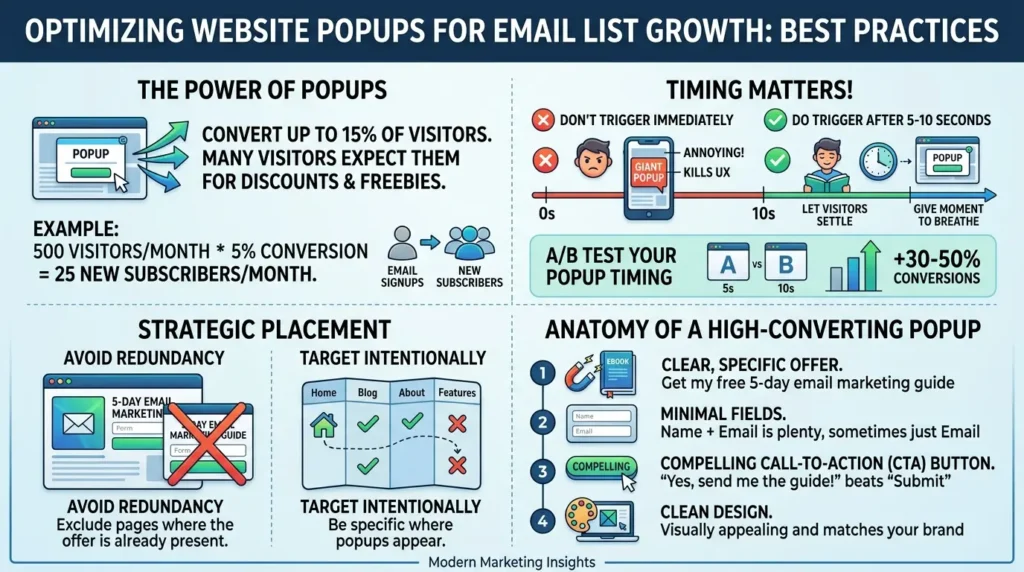
Popups convert up to 15% of visitors, and many website visitors actually expect them because they want discounts or freebies. That’s not a small number. If you have 500 people visiting your site monthly and you’re converting even 5% of them with a popup, that’s 25 new subscribers every single month without doing anything extra.
But here’s where most people mess this up.
They set the popup to fire the moment someone lands on the page. One second in, boom, a big box is in your face before you’ve even read a single line of the page. That’s annoying. That drives people away. And it absolutely kills your user experience.
Instead, set your popup to trigger after 5 to 10 seconds. Give them a moment to breathe, to settle into your content. Let them decide they like what they’re seeing before you ask for anything.
The second thing to watch? Where the popup appears. It’s tempting to set it to fire across your entire website. But if someone is already on a landing page for that same freebie, the popup showing up is redundant and jarring. Be intentional. Exclude pages where the offer is already present.
⚡ Quick Tip
Test your popup timing. Try 5 seconds on one week and 10 seconds the next. A/B testing your trigger timing can improve conversions by 30–50% with zero change to your offer or design.
What makes a high-converting popup?
- A clear, specific offer (“Get my free 5-day email marketing guide”)
- Minimal fields (name + email is plenty, sometimes just email)
- A compelling call to action button (“Yes, send me the guide!” beats “Submit” every single time)
- Clean design that matches your brand
Strategy 2: Social Media, Your Link in Bio, and the Underrated Pinterest Play
Here’s the truth about social media and email list building. Your social platforms shouldn’t just be content machines. They should be funnels. Every piece of content you post is an opportunity to move someone from casual follower to committed subscriber.
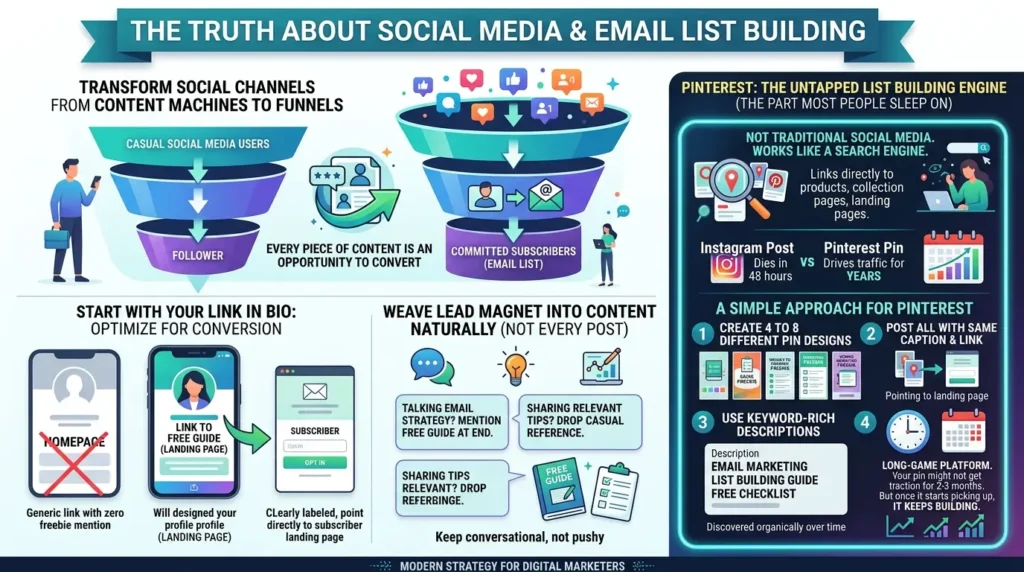
Start with your link in bio. This sounds obvious but you’d be shocked how many people have a generic website link there with zero mention of the freebie they’re offering. Your link in bio should be clearly labeled and point directly to your subscriber landing page. Not your homepage. Your landing page.
Then there’s your actual content. You don’t need to mention your lead magnet in every single post. That gets old fast. But weave it in naturally. If you’re talking about email marketing strategy, mention your free guide at the end. If you’re sharing tips that connect to your freebie topic, drop a casual reference. Keep it conversational, not pushy.
Now here’s the part most people sleep on completely.
Platforms like Pinterest link directly back to your products, collection pages, and landing pages, making it an easy and fast way to promote your freebie to new audiences. The reason Pinterest is so powerful for list building is that it works like a search engine. It’s not social in the traditional sense. People go to Pinterest with intention. They’re searching for something specific. And when your pin shows up in that search, they’re already in a receptive mindset.
Here’s the simple approach:
- Create four to eight different pin designs for your freebie (different colors, layouts, slightly different wording)
- Post all of them with the same caption and link pointing to your landing page
- Use keyword-rich descriptions so the pins get discovered organically over time
- Let them sit
That last point is important. Pinterest is a long-game platform. Your pin might not get traction for two or three months. But once it starts picking up, it keeps building. Unlike Instagram where a post dies in 48 hours, a good Pinterest pin can drive traffic to your landing page for years.
💡 Pinterest Strategy in a Nutshell
- Design multiple pin variations for the same freebie
- Include your target keywords in the pin title and description
- Link every pin directly to your subscriber landing page
- Pin consistently, even just 2–3 times per week
- Be patient. The compound effect here is real.
Strategy 3: Paid Advertising (Yes, It’s Worth Considering)
Nobody’s favorite topic. But let’s talk about it honestly.
Paid ads on Google or Meta platforms can absolutely accelerate your list growth. And if you think about it from a pure math perspective, it makes sense. If you know that every 100 subscribers you add generates $500 in revenue during a launch, then spending $50 to acquire those 100 subscribers is a very smart investment.
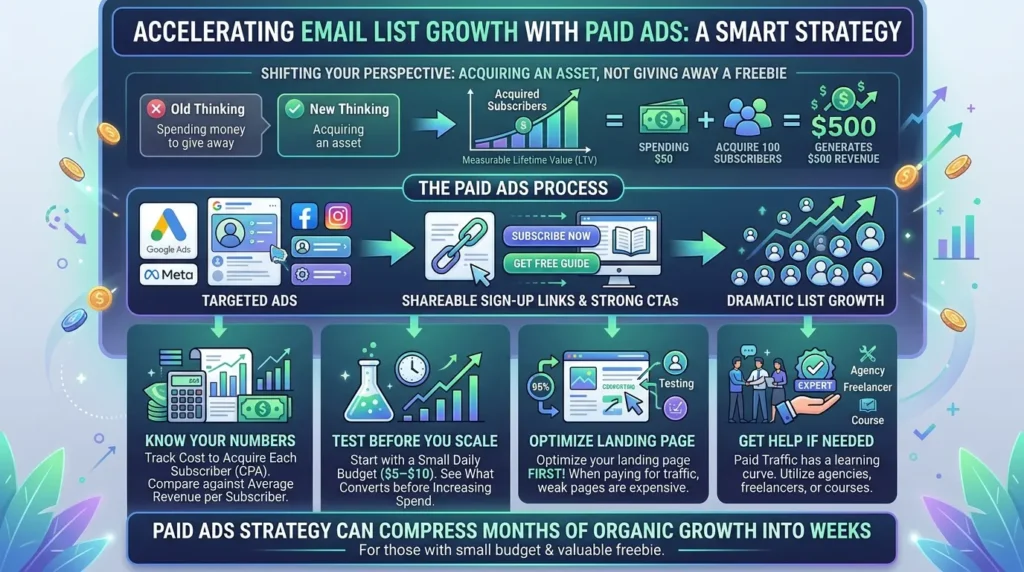
The reason people resist this strategy is that it feels like spending money to give something away for free. But you’re not giving something away. You’re acquiring an asset. Every engaged subscriber on your list has a measurable lifetime value.
Running targeted ads on Facebook and Instagram to reach specific audiences, combined with shareable sign-up links with strong calls to action, can dramatically boost your list size.
A few things to keep in mind if you go this route:
- Know your numbers: Track what it costs to acquire each subscriber and compare that against your average revenue per subscriber.
- Test before you scale: Start with a small daily budget ($5–$10) and see what converts before increasing spend.
- Your landing page matters more here: When you’re paying for traffic, a weak landing page is expensive. Optimize it first.
- Get help if you need it: Whether that’s an agency, a freelancer, or a solid course on Meta ads, paid traffic has a learning curve.
This strategy isn’t the right fit for everyone, especially if you’re just starting out. But if you have even a small budget and a freebie that genuinely delivers value, paid ads can compress months of organic growth into weeks.
Strategy 4: Product Hype and Waitlists (This One Is Special)
Okay, now we’re getting into the good stuff.
This strategy works best if your business has an element of scarcity or exclusivity. Limited drops. Small batch products. Seasonal collections. If your brand operates in a space where people get excited about new releases, this is incredibly powerful.
Here’s the concept. Before a product or collection launches, you create a waitlist landing page. This page is specifically about that product. It’s not your generic email opt-in with a freebie. It’s a focused, product-driven experience that builds anticipation and gets people to sign up so they don’t miss out.
Think about how this feels different from a normal opt-in. Instead of “Sign up to get a free checklist,” you’re saying, “Be the first to access our new limited collection.” That’s a completely different energy. It’s exciting. It creates urgency. And for the right audience, it’s irresistible.
One thing that makes this strategy even more effective: you push it to your existing list too. Your current subscribers become amplifiers. They talk about it. They share it. Word of mouth is still one of the most underrated growth tools available, and your email list is the ignition switch.
The sign-up form needs to be above the fold. Always. Nobody should have to scroll to find where they can join your waitlist. If they land on the page and can’t immediately see how to sign up, you’ve lost them.
Strategy 5: Hosting a Giveaway (The Fastest Way to Grow Your List)
This is it. The absolute best way to add a large number of engaged, excited subscribers to your email list in a very short amount of time.
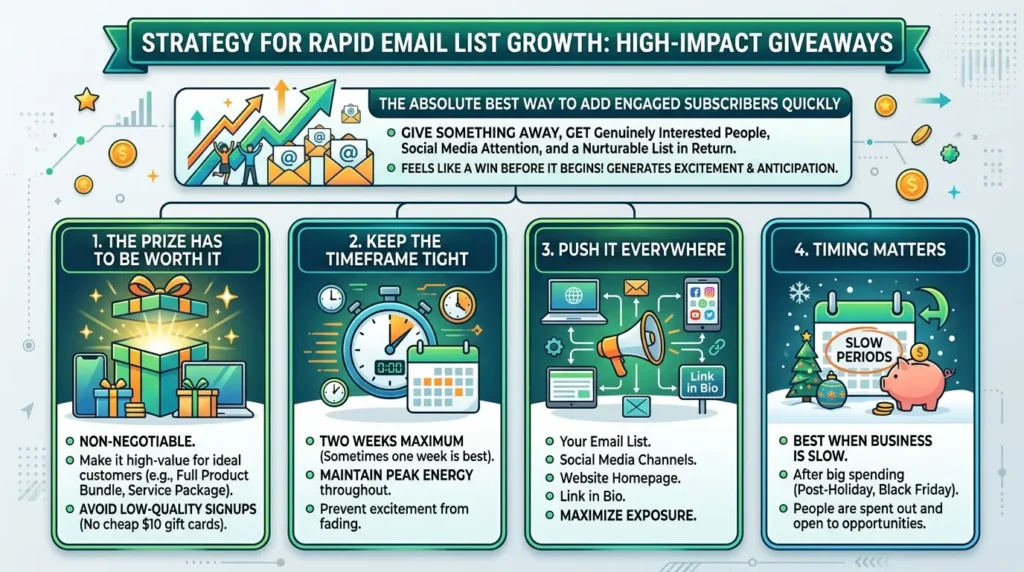
Yes, you have to give something away. But think about what you get in return. A surge of new people who are genuinely interested in your brand. A spike in social media attention. And a growing list that you can nurture into paying customers.
Contests requiring email entries are highly effective for rapid list growth, and the reason is simple. Entering a giveaway feels like a win before it even begins. There’s excitement, anticipation, and a reason to pay attention to your brand.
Here’s what makes a giveaway work:
The prize has to be worth it
This is non-negotiable. If you offer a $10 gift card, you’ll get low-quality signups from people who couldn’t care less about your business. Make the prize something your ideal customer would genuinely want. A full product bundle. A service package. Something with real value.
Keep the timeframe tight
Two weeks maximum. Honestly, even one week can work brilliantly. The hype around a giveaway is strongest at the start. It fades fast. A shorter window keeps the energy high throughout and gives you less time to “maintain” the momentum.
Push it everywhere
Your email list, your social media channels, your website homepage, your link in bio. Everywhere. The more exposure it gets, the faster your list grows.
Timing matters more than most people realize
The absolute best time to run a giveaway? When business is slow. After a big spending period, like right after Black Friday or the post-holiday season, people are spent out. They’re not in buying mode. A giveaway meets them exactly where they are, giving them a way to connect with your brand without asking for their money.
📅 Best Times to Run a Giveaway
Post Black Friday / Cyber Monday
Customers just spent big. Re-engage them with a prize instead of another pitch.
January (Post-Holiday Slump)
People are bored, not buying, and very open to fun brand interactions.
Any Natural Business Lull
Whenever revenue dips, a giveaway keeps your audience warm and your brand top of mind.
Before a Product Launch
Build your list first, then convert those warm subscribers into buyers on launch day.
Plan your giveaways ahead of time. Put two or three on the calendar for the year. Make them something your audience genuinely looks forward to. When you do it right, a single giveaway can add hundreds of engaged subscribers to your list within days.
The Real Secret Behind All Five Strategies
Here’s something I want you to sit with for a moment.
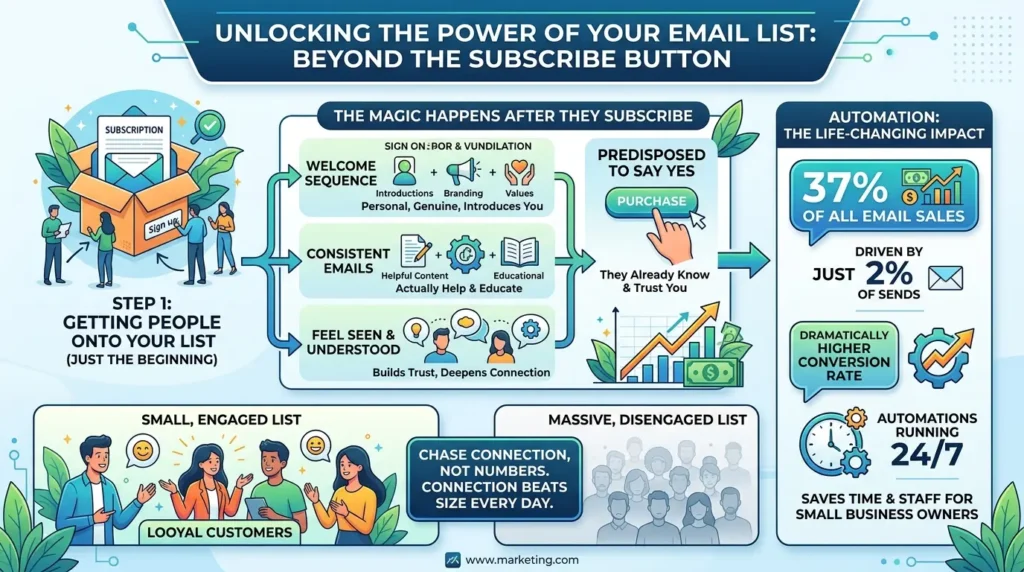
Getting people onto your list is just step one. The magic, the actual revenue, the $4,700-from-one-email kind of results, comes from what happens after they subscribe.
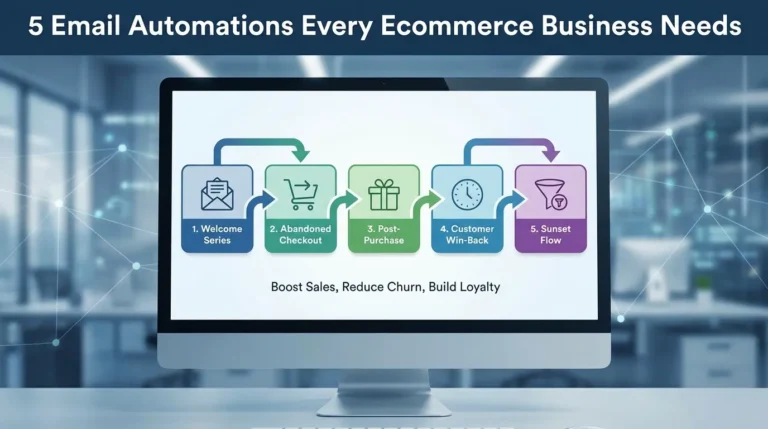
That means a welcome sequence that introduces you, your brand, and your values in a way that feels personal and genuine. It means consistent emails that actually help them. That educate them. That make them feel seen and understood. By the time you’re ready to sell something, they already know you, they already trust you, and they’re already predisposed to say yes.
Automations running around the clock drive 37% of all email sales from just 2% of sends, with a dramatically higher conversion rate than manual campaigns. That’s not just impressive. That’s life-changing for a small business owner who doesn’t have unlimited time or staff.
A small, engaged list beats a massive, disengaged one every single day. Don’t chase numbers. Chase connection.
A Quick Summary: Your 5 Email List Building Strategies
- Website Popup: Trigger after 5–10 seconds, offer real value, and keep the form simple.
- Social Media + Pinterest: Use your link in bio strategically and tap Pinterest for long-term organic discovery.
- Paid Ads: When you know your numbers, paid traffic is a smart investment in your most valuable asset.
- Product Hype / Waitlist: Build anticipation before launches. Scarcity and exclusivity are your best friends.
- Giveaways: The fastest list-growth strategy when done with the right prize, timing, and promotion.
Conclusion: Your List Is Your Most Valuable Business Asset
Here’s the bottom line. You can build an audience on any platform you want. You can grow your Instagram following into the tens of thousands. You can go viral on TikTok. But none of that is truly yours.
Your email list is different. It’s yours. It’s direct. It’s personal. And when you build it with intention, fill it with people who genuinely care about what you do, and nurture those relationships with real value, it becomes the most powerful revenue engine your business has.
Start with one strategy. Pick the one that feels most aligned with where your business is right now. Set it up properly. Commit to it. Then layer in the others over time.
Because the person who sent that first email to 85 subscribers and made $4,700 in a single day? They didn’t have a secret formula. They had an engaged list and a relationship built on trust.
That’s completely within your reach too.