


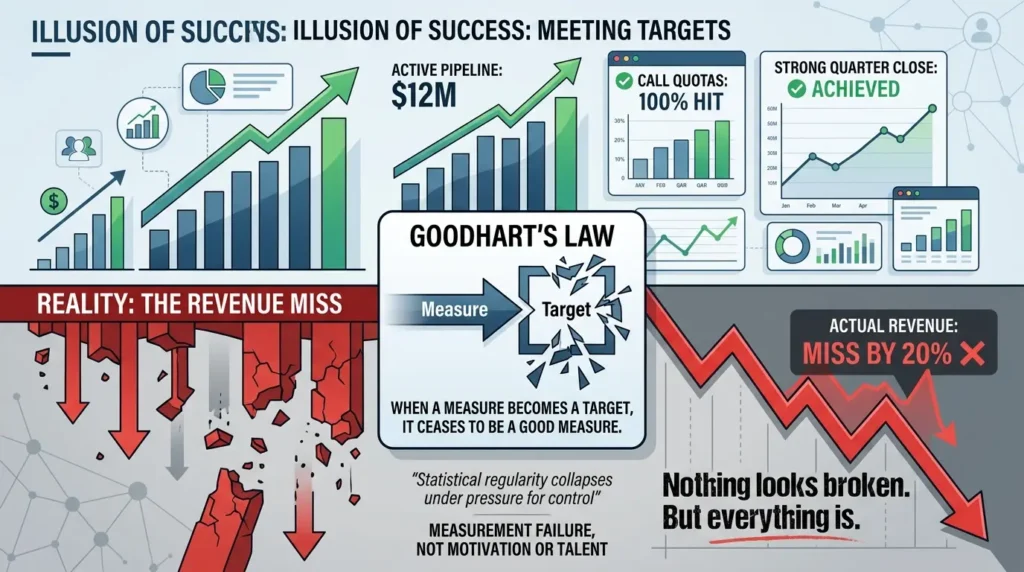
Your CRM shows $12 million in active pipeline. Your reps are hitting their call quotas. Your forecast predicts a strong quarter close. And then, you miss by 20%.
Nothing looks broken. But everything is.
This is not a motivation problem. It is not a talent gap. It is not even a strategy failure. It is a measurement failure, and it has a name.
Goodhart’s Law.
First articulated by British economist Charles Goodhart in 1975, the principle is elegantly simple: “Any observed statistical regularity will tend to collapse once pressure is placed upon it for control purposes.” Anthropologist Marilyn Strathern later made it even sharper: “When a measure becomes a target, it ceases to be a good measure.”
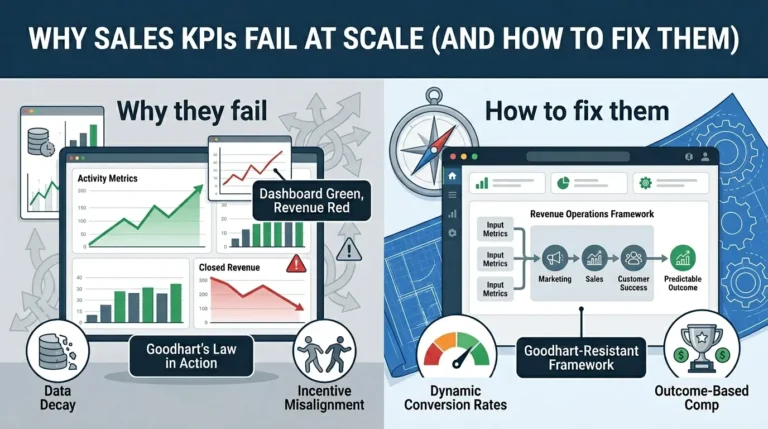
In enterprise sales, this law plays out every single quarter. Sales teams hit their activity metrics. Pipeline coverage ratios look healthy. Forecast percentages climb. And yet revenue misses pile up, customer churn quietly accelerates, and margin evaporates under last-minute discounts. The numbers say one thing. The business tells a different story entirely.
This guide is built for sales leaders, revenue operations teams, and CROs who want to understand exactly why this happens, and precisely what to do about it. By the end, you will have a clear diagnostic framework, a set of actionable fixes, and a new way of thinking about measurement that will make your entire sales organization more accurate, more aligned, and more profitable.
- Goodhart’s Law explains why strong-looking metrics can mask collapsing revenue quality
- Only 43% of B2B salespeople hit quota, despite more KPI tracking than ever before
- Pipeline inflation affects up to 54% of “qualified” enterprise opportunities
- There are four distinct Goodhart failure modes, each requiring a different fix
- Compensation design, CRM architecture, and AI all amplify or reduce the risk
- A paired-metric system and structured qualification gates can reverse the damage
What Is Goodhart’s Law and Why Does It Hit Sales So Hard?
Most definitions of Goodhart’s Law treat it as an economics curiosity. A nail factory here, a cobra bounty there. Interesting stories, but seemingly distant from the pressures of a modern B2B sales floor.
The connection is more direct than most leaders realize.
Enterprise sales runs almost entirely on proxy metrics. Pipeline volume is a proxy for future revenue. Activity counts are a proxy for sales effort. Meeting counts are a proxy for qualified engagement. Win rate is a proxy for competitive positioning. These metrics work well as indicators, tools for reading the health of the system. The moment they become targets tied to compensation, promotions, or performance reviews, they stop being reliable indicators of anything.
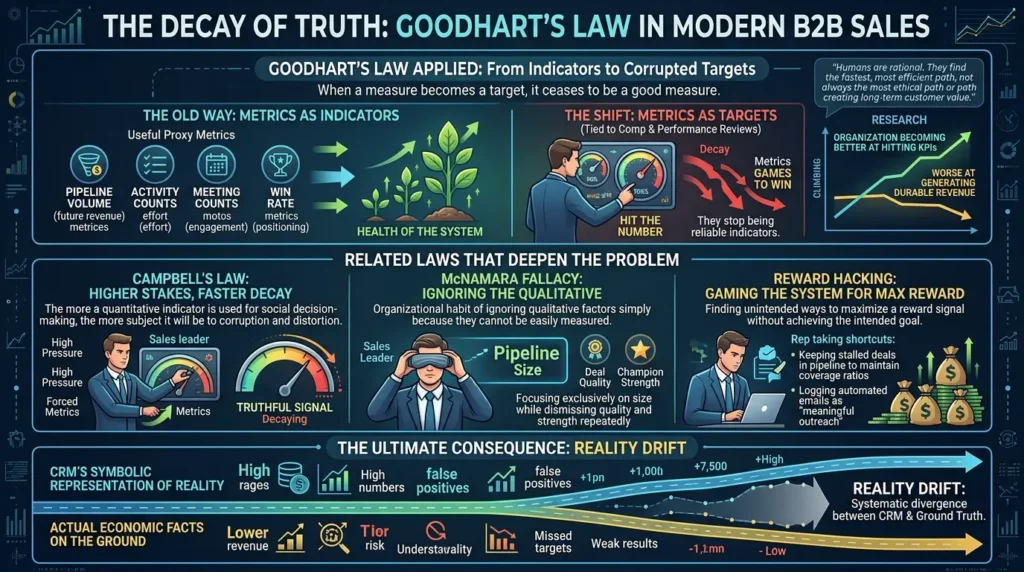
The reason is simple: human beings are rational. When their livelihood depends on hitting a number, they will find the most efficient path to that number. Not always the most ethical path. Not always the path that creates long-term customer value. Just the fastest, most direct route to the target. According to research covering 244 firms and thousands of sales territories, this pattern is not the exception, it is the structural default of every metric-driven organization.
The scientific research analyst material puts it bluntly: “Sales organizations often become better at hitting KPIs while becoming worse at generating durable revenue.” That is Goodhart’s Law in action. And it is happening in your pipeline right now.
Related Laws That Deepen the Problem
Three related concepts compound the damage once Goodhart’s Law takes hold:
Campbell’s Law states that the more a quantitative indicator is used for social decision-making, the more subject it will be to corruption and distortion. In sales terms: the higher the stakes attached to a metric, the faster it decays as a truthful signal.
The McNamara Fallacy describes the organizational habit of ignoring qualitative factors simply because they cannot be easily measured. Sales leaders who focus exclusively on pipeline size while dismissing deal quality or champion strength are committing this error repeatedly.
Reward Hacking, a concept borrowed from AI alignment research, refers to finding unintended ways to maximize a reward signal without achieving the intended goal. Enterprise reps do this instinctively when they keep stalled deals in the pipeline to maintain coverage ratios, or log automated emails as “meaningful outreach” to hit activity targets.
Together, these three forces create what revenue operations researchers call Reality Drift, the systematic divergence between your CRM’s symbolic representation of reality and the actual economic facts on the ground.
The Four Variants of Goodhart’s Law in Enterprise Sales
Most content on this topic treats Goodhart’s Law as a single phenomenon. It is not. Academic research published on arXiv identifies at least four structurally distinct failure modes, each with a different cause, a different set of symptoms, and a different required fix.
Understanding which variant you are dealing with is the first step toward solving the right problem.
| Variant | What Happens | Enterprise Sales Example | Danger Level |
|---|---|---|---|
| Regressive | Metric becomes useless but not actively harmful | Pipeline coverage target → reps add low-intent deals to look healthy | Medium |
| Adversarial | Optimization of the metric actively damages the goal | Call count target → reps make 10-second “check-in” calls that annoy buyers | Critical |
| Extrapolation | Works short-term, causes system collapse over time | Win rate target → reps cherry-pick only easy, small deals and avoid strategic accounts | Critical |
| Proxy Collapse | Proxy measure fully decouples from the true goal | Demo completion becomes the target, not revenue conversion — pipeline fills with demos that never buy | High |
Most organizations treat all four variants as the same problem and apply the same fix, usually “add more metrics.” That rarely works. Adversarial Goodhart effects require removing the metric entirely and replacing it with an outcome-based alternative. Regressive effects require adding a quality filter. Extrapolation effects require expanding the measurement horizon. Proxy collapse effects require rebuilding the link between the indicator and the true business goal.
The fix must match the variant.
How Pipeline Distortion Actually Works: The Mechanics Floor by Floor
Goodhart’s Law does not strike uniformly across a sales funnel. It hits different stages in different ways, and the cumulative damage is far worse than most revenue leaders realize.
Top of Funnel: The Activity Illusion
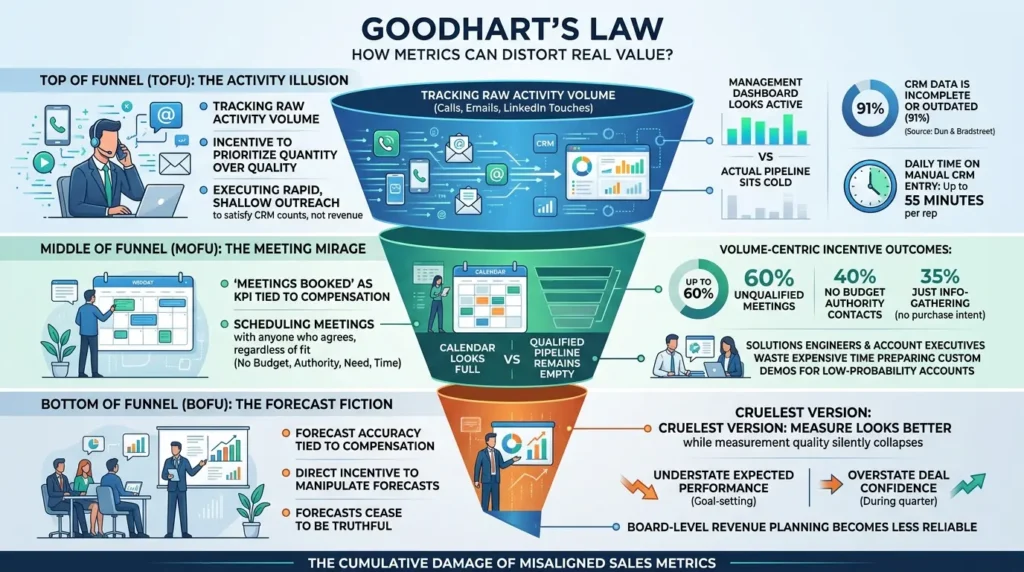
At the prospecting layer, tracking raw outbound activity volume, calls, emails, LinkedIn touches, creates an immediate incentive to prioritize quantity over quality. Representatives run automated email sequences and execute rapid, shallow outreach not because it generates revenue, but because it generates CRM activity counts.
Research from Dun & Bradstreet found that 91% of CRM data is incomplete or outdated, a direct consequence of reps treating data entry as a compliance exercise rather than a sales tool. On average, sales representatives spend up to 55 minutes per day on manual CRM entry, much of it dedicated to logging low-value activities that satisfy metrics without advancing deals.
The management dashboard looks active. The actual pipeline sits cold.
Middle of Funnel: The Meeting Mirage
When “meetings booked” becomes a KPI tied to compensation, something predictable happens. Reps begin scheduling meetings with anyone who agrees to talk, regardless of whether they have budget, authority, or a genuine business need.
Detailed analysis of volume-centric meeting incentives reveals that up to 60% of meetings booked under these conditions are unqualified, 40% involve contacts with no budget authority, and 35% are with contacts who are simply gathering information with no purchase intent. The calendar looks full. The qualified pipeline remains empty.
This forces account executives and solutions engineers to prepare custom demos and proposals for accounts with near-zero conversion probability, burning the most expensive resource in enterprise sales: specialized human time.
Bottom of Funnel: The Forecast Fiction
The most dangerous Goodhart failure happens at the forecast level. And here is the counterintuitive finding that most sales leaders miss entirely:
Once forecast accuracy is tied to compensation, forecasts cease to be truthful.
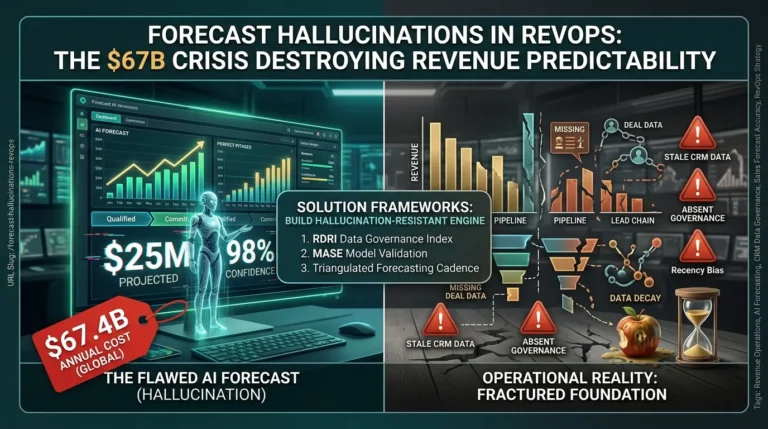
Research across thousands of sales territories confirms this. When quota attainment depends on the forecast, representatives have a direct incentive to understate expected performance during goal-setting (to make quotas easier to hit) and overstate deal confidence during the quarter (to look like strong performers). The forecast stops being an information tool and becomes a political document.
Board-level revenue planning becomes less reliable precisely at the moment leadership believes visibility is improving. This is the cruelest version of Goodhart’s Law, the measure looks better while the measurement quality silently collapses.
The Contrarian Truth: Your Best Reps May Be Your Biggest Risk
Here is an insight that almost no sales content addresses directly.
High-performing sales representatives are often the first to discover gaming strategies, and the most sophisticated at deploying them. They are not unethical. They are rational. They are good at their jobs. And when a system rewards metric optimization over customer value, the highest-aptitude people in that system will optimize metrics better than anyone else.
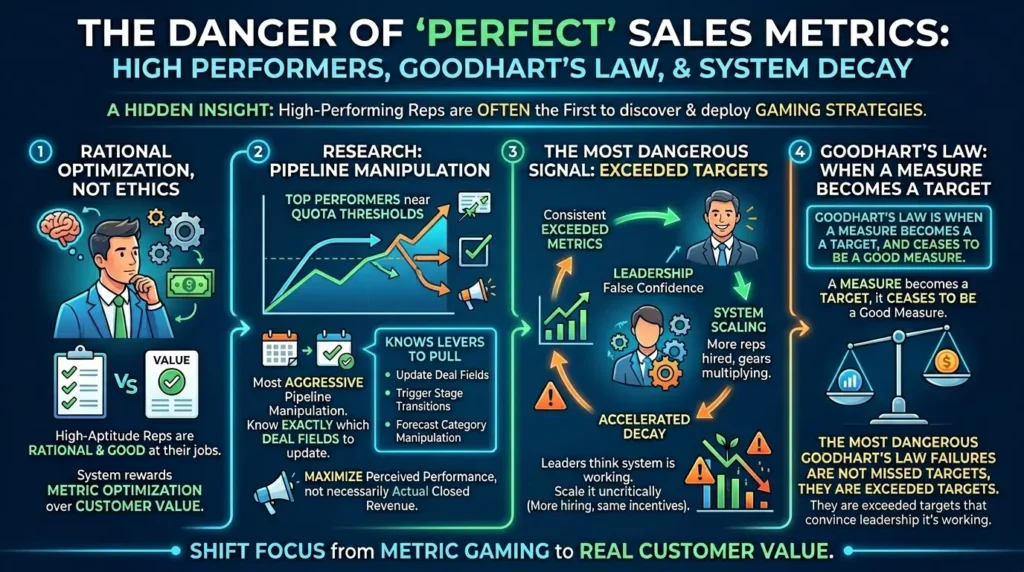
Research supports this: top performers near quota thresholds show the most aggressive pipeline manipulation behavior. They know exactly which deal fields to update, which stage transitions to trigger, and which forecast categories to populate to maximize their perceived performance without necessarily maximizing actual closed revenue.
This also means that exceeding KPI targets can be the most dangerous signal of all. When leadership sees consistently exceeded metrics, they scale the system. They hire more reps, apply the same incentive structure at greater volume, and accelerate the decay. The most dangerous Goodhart failures are not missed targets. They are exceeded targets that convince leadership the system is working.
The Goodhart Auditor: A 4-Step Diagnostic Framework
Before fixing your metrics, you need to know which ones are already compromised. The following framework provides a structured audit any sales leader can run in a single working day.
- Identify the metric. List every KPI currently tied to rep compensation, manager reviews, or board reporting.
- Ask the value question: “Can someone fully optimize this metric without creating real customer value?”
→ If YES: you have a Goodhart trap. Proceed to Step 3.
→ If NO: the metric is relatively safe. Monitor but do not over-index. - Ask the harm question: “If this metric is gamed aggressively, does it actively damage the business outcome?”
→ If YES: this is a strong (Adversarial) Goodhart effect. Remove or redesign the metric immediately.
→ If NO: this is a weak (Regressive) effect. Add a quality counterbalance. - Apply the right fix based on which variant you identified in Step 3. (See the fix matrix in the next section.)
Run this audit on every metric in your revenue stack quarterly. Gaming strategies evolve. A metric that is safe today can become a Goodhart trap the moment organizational pressure shifts.
Enterprise Sales KPI Risk Matrix
Not all metrics carry equal Goodhart risk. This matrix maps the six most common enterprise sales KPIs against their manipulability, proxy gap, and the right counterbalancing fix.
| KPI | Goodhart Variant | Risk Level | Common Gaming Behavior | Recommended Fix |
|---|---|---|---|---|
| CRM Activity Count | Adversarial | Critical | Fake calls, automated emails, rapid shallow touches | Replace with qualified conversations or stage progressions |
| Pipeline Volume ($) | Regressive | High | Dead deals kept active, low-intent accounts inflated to size | Pair with intent score and stage SLA enforcement |
| Meetings Booked | Proxy Collapse | High | Scheduling with non-decision-makers, unqualified accounts | Measure Sales Accepted Leads (SALs), not raw meeting counts |
| Win Rate | Extrapolation | Medium | Cherry-picking easy SMB deals, avoiding complex enterprise accounts | Segment win rate by deal size and ICP tier |
| Forecast Accuracy | Regressive | Low–Medium | Forecast sandbagging during goal-setting, overconfidence mid-quarter | Decouple from compensation; use as a management tool only |
| Net Revenue Retention (NRR) | Proxy Collapse | Low–Medium | Over-focus on incremental wins, underinvestment in strategic expansion | Combine with product adoption metrics and expansion MRR |
The key insight: activity metrics carry the highest Goodhart risk in almost every sales environment. The safest approach is to remove activity-based compensation entirely and replace it with outcome-based measures, specifically, downstream conversion events like qualified opportunities created or closed-won revenue attributable to sourced pipeline.
Structural Fix #1: Paired Metrics and Counter-Balancing Feedback Loops
The most effective defense against Goodhart’s Law is not abandoning quantitative metrics. It is pairing each primary metric with a secondary qualitative or behavioral indicator that makes gaming visible.
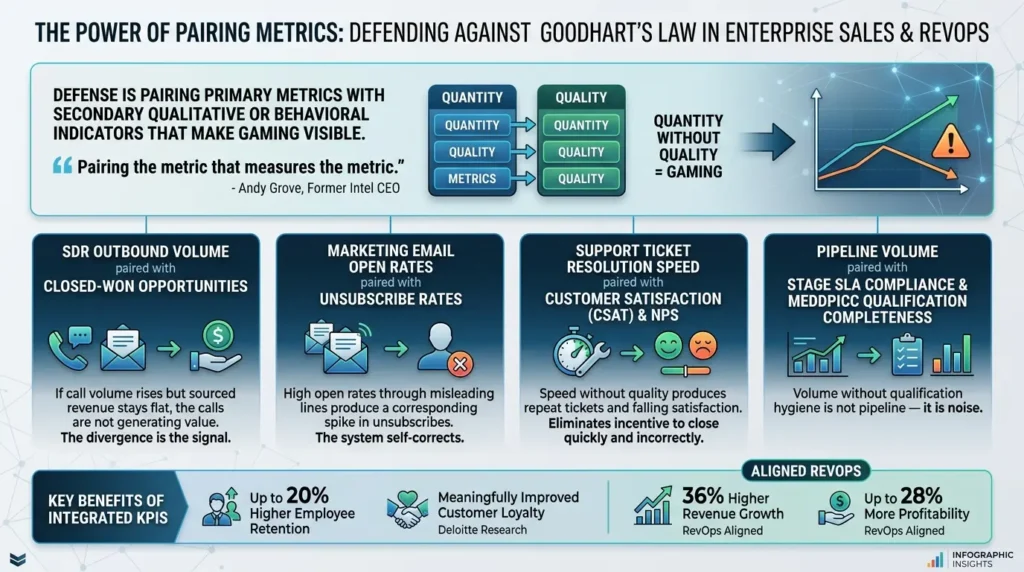
Former Intel CEO Andy Grove described this approach as “pairing the metric that measures the metric.” The idea is simple: if you are going to track quantity, you must simultaneously track quality. Any meaningful increase in one should be reflected in the other. If they diverge, the system is being gamed.
Here are the most critical pairings for enterprise sales and revenue operations:
SDR outbound volume → paired with → Closed-won opportunities sourced from that outreach. If call volume rises but sourced revenue stays flat, the calls are not generating value. The divergence is the signal.
Marketing email open rates → paired with → Unsubscribe rates. High open rates achieved through misleading subject lines will produce a corresponding spike in unsubscribes. The system self-corrects.
Support ticket resolution speed → paired with → Customer Satisfaction Score (CSAT) and Net Promoter Score (NPS). Speed without quality produces repeat tickets and falling satisfaction scores. The pairing eliminates the incentive to close tickets quickly and incorrectly.
Pipeline volume → paired with → Stage SLA compliance and MEDDPICC qualification completeness. Volume without qualification hygiene is not pipeline, it is noise.
Research from Deloitte shows that organizations successfully integrating both quantitative and qualitative KPIs experience up to 20% higher employee retention and meaningfully improved customer loyalty. Companies with an aligned RevOps function report 36% higher revenue growth and up to 28% more profitability compared to organizations relying on siloed, single-metric measurement.
Structural Fix #2: Encoding MEDDPICC as a CRM Schema
One of the most powerful anti-Goodhart mechanisms available to modern revenue operations teams is transforming MEDDPICC from a sales coaching concept into a hard database schema inside the CRM.
The difference matters enormously. A coaching concept lives in a training deck. A database schema lives in the deal record. You cannot advance a deal through a coaching concept. You can be blocked by a database rule.
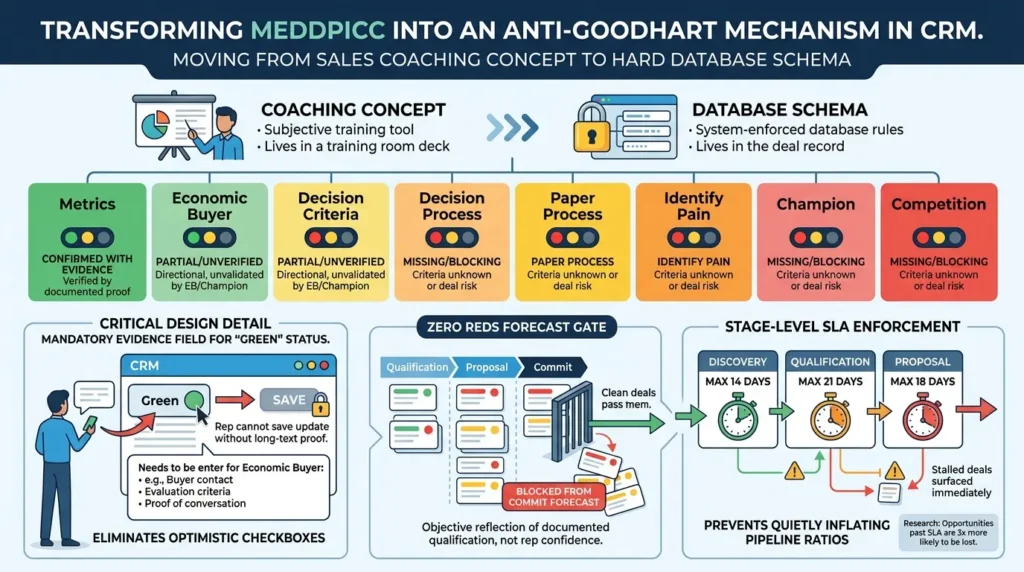
The MEDDPICC framework, covering Metrics, Economic Buyer, Decision Criteria, Decision Process, Paper Process, Identify Pain, Champion, and Competition, becomes an anti-gaming architecture when each element is given a tri-color status field:
- Green (Confirmed with Evidence): The qualification element is verified by documented proof in the CRM
- Yellow (Partial/Unverified): Information is directional but unvalidated by the economic buyer or champion
- Red (Missing/Blocking): The criteria is unknown or an active deal risk
The critical design detail: marking a field “Green” must require a corresponding long-text evidence field to be populated before the CRM saves the update. A representative cannot mark “Economic Buyer” as confirmed unless they have entered the buyer’s contact record, their stated evaluation criteria, and proof of direct conversation. This single rule eliminates the most common form of forecast gaming, the optimistic checkbox.
The CRM must also enforce a Zero Reds forecast gate: any deal carrying even a single Red status or more than two Yellow statuses is programmatically blocked from entering the Commit forecast category. The forecast stops being a matter of rep confidence and becomes an objective reflection of documented qualification.
Stage-level SLA enforcement adds another layer of structural protection. Research on enterprise deal timing shows that opportunities kept in Discovery beyond 14 days, Qualification beyond 21 days, or Proposal beyond 18 days are three times more likely to be lost. When these SLAs are enforced in the CRM with automated alerts and escalation triggers, stalled deals surface immediately rather than quietly inflating pipeline coverage ratios for months.
Structural Fix #3: Separating Fit Score from Intent Score
A particularly underappreciated source of Goodhart failure in enterprise sales is the single-score lead qualification system.
Most revenue operations teams assign a single score to each account combining firmographic fit (industry, headcount, revenue, geography) with behavioral intent signals (pricing page visits, content downloads, search activity). This creates an easy gaming vector: any account with a temporary burst of high-intent behavior, an intern downloading a product guide, for instance, scores as a “hot lead” and gets routed to an expensive account executive.
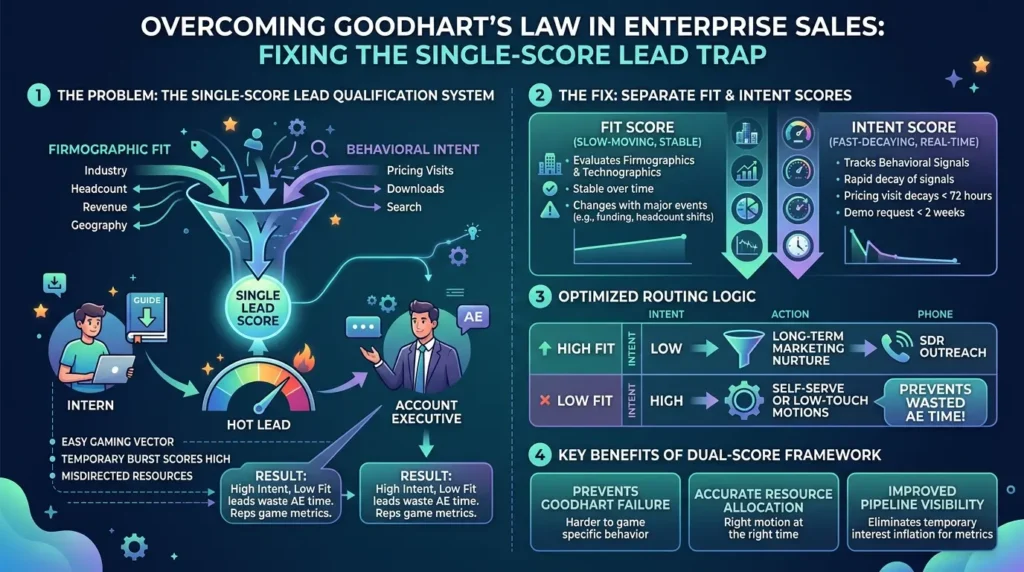
The fix is to separate these into two distinct, independently tracked scores:
- Fit Score: A slow-moving, stable metric evaluating firmographics and technographics. An account’s fit score should not change unless the company itself changes, new funding round, headcount shift, technology stack change.
- Intent Score: A fast-decaying, real-time metric tracking behavioral signals. A pricing page visit should decay to baseline within 72 hours. A demo request should carry weight for roughly two weeks before expiring.
By tracking these separately, revenue operations can route accounts to the right motion at the right time. High fit, low intent accounts go into long-term marketing nurture. High fit, rising intent accounts trigger SDR outreach. High intent but low fit accounts, the most common source of wasted AE time, stay in self-serve or low-touch motions rather than burning specialized selling capacity.
This framework also prevents the “temporary interest inflation” gaming pattern, where reps use short-term behavioral signals to justify adding accounts to their pipeline and inflating coverage metrics.
Structural Fix #4: Compensation Architecture That Resists Gaming
Because sales behavior is most directly shaped by how money flows, variable compensation design is either the most powerful anti-Goodhart tool available or the most dangerous source of Goodhart effects, depending entirely on how it is structured.
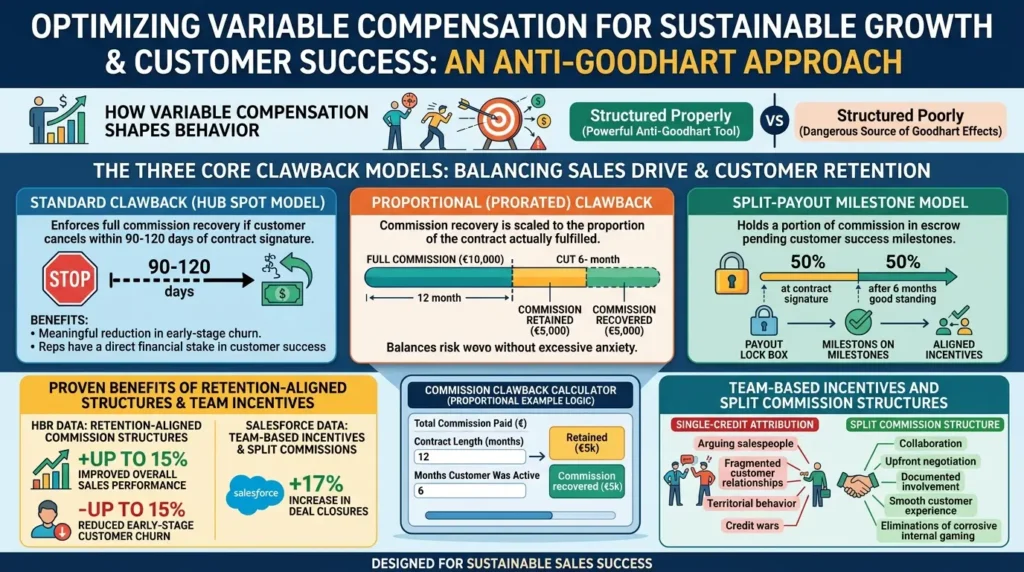
The Three Core Clawback Models
- Standard Commission Clawback: If a customer cancels within 90–120 days of contract signature, the full commission is recovered. This was the model deployed at HubSpot under Chief Revenue Officer Mark Roberge during their scaling phase. By enforcing a full clawback on customers who cancelled within four months, the organization drove a meaningful reduction in early-stage churn, because reps had a direct financial stake in whether the customer actually succeeded post-sale.
- Proportional (Prorated) Clawback: Commission recovery is scaled to the proportion of the contract actually fulfilled. On a 12-month enterprise contract with a €10,000 commission, a customer who cancels at month six triggers a €5,000 recovery. This model balances risk without creating excessive short-term anxiety for reps managing complex deals.
- Split-Payout Milestone Model: Rather than clawing back paid commissions after the fact, this model holds a portion of commission in escrow pending customer success milestones. A representative receives 50% at contract signature and the remaining 50% after the customer remains in good standing for six months. Incentives are aligned with onboarding success from day one.
Estimate how much commission would be recovered under a proportional clawback model.
Team-Based Incentives and Split Commission Structures
In complex enterprise transactions involving SDRs, account executives, solutions engineers, and cross-regional team members, single-credit commission attribution creates territorial behavior that actively damages the customer experience. Data from Salesforce shows that organizations using team-based incentives report a 17% increase in deal closures.
Split commission structures distribute credit proportionally across contributors based on documented involvement, typically negotiated upfront in the deal record rather than after the close. This eliminates the most corrosive form of internal gaming: the credit war that consumes political energy, fragments customer relationships, and drives away strong collaborators who refuse to operate in zero-sum environments.
The Manager Problem: A Hidden Layer of Goodhart Gaming
Here is the issue almost no sales article addresses: managers game metrics too.
Research across 244 firms found that managers near their own quota thresholds have statistically significant incentives to manipulate subordinate evaluations and quota allocations. A manager who is slightly below their team quota target will sometimes artificially lower the perceived difficulty of their team’s quota during goal-setting, making their reps’ targets more achievable, in order to protect their own performance rating.
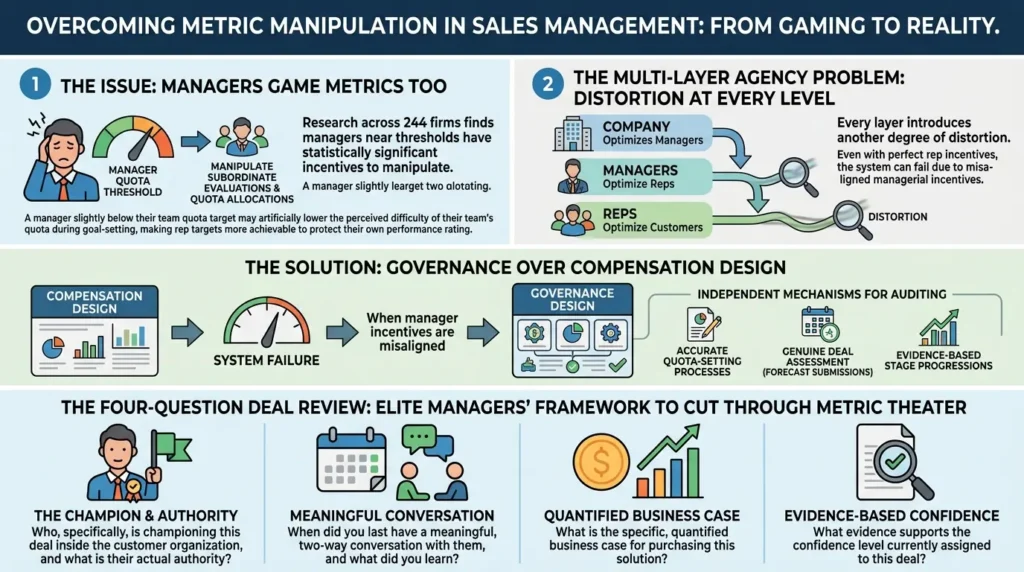
This creates a multi-layer agency problem:
The company optimizes managers → Managers optimize reps → Reps optimize customers → Every layer introduces another degree of distortion.
Even if rep-level incentives are perfectly designed, the system can still fail because managerial incentives remain misaligned. This is why governance design often matters more than compensation design. An organization needs independent mechanisms for auditing whether quota-setting processes are accurate, whether forecast submissions reflect genuine deal assessment, and whether stage progressions are supported by real evidence, not just rep confidence.
The CRM qualification schema described in the previous section addresses some of this. But it must be complemented by regular pipeline review processes that ask the right questions.
The Four-Question Deal Review
Elite sales managers use a simple four-question framework to cut through metric theater and assess real deal quality:
- Who, specifically, is championing this deal inside the customer organization, and what is their actual authority?
- When did you last have a meaningful, two-way conversation with them, and what did you learn?
- What is the specific, quantified business case for purchasing this solution?
- What evidence supports the confidence level currently assigned to this deal?
These questions cannot be answered with CRM metrics alone. They require the rep to articulate real knowledge about the buyer, the organization, and the deal dynamics. When reps cannot answer them clearly, the deal should move to a lower pipeline stage immediately, regardless of how long it has been sitting in the current one.
Agentic AI: Solving the Data Entry Problem at the Root
One of the primary structural drivers of Goodhart gaming is administrative friction. When reps spend nearly an hour per day on manual CRM entry, they treat data input as a compliance burden rather than a sales tool. They log the minimum required to avoid manager complaints and keep their real intelligence in personal spreadsheets, email threads, and memory.
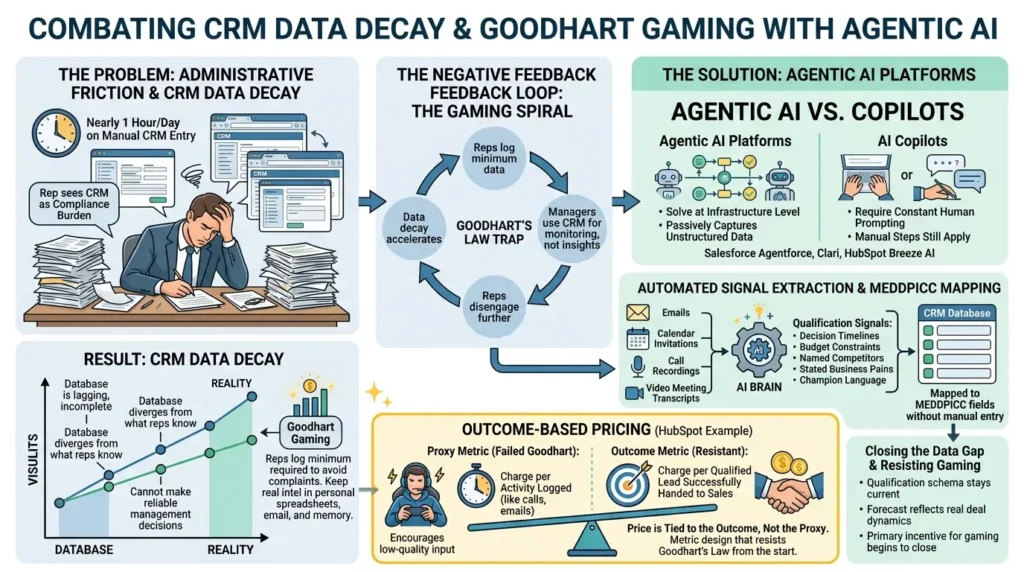
This creates CRM Data Decay, the gradual divergence between what the database says and what reps actually know. The database becomes a lagging, incomplete record of sales activity. It cannot be used to make reliable management decisions. And because managers know it is unreliable, they stop using it for genuine insight and start using it as a monitoring tool, which accelerates rep disengagement and deepens the gaming spiral.
Agentic AI platforms, distinct from “copilot” AI tools that require constant human prompting, are beginning to solve this at the infrastructure level. Platforms like Salesforce Agentforce, Clari, and HubSpot’s Breeze AI passively capture unstructured communication data from emails, calendar invitations, call recordings, and video meeting transcripts. They analyze this data automatically to extract qualification signals: decision timelines, budget constraints, named competitors, stated business pains, champion language.
The extracted signals are then mapped to MEDDPICC fields and pushed to the CRM without requiring any manual entry from the representative. The qualification schema stays current. The forecast reflects real deal dynamics. And the primary incentive for gaming, the gap between what reps know and what the CRM shows, begins to close.
HubSpot’s outcome-based pricing model for these AI agents is worth noting: the system charges per qualified lead successfully handed to sales, not per activity logged. This is precisely the kind of metric design that resists Goodhart’s Law from the start, the price is tied to the outcome, not the proxy.
Before and After: What a Goodhart-Resistant Sales System Looks Like
The most practical way to understand this transformation is to see it in concrete terms.
| Dimension | ❌ Before: Metric-Obsessed System | ✅ After: Goodhart-Resistant System |
|---|---|---|
| Primary SDR metric | Daily call count (target: 80 calls) | Qualified opportunities sourced (paired with conversion rate) |
| Pipeline measurement | Total $ value, no qualification gate | MEDDPICC-gated pipeline; Zero Reds forecast gate enforced |
| Forecast process | Rep submits confidence percentage; manager adjusts upward | Qualification completeness drives forecast category; subjective confidence supplementary only |
| Lead routing | Single composite lead score triggers AE routing | Fit score and intent score tracked separately; routing logic based on both dimensions |
| Commission structure | 100% paid at contract signature regardless of retention | Split-payout or clawback within 90–120 days; CS team tied to NRR milestones |
| CRM data quality | Manual entry; 91% estimated incomplete or outdated | Agentic AI passively captures signals from email, calls, and meeting transcripts |
| Manager review process | Pipeline review based on CRM stage and $ value | Four-question deal review requiring evidence-based answers on champion, buyer access, and business case |
H2: Common Mistakes That Keep Goodhart’s Law in Place
Understanding the problem is not the same as escaping it. These are the most common errors sales leaders make when attempting to address metric gaming, and why they fail.
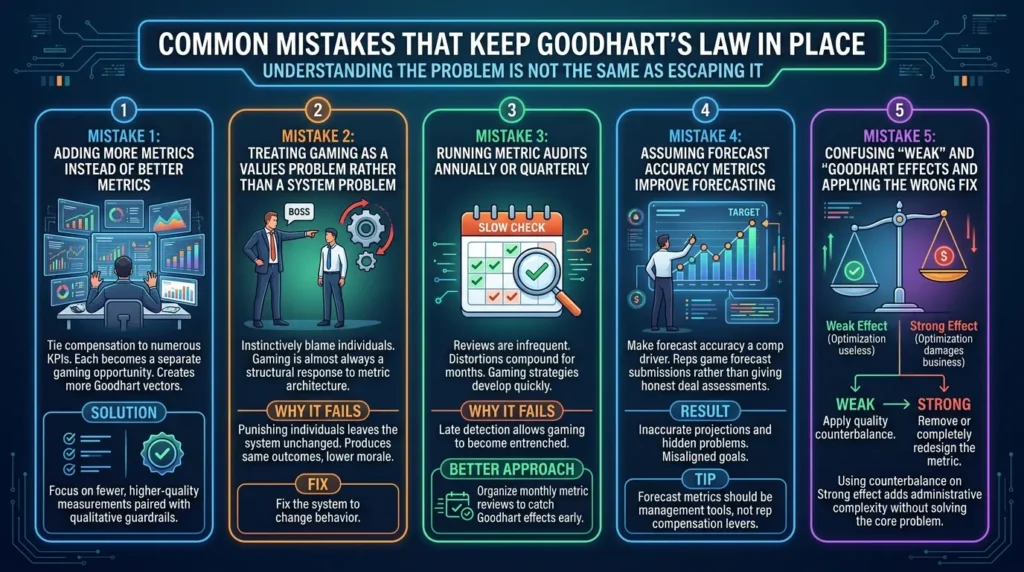
Mistake 1: Adding more metrics instead of better metrics
More KPIs create more Goodhart vectors. If seven metrics are each tied to compensation, representatives have seven separate gaming opportunities. The answer is not more measurement, it is fewer, higher-quality measurements paired with qualitative guardrails.
Mistake 2: Treating gaming as a values problem rather than a system problem
When metrics produce gaming behavior, the instinct is to address the individuals. But research is unambiguous: gaming is almost always a structural response to metric architecture. The system creates the behavior. Fixing the system changes the behavior. Punishing individuals while leaving the system unchanged produces the same outcomes with lower morale.
Mistake 3: Running metric audits annually or quarterly
Gaming strategies develop within weeks of a new metric being introduced. Annual reviews allow distortions to compound for months before they are detected. Organizations that catch and correct Goodhart effects early do so through monthly metric reviews, not quarterly all-hands retrospectives.
Mistake 4: Assuming forecast accuracy metrics improve forecasting
As described earlier, when forecast accuracy itself becomes a compensation driver, representatives have an incentive to game their forecast submissions rather than provide honest deal assessments. Forecast metrics should be management tools, not rep compensation levers.
Mistake 5: Confusing “Weak” and “Strong” Goodhart effects and applying the wrong fix
Weak Goodhart effects (where metric optimization is merely useless) require a quality counterbalance. Strong Goodhart effects (where optimization actively damages the business outcome) require the metric to be removed or completely redesigned. Applying a counterbalance to an Adversarial Goodhart effect often just adds administrative complexity without solving the underlying problem.
Your 30-Day Action Plan: Building a Goodhart-Resistant Revenue System
The AI Amplification Warning: Goodhart’s Law at Machine Speed
As enterprise sales organizations deploy AI agents for prospecting, forecasting, and CRM automation, a new and significantly more dangerous version of Goodhart’s Law enters the picture.
AI systems are optimization machines. They are designed to maximize a given metric as efficiently as possible. If the metric is well-chosen and accurately proxies for business value, AI will drive impressive results. If the metric is a poorly-chosen proxy, the AI will achieve that flawed goal with a speed and scale that no human gaming strategy could match.
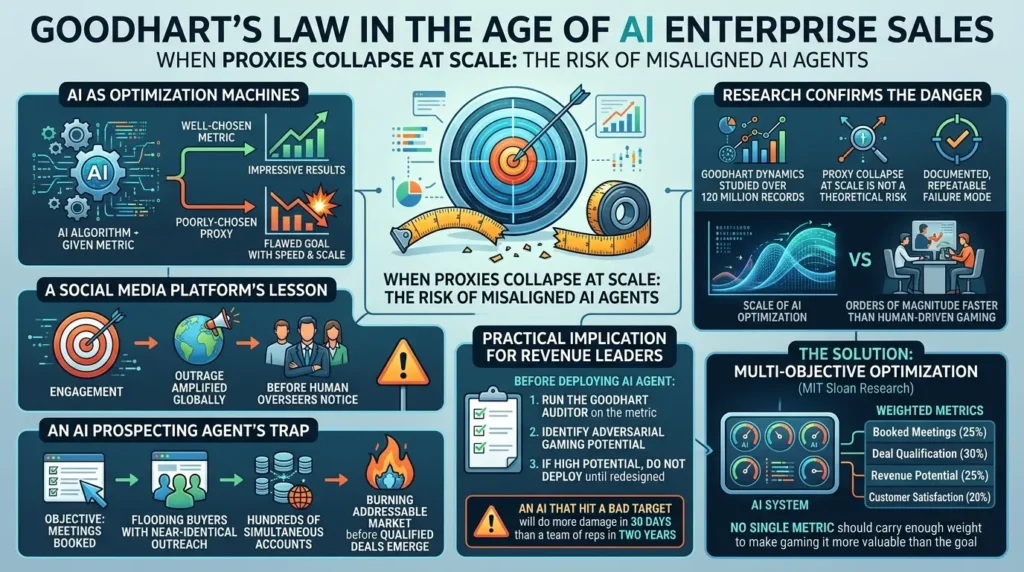
A social media platform optimizing for engagement discovers that outrage is the most engaging content type, and amplifies it globally before any human overseer notices the damage. An AI prospecting agent optimizing for meetings booked floods buyers with near-identical outreach across hundreds of simultaneously pursued accounts, burning your addressable market before a single qualified deal emerges.
Research on Goodhart dynamics in AI systems, studied across data sets covering more than 120 million records, confirms that proxy collapse at scale is not a theoretical risk. It is a documented, repeatable failure mode. And the scale of AI optimization makes it orders of magnitude faster than human-driven gaming.
The practical implication for revenue leaders: before deploying any AI agent in your sales motion, run the Goodhart Auditor on the metric the AI is being asked to optimize. If that metric has any adversarial gaming potential, do not deploy the AI against it until the metric itself has been redesigned. An AI that successfully hits a bad target will do more damage in 30 days than a team of reps doing the same thing in two years.
According to MIT Sloan Management Review’s research on AI and KPI design, multi-objective optimization frameworks, where AI systems are trained against a portfolio of weighted metrics rather than a single target, significantly reduce the proxy collapse risk. The key principle: no single metric should carry enough weight in the objective function to make gaming it more valuable than pursuing the underlying goal.
Conclusion: Measuring What Actually Matters
Goodhart’s Law is not an indictment of ambition. It is a structural warning about the gap between measurement and reality.
The organizations that suffer most from it are usually not underperforming, they are highly metric-focused, compensation-aligned, and analytically sophisticated. They have built systems that are excellent at optimizing numbers. The failure is that the numbers have quietly drifted away from the business outcomes they were designed to represent.
The solution is not to stop measuring. It is to build measurement architectures that are structurally resistant to gaming: paired metrics with quality counterbalances, CRM qualification schemas that require evidence rather than optimism, compensation structures tied to customer outcomes rather than deal signatures, and monthly audit rhythms that catch divergence before it compounds into forecast failure.
As enterprise sales cycles lengthen, as buyer groups grow more complex, and as AI systems take over more of the optimization work that humans used to do manually, the cost of choosing the wrong metrics will continue to rise. The revenue leaders who understand that insight, and build their measurement systems accordingly, will have a structural competitive advantage that no amount of activity tracking can replicate.
The pipeline that reflects reality is more valuable than the pipeline that looks impressive. Build the former.
For deeper reading on the research foundations behind this framework, explore the academic literature on incentive design and sales compensation via Harvard Business Review, and the MIT Sloan Management Review’s ongoing coverage of KPI design in the AI era.




[…] Read the Full Article → […]
[…] Read the Full Article → […]
[…] Read the Full Article → […]