
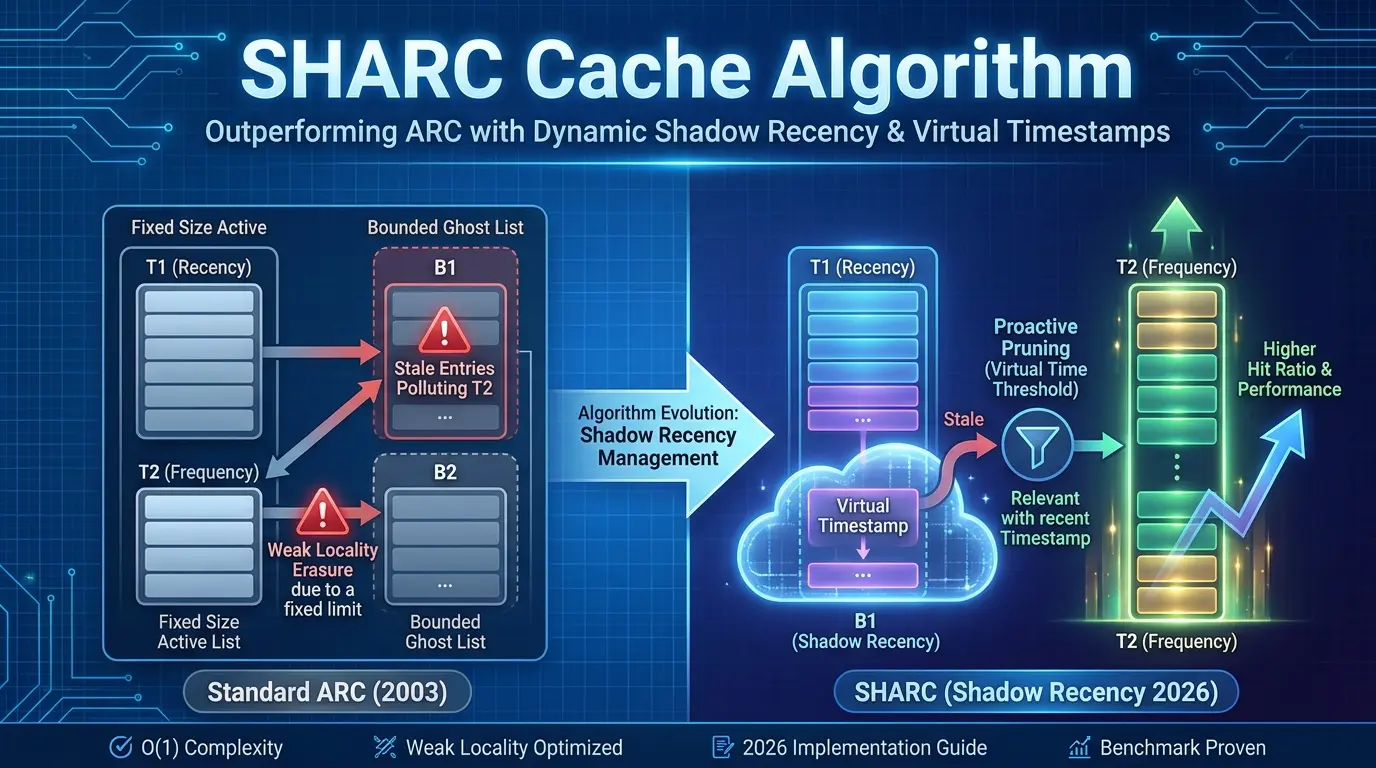

ARC has been the gold standard for adaptive cache replacement since 2003. Engineers trusted it. Storage systems embedded it. IBM patented it.
But there is a problem. ARC gets recency wrong, structurally, not accidentally. And for two decades, this flaw quietly degraded cache performance across enterprise systems, databases, and key-value stores worldwide.
SHARC ( SHARC Cache Algorithm) changes that. Introduced at ACM Middleware 2021 by researchers at Intel, SHARC (Shadow Recency Cache Management) does not merely tune ARC’s parameters. It rethinks how cache history should be tracked, validated, and acted upon, replacing rigid physical boundaries with temporally guided, workload-aware shadow management.
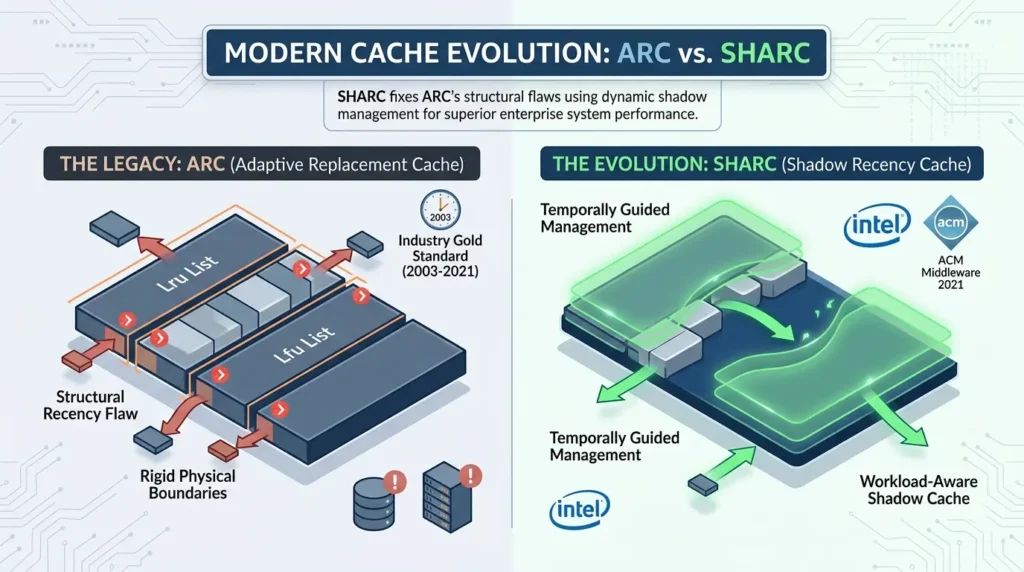
This guide provides a technically rigorous yet accessible analysis of SHARC, covering its theoretical foundations, its practical improvements over ARC and LIRS, implementation guidance, and its position within the broader landscape of modern caching research. Whether you are a systems architect, a storage engineer, or a researcher evaluating replacement policies, this article delivers the depth and clarity currently absent from existing literature.
- The two structural weaknesses in ARC that SHARC was designed to fix
- How shadow recency management and virtual timestamps work in practice
- Head-to-head comparison: SHARC vs ARC vs LIRS vs W-TinyLFU
- Step-by-step SHARC implementation guide with Python pseudocode
- When to deploy SHARC, and when to choose a different algorithm
- Expert insights on ghost caches as predictive systems and the metadata scalability bottleneck
- Performance benchmarks across MSR Cambridge, Twitter, FIU, and VDI traces
What Is Adaptive Replacement Cache (ARC)? The Foundation You Need
Definition: The Adaptive Replacement Cache (ARC) is a self-tuning page replacement algorithm that dynamically balances recency and frequency in cache eviction decisions, without requiring manual parameter configuration from the operator.
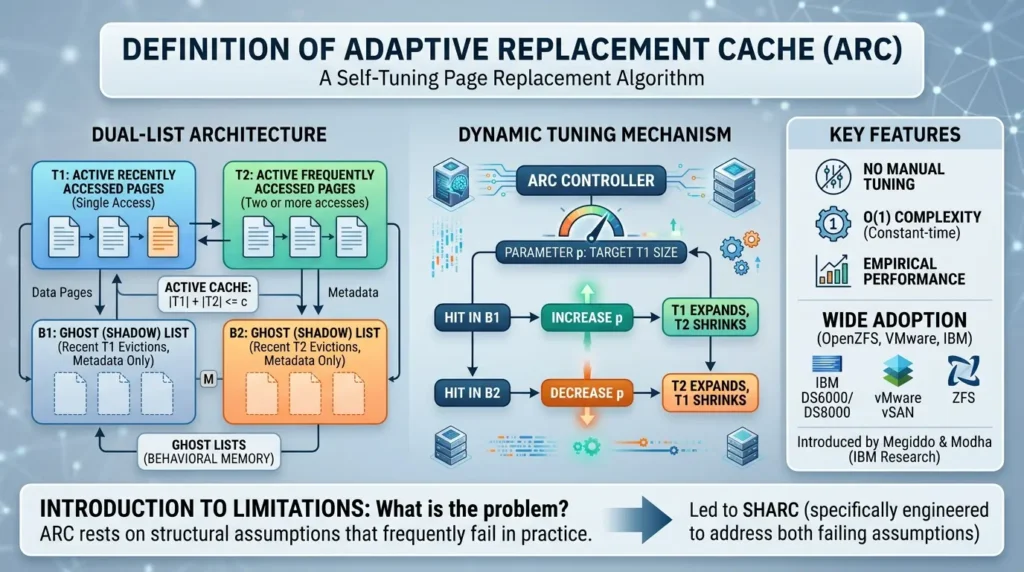
Introduced by Megiddo and Modha at IBM Research, ARC maintains a dual-list architecture partitioned across four logical components:
- T1: Active cache for recently accessed pages (single-access recency)
- T2: Active cache for frequently accessed pages (two or more accesses)
- B1: Ghost (shadow) list storing only metadata of recently evicted T1 entries
- B2: Ghost (shadow) list storing only metadata of recently evicted T2 entries
The total active cache satisfies the constraint |T1| + |T2| ≤ c, where c is the physical cache capacity in pages. The ghost lists B1 and B2 hold no actual data, only page identifiers and timestamps. They function as behavioral memory.
ARC dynamically adjusts a target parameter p, the desired size of T1, based on ghost list activity. A hit in B1 signals that the recency partition was undersized; ARC increases p to grow T1. A hit in B2 signals the reverse; ARC decreases p to expand T2. This self-learning mechanism drove ARC’s adoption into IBM’s DS6000 and DS8000 storage controllers, VMware vSAN, and the ZFS file system, as documented in the OpenZFS architecture documentation. ARC’s appeal is genuine: no manual tuning, O(1) per-request complexity, and strong empirical performance across diverse workloads.
So what is the problem?
Section summary: ARC’s self-tuning mechanism is powerful but rests on two structural assumptions that frequently fail in practice, and SHARC was engineered specifically to address both.
The Two Structural Weaknesses ARC Cannot Self-Correct
Understanding SHARC requires precise knowledge of where ARC fails. These are not corner cases. They manifest systematically under two workload regimes that are common in production systems.
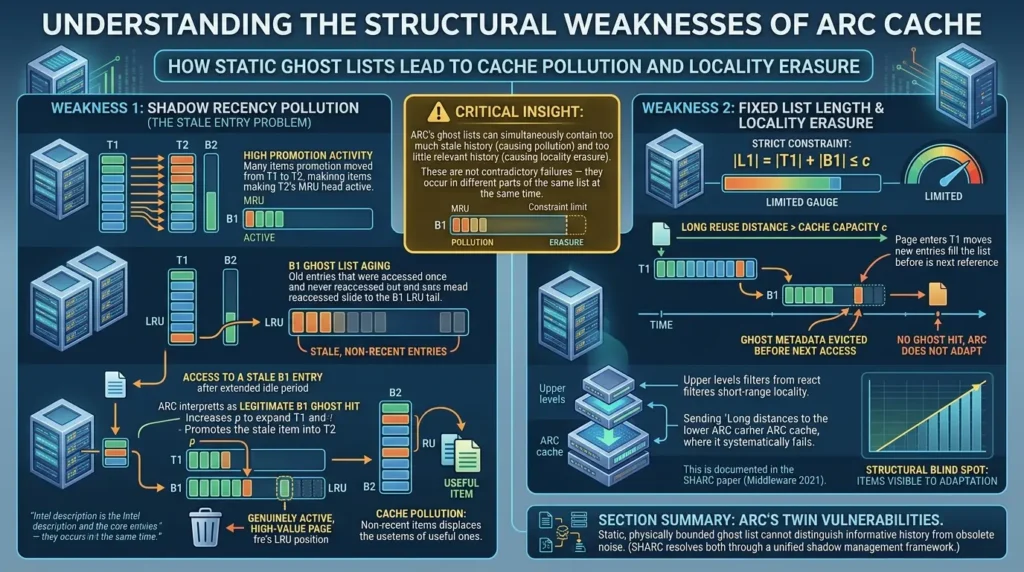
Weakness 1: Shadow Recency Pollution (The Stale Entry Problem)
When workloads generate high promotion activity, many pages receive their second access and migrate from T1 to T2, the MRU head of T2 is continuously refreshed with active, recently promoted items. Older, less active frequency entries drift toward T2’s LRU tail.
Simultaneously, the ghost list B1 ages. Its entries slide toward the LRU tail as new entries are added at the MRU head. These aging B1 entries may represent pages that were accessed once, evicted, and never meaningfully reaccessed within any operationally relevant time window.
Here is the critical failure mode. If one of these stale, non-recent B1 entries receives a reference, perhaps after an extended idle period, ARC interprets this as a legitimate B1 ghost hit. It responds by increasing p (expanding T1), promoting the stale page into T2, and evicting a genuinely active, high-value page from the frequency cache.
The result is cache pollution: a non-recent item displaces a high-utility one. As the original SHARC presentation at Intel described, “there can be very old items close to the LRU position of the recency shadow list. Later, if one of those non-recent items gets accessed, the end result is promoting the item to the frequency cache, likely evicting a certain useful item.”
Weakness 2: Fixed List Length and Weak Locality Erasure
ARC enforces a hard constraint on the combined recency list length: |L1| = |T1| + |B1| ≤ c.
This constraint prevents unbounded memory growth but introduces a structural blind spot. If a page’s reuse distance slightly exceeds the cache capacity c, its ghost metadata in B1 is evicted before the page’s next access arrives. ARC never registers a ghost hit for this page. It never learns to expand the recency partition to accommodate it. The page remains invisible to ARC’s adaptation mechanism.
In multi-level buffer hierarchies, common in enterprise storage controllers and file servers, upper-level caches filter out short-range temporal locality. The request stream arriving at lower-level caches is dominated by long reuse distances. ARC’s rigid |L1| ≤ c constraint systematically fails this regime. This failure mode is rigorously documented in the original SHARC paper published in the ACM Digital Library (Middleware 2021).
Section summary: ARC’s twin vulnerabilities stem from the same root cause, a static, physically bounded ghost list that cannot distinguish between genuinely informative history and obsolete noise.
How SHARC Works: Shadow Recency Management Explained
Definition: SHARC (Shadow Recency Cache Management) is an adaptive cache replacement algorithm that extends ARC by removing rigid constraints on the recency shadow list length and applying proactive, virtual timestamp-based pruning to eliminate non-prospective ghost entries before they can corrupt adaptation signals.
SHARC introduces two fundamental modifications to ARC’s architecture. Together, they form a coherent framework for treating ghost lists as dynamic behavioral inference mechanisms rather than passive eviction logs.
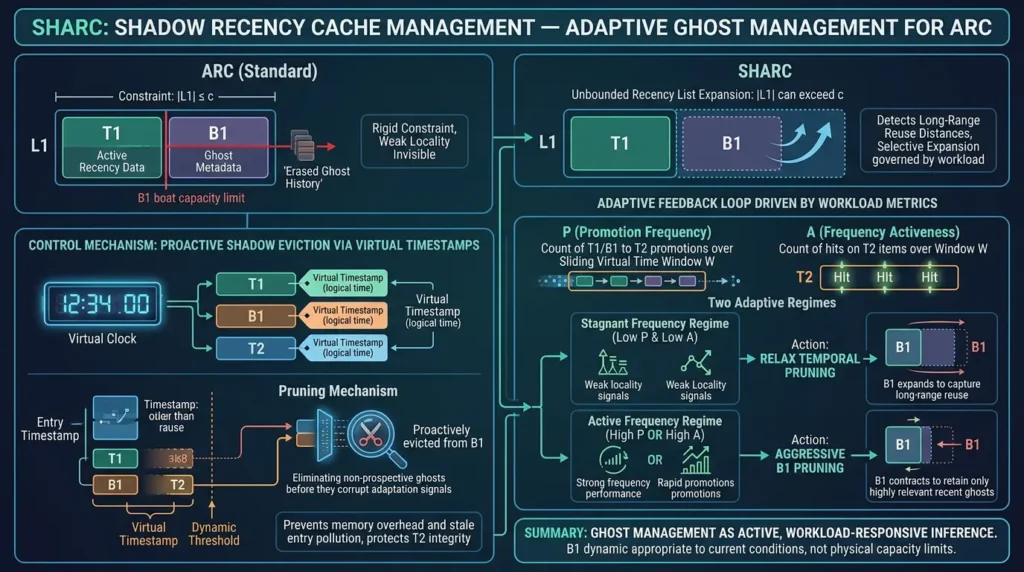
Modification 1: Unbounded Recency List Expansion
SHARC removes the hard constraint |L1| ≤ c. The shadow recency list B1 is permitted to grow beyond c on demand, enabling SHARC to retain ghost metadata for pages with long reuse distances. Pages that would have been erased from ARC’s ghost history remain visible to SHARC, allowing it to detect and exploit weak temporal locality that ARC structurally cannot access.
This is not simply “more memory for ghost entries.” The expansion is selective, conditional, and governed by workload signals, which leads to the second modification.
Modification 2: Proactive Shadow Eviction via Virtual Timestamps
Unbounded list growth without control would introduce prohibitive memory overhead and degrade lookup performance. SHARC prevents this through temporal pruning guided by virtual timestamps.
Every cache entry and ghost metadata block is tagged with a virtual timestamp, a logical counter representing its most recent access time in the system’s virtual clock. SHARC continuously evaluates the recency of shadow entries against a dynamically computed eviction threshold. Entries that exceed this threshold, meaning their virtual age indicates that their reuse window has likely closed, are proactively evicted from B1, even if physical memory could accommodate them.
The Two Workload Metrics That Drive SHARC’s Adaptation
The eviction threshold is not static. It adapts in response to two metrics tracked over a sliding virtual time window W:
- P (Promotion Frequency): The count of items promoted from L1 (T1 or B1) to L2 (T2) within window W. High P indicates that items entering the system are finding second accesses — the locality structure is strong enough to reward frequency tracking.
- A (Frequency Activeness): The count of active hits on T2 items within window W. High A indicates that the frequency cache is successfully capturing the workload’s hot items.
Stagnant Frequency Regime (Low P and Low A): The frequency cache is underperforming. The workload exhibits weak locality. SHARC relaxes temporal pruning, allowing B1 to expand and capture long-range reuse distances that would be invisible to ARC.
Active Frequency Regime (High P or High A): The frequency cache is performing well, and/or items are being rapidly promoted. Expanding B1 under these conditions risks stale entry pollution. SHARC aggressively prunes B1, retaining only highly relevant recent ghost entries.
Recency Data
Metadata
Unbounded
Frequency Data
Metadata
(Standard)
Section summary: SHARC treats ghost management as an active, workload-responsive inference problem. The expansion and contraction of B1 is governed not by physical capacity limits but by live workload signals, making the system’s historical footprint dynamically appropriate to current conditions.
The SHARC Eviction Criterion: The Formula That Makes It Work
The eviction threshold in SHARC is derived from the virtual access times of the LRU entries in T1 and T2. In strong locality scenarios, where T2 items are frequently accessed, SHARC sets the eviction boundary close to the virtual timestamp of T2’s LRU entry. In weak locality scenarios, the threshold is governed by the activeness metrics P and A.
A shadow recency entry in B1 with virtual timestamp t_entry is proactively evicted when:
t_entry < T(t_LRU_T2, P, A, W)
t_LRU_T2 — Virtual timestamp of the LRU entry in T2 (frequency cache)
P — Promotion count within window W (items moving L1 → T2)
A — Activeness count within window W (T2 hits)
W — Sliding virtual time window width
T(·) — Adaptive threshold function: tighter when P or A is high; relaxed when both are low
SHARC vs ARC vs LIRS vs W-TinyLFU: A Comprehensive Algorithm Comparison
| Algorithm | Complexity | Worst Case | Metadata Footprint | Weak Locality | Adaptation | Best For |
|---|---|---|---|---|---|---|
| LRU | O(1) | O(1) | Minimal (c entries) | ❌ Poor | None | Simple, stable workloads |
| ARC | O(1) | O(1) | Strict 2c entries | ⚠️ Limited | Ghost-hit driven | Balanced mixed workloads |
| SHARC | O(1) | O(1) | Variable (bounded) | ✅ Strong | Virtual timestamp pruning | Weak locality, mixed traces |
| LIRS | O(1) avg | O(N) worst | High (>2c entries) | ✅ Good | IRR stack tracking | Loop-heavy, scan workloads |
| W-TinyLFU | O(1) | O(1) | Low (frequency sketch) | ⚠️ Moderate | Admission filter | Hot-key, frequency-biased |
| ALPS (ML) | O(1) | O(1) | Low (sketches) | ✅ Excellent | ML policy selection | Phase-shifting cloud workloads |
The comparative profile above clarifies SHARC’s distinct position in the algorithm design space.
Against LIRS/DLIRS
LIRS achieves strong hit ratios on weak locality workloads by tracking inter-reference recency through a global stack. However, stack pruning events, triggered on eviction or hit, can cascade through enormous numbers of metadata entries.
Experimental evaluation across 104 configurations documented in the SHARC Middleware 2021 paper found that LIRS stack pruning exceeded 1,000 entries per request in 23 configurations, with worst-case traversal exceeding one million entries in DLIRS. This non-deterministic tail latency behavior creates severe bottlenecks in high-concurrency storage systems, a failure mode SHARC structurally avoids by maintaining a strict three-entry-maximum manipulation bound per request.
Against W-TinyLFU
W-TinyLFU, deployed in Java’s Caffeine and Go’s Ristretto libraries, excels under frequency-biased workloads with strong hot-key distributions. It uses admission filters and approximate frequency sketches to achieve excellent hit ratios with low memory overhead. Under workloads with genuine weak temporal locality, however, SHARC’s dynamic shadow recency management provides superior performance.
Section summary: No single algorithm dominates all workload regimes. SHARC’s strength is deterministic O(1) complexity combined with superior hit ratio under weak locality, a combination that ARC achieves partially but not fully.
Performance Benchmarks: What the Empirical Evidence Shows
SHARC’s performance has been validated across a wide range of real-world and synthetic traces including MSR Cambridge enterprise block I/O workloads, FIU academic storage traces, UMass virtual desktop infrastructure (VDI) traces, Twitter Memcached production key-value traces, and synthetic frequency-biased and recency-biased workloads.
| Policy | Tested Datasets | Primary Metric | Key Result | Baseline |
|---|---|---|---|---|
| SHARC | MSR Cambridge, FIU, UMass VDI, Twitter Memcached, Synthetic | Hit ratio improvement | Outperforms ARC in most configs; O(1) maintained | ARC, LIRS, DLIRS |
| SEMU | RocksDB YCSB, Synthetic Key-Value | Throughput under contention | +1.9× throughput; +59.67% RocksDB | LRU, 2Q, FIFO |
| ALPS | Wikipedia, Cloud Traces (A1, A2) | Hit ratio via ML selection | Up to +31% over W-TinyLFU; +9% over ARC | LRU, ARC, W-TinyLFU |
| LAC | SSD controller traces (MQSim) | Write response time | −78.5% write latency; −47.8% erase cycles | LRU, CFLRU, GCaR-LRU |
Two case studies from the original research are particularly instructive.
Case Study : Frequency-Biased Trace (From the Original ARC Paper)
Under a trace where most hits originate from T2, ARC and SHARC diverge meaningfully. In standard ARC with a 4c recency timing threshold applied analytically, a considerable percentage of B1 promotions to T2 involve non-recent items. These promotions deliver lower average hit counts per promoted item than promotions of genuinely recent items.
In SHARC, proactive pruning eliminates non-recent shadow entries before they trigger incorrect promotions. Average hits per promoted item increase, frequency cache hit ratio rises, and overall hit ratio improves substantially.
Case Study 2: MSR Cambridge Weak Locality Trace
At a cache size of approximately 1/30th of the unique block count, a frequency-biased workload with weak locality reveals ARC’s rigid constraint directly. Experimentally relaxing ARC’s hard constraint to 1.3c allowed the recency list to grow longer, frequency-biased items to be identified, and hit ratio to improve significantly.
SHARC, operating without the hard constraint, achieves comparable recency list growth organically, identifying the frequency bias, reallocating cache capacity accordingly, and reaching an even higher hit ratio.
Section summary: SHARC’s empirical gains are not marginal. They are structurally predictable, concentrated in exactly the workload regimes where ARC’s design assumptions break down.
A Contrarian Perspective: Why “Self-Tuning” Is a Misleading Label
Here is an insight that most cache algorithm discussions overlook, and it applies directly to SHARC as much as it does to ARC.
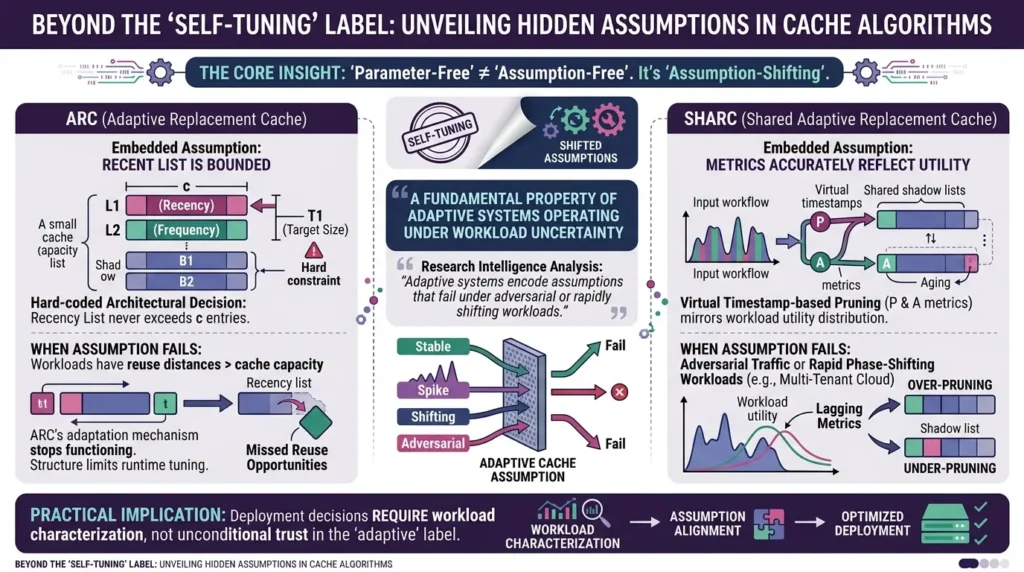
Algorithms described as “self-tuning” or “parameter-free” are not actually free of assumptions. They replace explicit, user-specified parameters with implicit behavioral assumptions embedded in their structural design.
ARC assumes that the recency list should never exceed c entries. This is not a configuration parameter, it is a hard-coded architectural decision that encodes the implicit assumption that workloads have reuse distances bounded by cache capacity. When that assumption fails, ARC’s adaptation mechanism stops functioning correctly. No amount of runtime tuning compensates for a structurally incorrect prior.
SHARC modifies this assumption but introduces its own: that virtual timestamp-based pruning accurately reflects the workload’s utility distribution. Under adversarial traffic patterns or rapidly phase-shifting workloads, common in multi-tenant cloud environments, SHARC’s P and A metrics may lag behind true workload state, causing over-pruning or under-pruning of the shadow list.
This is a fundamental property of adaptive systems operating under workload uncertainty, not a deficiency unique to any single algorithm. As the research intelligence analysis supporting this work notes, “adaptive systems encode assumptions that fail under adversarial or rapidly shifting workloads.” The practical implication: deployment decisions should always be accompanied by workload characterization, not unconditional trust in the “adaptive” label.
Before and After: The Operational Impact of SHARC
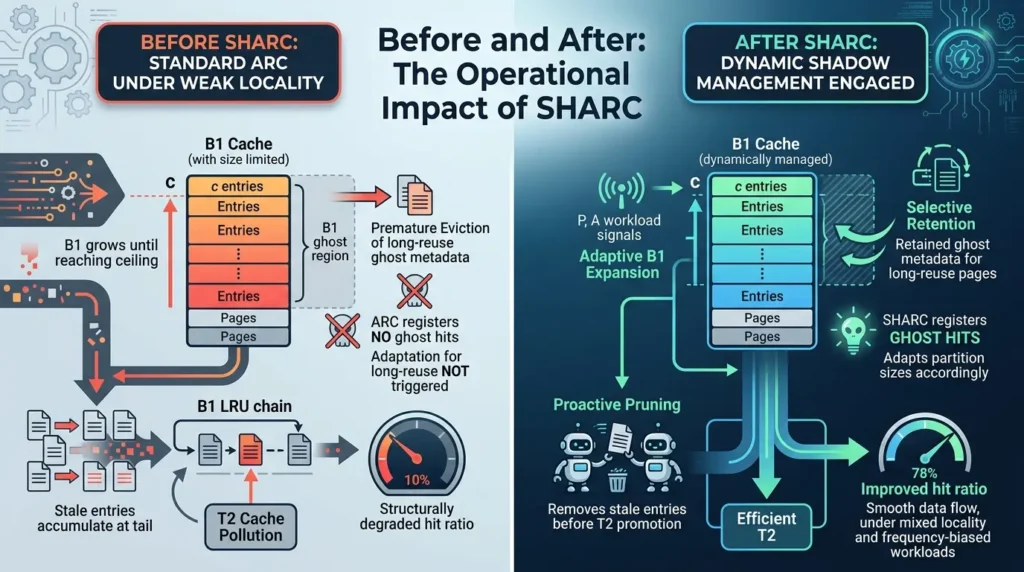
Before SHARC: Standard ARC Under Weak Locality
- B1 grows until it reaches the hard ceiling of c entries
- Pages with reuse distances greater than c have their ghost metadata evicted prematurely
- ARC never registers ghost hits for these pages; adaptation for long-reuse items never triggers
- Stale entries accumulate at the LRU tail of B1, waiting to pollute T2
- Cache operates at a structurally degraded hit ratio, unable to exploit the workload’s actual locality structure
After SHARC: Dynamic Shadow Management Engaged
- B1 is permitted to expand beyond c based on live workload signals (P and A)
- Ghost metadata for long-reuse-distance pages is retained selectively
- SHARC registers ghost hits on previously invisible pages and adapts partition sizes accordingly
- Proactive pruning removes stale entries before they trigger incorrect T2 promotions
- Hit ratio improves measurably, particularly under mixed locality and frequency-biased workloads
Implementation Guide: Building SHARC Step by Step
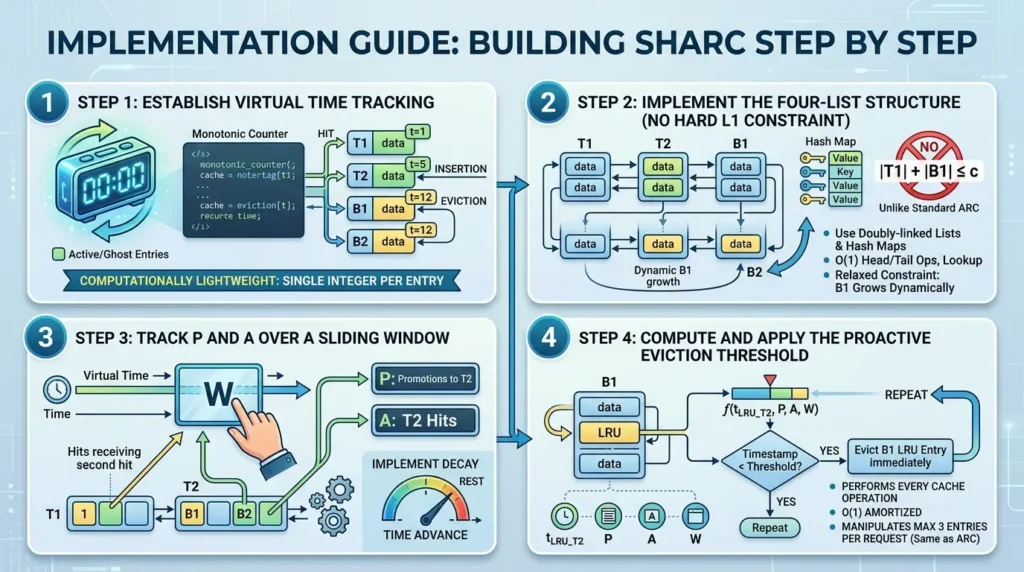
Step 1: Establish Virtual Time Tracking
Assign a monotonically increasing virtual clock to the cache subsystem. Every cache operation, hit, insertion, eviction, records the current virtual time. Tag each entry, both active and ghost, with its last virtual access time. This is computationally lightweight: a single integer counter per entry.
Step 2: Implement the Four-List Structure Without the Hard L1 Constraint
Maintain T1, T2, B1, B2 using doubly-linked lists for O(1) head/tail operations and hash maps for O(1) lookup. Unlike standard ARC, do not enforce |T1| + |B1| ≤ c. Allow B1 to grow dynamically.
Step 3: Track P and A Over a Sliding Window
Over a virtual time window W, maintain rolling counters for:
- P: incremented when an L1 item (from T1 or B1) receives a second hit and is promoted to T2
- A: incremented when a T2 item receives a cache hit
Implement decay by resetting or weighting these counters as the virtual clock advances beyond W.
Step 4: Compute and Apply the Proactive Eviction Threshold
On every cache operation, evaluate the LRU entry of B1. If its virtual timestamp falls below the threshold derived from t_LRU_T2, P, A, and W:
- Evict it from B1 immediately
- Repeat until the LRU entry of B1 satisfies the threshold condition
This operation is O(1) amortized. SHARC manipulates at most three entries per request, the same bound as ARC.
class SHARC:
    def __init__(self, capacity):
        self.c = capacity            # Physical cache capacity
        self.p = 0                   # Target T1 size (adaptive)
        self.virtual_time = 0        # Global virtual clock
        self.window_W = capacity     # Sliding window width

        # Active lists (store data + metadata)
        self.T1 = OrderedDict()      # Recency cache
        self.T2 = OrderedDict()      # Frequency cache

        # Ghost lists (store metadata only: page_id -> virtual_timestamp)
        self.B1 = OrderedDict()      # Recency ghost (UNBOUNDED in SHARC)
        self.B2 = OrderedDict()      # Frequency ghost

        # Workload metrics over window W
        self.P = 0                   # Promotion count
        self.A = 0                   # Frequency activeness count

    def access(self, page):
        self.virtual_time += 1

        # === CACHE HIT in T1 ===
        if page in self.T1:
            self.T1.pop(page)
            self.T2[page] = self.virtual_time
            self.A += 1
            self._proactive_prune_B1()

        # === CACHE HIT in T2 ===
        elif page in self.T2:
            self.T2.move_to_end(page)
            self.T2[page] = self.virtual_time
            self.A += 1
            self._proactive_prune_B1()

        # === GHOST HIT in B1 ===
        elif page in self.B1:
            delta = max(
                1,
                len(self.B2) // max(len(self.B1), 1)
            )

            self.p = min(
                self.p + delta,
                self.c
            )

            self.B1.pop(page)

            self._evict_and_insert(
                page,
                to_T2=True
            )

            self.P += 1
            self._proactive_prune_B1()

        # === GHOST HIT in B2 ===
        elif page in self.B2:
            delta = max(
                1,
                len(self.B1) // max(len(self.B2), 1)
            )

            self.p = max(
                self.p - delta,
                0
            )

            self.B2.pop(page)

            self._evict_and_insert(
                page,
                to_T2=True
            )

        # === CACHE MISS ===
        else:
            self._evict_and_insert(
                page,
                to_T2=False
            )

    def _proactive_prune_B1(self):
        """
        Core SHARC innovation:
        remove non-prospective B1 entries
        using the virtual timestamp threshold
        derived from T2's LRU entry and
        workload metrics P and A.
        """

        if not self.B1 or not self.T2:
            return

        t_lru_t2 = next(
            iter(self.T2.values())
        )

        activity_factor = (
            self.P + self.A
        ) / max(self.window_W, 1)

        threshold = (
            t_lru_t2
            - int(
                self.c
                * (
                    1
                    - min(
                        activity_factor,
                        1
                    )
                )
            )
        )

        while self.B1:
            lru_page, lru_ts = next(
                iter(self.B1.items())
            )

            if lru_ts < threshold:
                self.B1.pop(lru_page)

            else:
                break

    def _evict_and_insert(
        self,
        page,
        to_T2
    ):
        while (
            len(self.T1)
            + len(self.T2)
            >= self.c
        ):

            if (
                len(self.T1) > self.p
                or len(self.T2) == 0
            ):
                evicted, ts = (
                    self.T1.popitem(
                        last=False
                    )
                )

                self.B1[evicted] = ts

            else:
                evicted, ts = (
                    self.T2.popitem(
                        last=False
                    )
                )

                self.B2[evicted] = ts

        if to_T2:
            self.T2[page] = (
                self.virtual_time
            )

        else:
            self.T1[page] = (
                self.virtual_time
            )
When to Deploy SHARC: A Decision Framework
- Weak temporal locality in workload (long reuse distances)
- Multi-level buffer hierarchy in place
- Cache size ≥ 1 GB (overhead justified)
- Deterministic O(1) latency required
- Need a patent-considerations-aware ARC alternative
- Mixed recency and frequency workload characteristics
- Pure hot-key frequency workloads → use W-TinyLFU
- Memory-constrained embedded systems → use CLOCK or LRU
- Primary bottleneck is multi-thread throughput → use SEMU
- Phase-shifting cloud workloads → evaluate ALPS
- Very small cache sizes (overhead not amortized)
Common Mistakes When Working with Adaptive Cache Algorithms
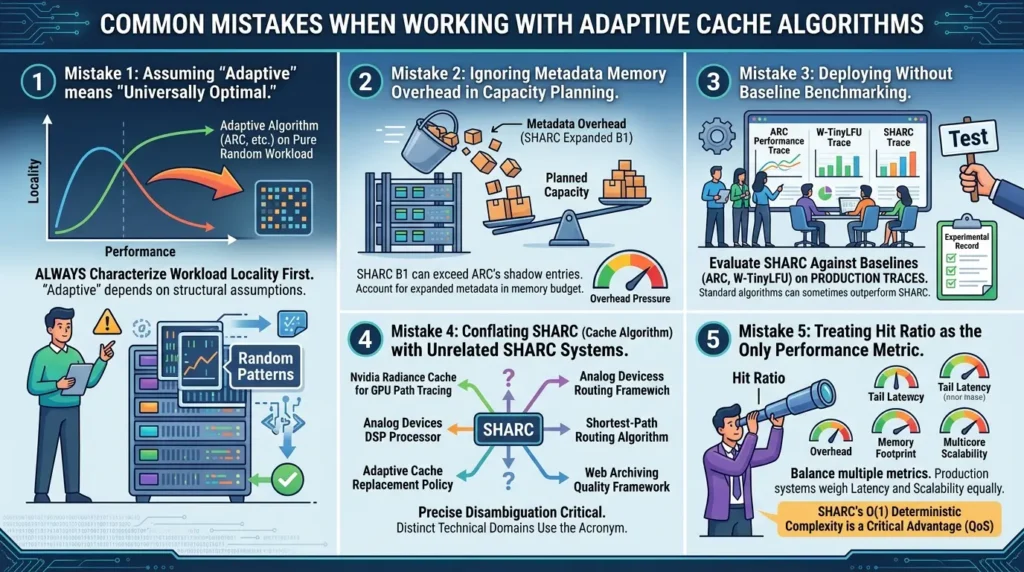
Mistake 1: Assuming “adaptive” means “universally optimal.”
Adaptive algorithms like ARC and SHARC adapt within the constraints of their structural assumptions. If the workload violates those assumptions, e.g., purely random access with no reuse, no runtime adaptation compensates. Always characterize workload locality distribution before selecting a replacement policy.
Mistake 2: Ignoring metadata memory overhead in capacity planning.
SHARC’s expanded B1 can consume memory beyond ARC’s standard 2c shadow entries. In memory-constrained environments, this additional overhead must be budgeted explicitly. Failing to account for it can result in memory pressure that negates hit ratio gains.
Mistake 3: Deploying without baseline benchmarking.
SHARC should be evaluated against ARC and W-TinyLFU on representative production traces before deployment. The experimental record confirms that there are configurations where standard ARC outperforms SHARC, recognizing these cases is essential to responsible engineering decisions.
Mistake 4: Conflating SHARC (cache algorithm) with unrelated SHARC systems.
The acronym SHARC is used across several distinct technical domains: Nvidia’s Spatially Hashed Radiance Cache for GPU path tracing, Analog Devices’ SHARC+ DSP processor family, a time-dependent shortest-path routing algorithm for road networks, and a web archiving quality framework. None of these are related to cache replacement policy design. Precise disambiguation is critical in multi-domain literature searches.
Mistake 5: Treating hit ratio as the only performance metric.
As research documented across IEEE Xplore storage systems publications consistently demonstrates, tail latency, CPU overhead, memory footprint, and multicore scalability carry equal or greater weight in production systems. SHARC’s O(1) deterministic complexity is a critical advantage over LIRS/DLIRS for QoS-sensitive enterprise workloads, a property that should feature prominently in any deployment evaluation.
Expert Insights: Three Advanced Perspectives

Insight 1: Ghost Caches as Behavioral Prediction Systems
The conventional framing of ghost caches as “passive eviction logs” significantly understates their operational function. Ghost lists are, in architectural terms, lightweight online prediction systems.
When ARC observes a B1 hit, it is not merely reacting to a cache miss, it is updating a probabilistic prediction about the workload’s recency/frequency balance. SHARC extends this predictive role by filtering stale signals, improving the fidelity of behavioral inference.
This reframing, from bookkeeping structure to predictive mechanism, connects cache replacement research directly to online learning theory, streaming inference, and reinforcement adaptation. The convergence of cache design with machine learning principles is not a future aspiration; it is an architectural reality already present in ARC and SHARC’s ghost management logic.
Insight 2: The Metadata Scalability Bottleneck
A structural shift is underway in storage system economics. As NVMe SSDs and persistent memory reduce media access latency dramatically, the relative cost of metadata coordination has increased proportionally. In high-concurrency systems, the overhead of maintaining adaptive metadata structures, pointer chasing, lock contention, NUMA penalties, cache-line bouncing, can consume a substantial fraction of the I/O path budget.
SHARC’s strict O(1) complexity and three-entry-maximum manipulation bound make it a strong candidate for environments where metadata overhead is a first-class operational concern. This advantage will become more pronounced as storage media latency continues to decline, further exposing the cost of complex metadata management per request.
Insight 3: The Trajectory Toward Hybrid Adaptive-ML Policies
SHARC represents an important intermediate point on a trajectory toward hybrid caching systems. Current developments, including cost-aware policies like CATinyLFU and CRA achieving up to 46% latency reduction in storage workloads, and machine-learning-based meta-policies like ALPS achieving up to 31% hit ratio improvement over W-TinyLFU on cloud traces, suggest that future production-grade cache algorithms will combine SHARC-style adaptive shadow management with lightweight predictive models trained on live workload telemetry.
The challenge is maintaining O(1) complexity guarantees while incorporating learned predictions. This represents a significant open research problem with substantial implications for cloud-native storage, AI inference serving, and edge caching architectures, a topic extensively covered in ACM Computing Surveys on memory management systems.
SHARC in the Broader Caching Research Ecosystem
SHARC occupies a specific position in a rapidly evolving ecosystem of cache replacement policies, each targeting a distinct region of the design space. Understanding this landscape is essential for engineers making deployment decisions.
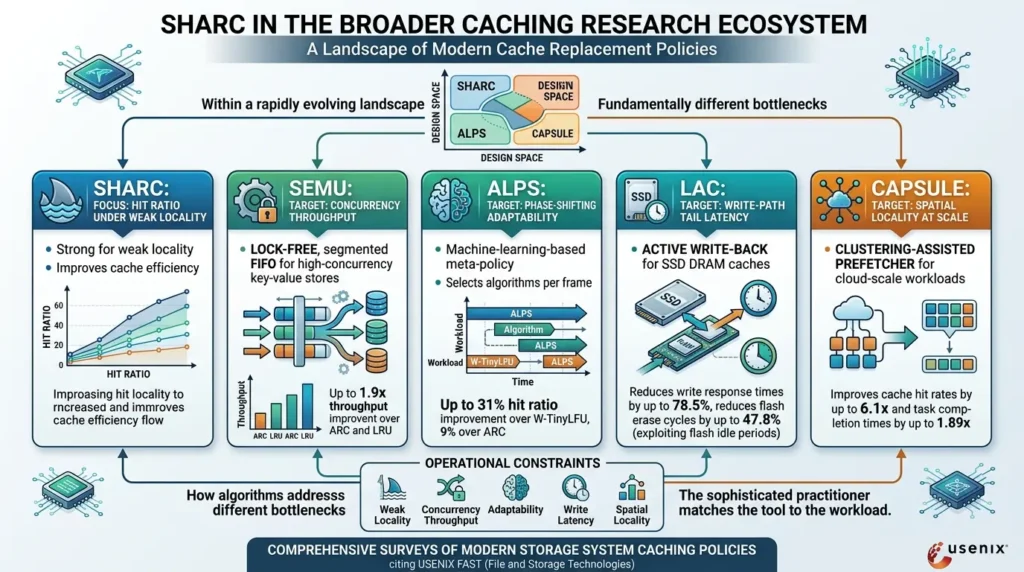
Recent significant developments include:
- SEMU: A lock-free, segmented FIFO cache for high-concurrency key-value stores, achieving up to 1.9× throughput improvement over ARC and LRU under contended workloads by eliminating global list-locking overhead
- ALPS: A machine-learning-based meta-policy that selects among replacement algorithms per frame, achieving up to 31% hit ratio improvement over W-TinyLFU and 9% over ARC on cloud storage traces
- LAC (Latency-Aware Caching): An active write-back framework for SSD DRAM caches that reduces write response times by up to 78.5% and flash erase cycles by up to 47.8% by exploiting flash idle periods
- CAPSULE: A clustering-assisted prefetcher for cloud-scale workloads, improving cache hit rates by up to 6.1× and task completion times by up to 1.89× over traditional prefetchers
These algorithms address fundamentally different bottlenecks. SHARC targets hit ratio under weak locality. SEMU targets concurrency throughput. ALPS targets phase-shifting adaptability. LAC targets write-path tail latency.
CAPSULE targets spatial locality exploitation at scale. The sophisticated practitioner understands not just what each algorithm does, but which operational constraint it is designed to address, because selecting the wrong tool for the right workload achieves nothing.
Comprehensive comparative surveys of modern storage system caching policies, including SHARC’s positioning, are documented in proceedings from USENIX FAST (File and Storage Technologies), which annually publishes state-of-the-art storage system research.
Future Directions SHARC Points Toward
SHARC’s contribution extends beyond its specific algorithmic improvements. It demonstrates a broader architectural principle that will shape the next generation of cache design: cache metadata management should be temporally adaptive and workload-responsive, not physically bounded.
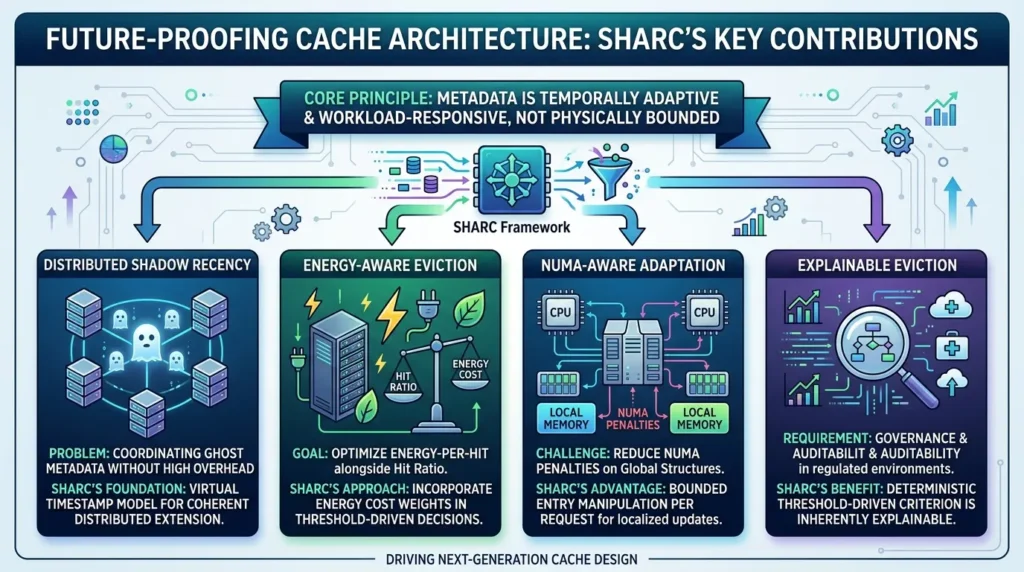
Several high-value research directions follow directly from SHARC’s framework:
- Distributed shadow recency: In multi-node distributed caches, coordinating ghost metadata across nodes without prohibitive synchronization overhead is an open problem. SHARC’s virtual timestamp model provides a coherent foundation for distributed extension.
- Energy-aware eviction: As data center sustainability constraints gain prominence, future cache policies will need to optimize energy-per-hit alongside hit ratio. SHARC’s threshold-driven framework could incorporate energy cost weights on eviction decisions.
- NUMA-aware adaptation: Adaptive policies operating on global metadata structures incur NUMA penalties absent from theoretical complexity analyses. SHARC’s bounded entry manipulation per request positions it favorably for NUMA-aware implementation on multi-socket servers.
- Explainable eviction: As cache systems are deployed in regulated environments, financial infrastructure, healthcare data systems, multi-tenant cloud platforms, the ability to audit and explain eviction decisions may become a governance requirement. SHARC’s deterministic, threshold-driven eviction criterion is inherently more explainable than opaque ML-based policies, a property of growing operational value.
Key Takeaways
- SHARC identifies and resolves two structural weaknesses in ARC: shadow list pollution from stale entries, and locality erasure from the rigid |L1| ≤ c constraint
- Shadow recency management works by combining an unbounded recency ghost list with proactive virtual timestamp-based pruning, governed by promotion frequency (P) and frequency activeness (A) metrics
- SHARC maintains ARC’s O(1) per-request complexity and three-entry maximum manipulation bound, matching ARC’s computational efficiency while improving hit ratios under weak locality
- SHARC is most effective for workloads with weak temporal locality. For frequency-biased workloads with strong hot-key distributions, W-TinyLFU remains the preferred choice
- The convergence of adaptive heuristics, ghost-cache-as-predictor frameworks, and lightweight ML policies represents the leading edge of cache replacement research in 2026
Conclusion: Why SHARC Matters Beyond Its Algorithm
SHARC’s contribution to the caching literature is specific and important. It demonstrates, with formal rigor and empirical evidence, that the ghost list, a structure present in ARC since 2003, has been simultaneously over-trusted and under-utilized. Over-trusted because stale ghost entries were permitted to corrupt adaptation signals. Under-utilized because rigid physical constraints prevented it from capturing the locality information it was designed to track.
By replacing static boundaries with virtual timestamp-driven, workload-responsive shadow management, SHARC advances a design principle that is broadly applicable: the informational quality of cache metadata matters as much as the quantity of metadata stored.
This principle will continue to inform cache algorithm design as workloads grow more complex, storage hierarchies grow more heterogeneous, and the gap between media latency and metadata coordination cost continues to narrow.
For systems engineers, SHARC is a deployable improvement for specific workload classes today and a conceptual foundation for the hybrid adaptive-ML cache systems that will define the field in the years ahead.
Ready to unlock the full potential of your cache?
Benchmark, integrate, and tune SHARC today, and join the next evolution in high-performance, adaptive caching.
This analysis synthesizes findings from the original SHARC paper (Du & Li, ACM Middleware 2021), Intel technical presentations, and broader systems caching research literature. For the most current benchmarking data and implementation guidance, consult the ACM Digital Library and the USENIX FAST proceedings archive.
Frequently Asked Questions