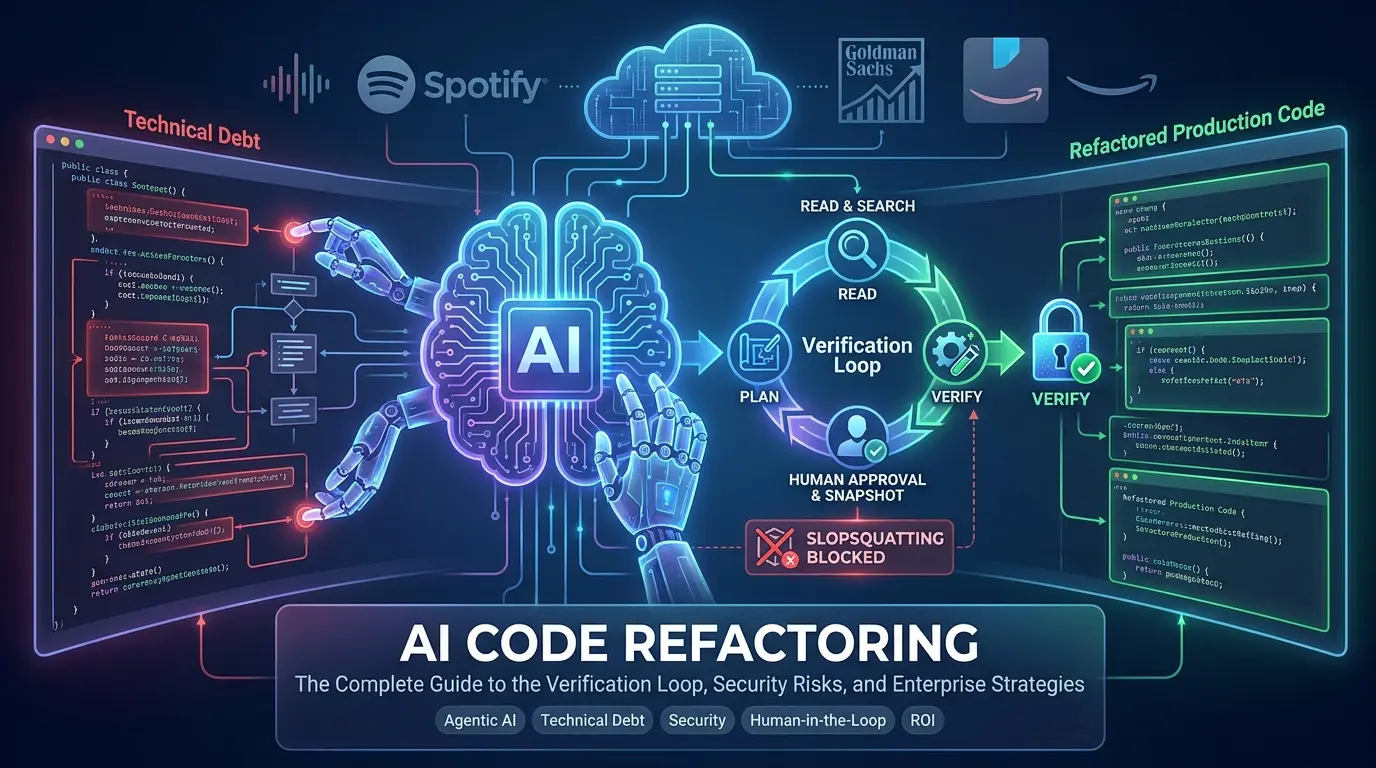

AI code refactoring sounds like a clean, controlled process, a machine tidying up your codebase the way a professional organizer tidies up a closet. But here’s what’s actually happening under the hood: a probabilistic guessing machine is rewriting the internals of systems that banks run on, that streaming apps depend on, that hospitals use.
That’s what AI code refactoring really is. And before we go any further, we should ask the obvious question.
Is it actually safe?
Here’s the short answer: sometimes. It depends entirely on what sits between the model’s guess and your production branch. That gap, the verification loop, the human checkpoints, the test coverage, is what this guide is really about.
- The real difference between inline and agentic refactoring, not the marketing version
- The exact loop autonomous agents run through before they touch a single line
- Why 45% of AI-generated code ships with a security flaw, and what that means for refactoring specifically
- A named attack (“slopsquatting”) that exists only because AI refactors and generates code
- How Spotify, Goldman Sachs, and Amazon actually measure whether this is working
- A working ROI calculator so you can run your own numbers before you commit budget
What Is Code Refactoring, and Why Does It Matter Before AI Even Enters the Picture?
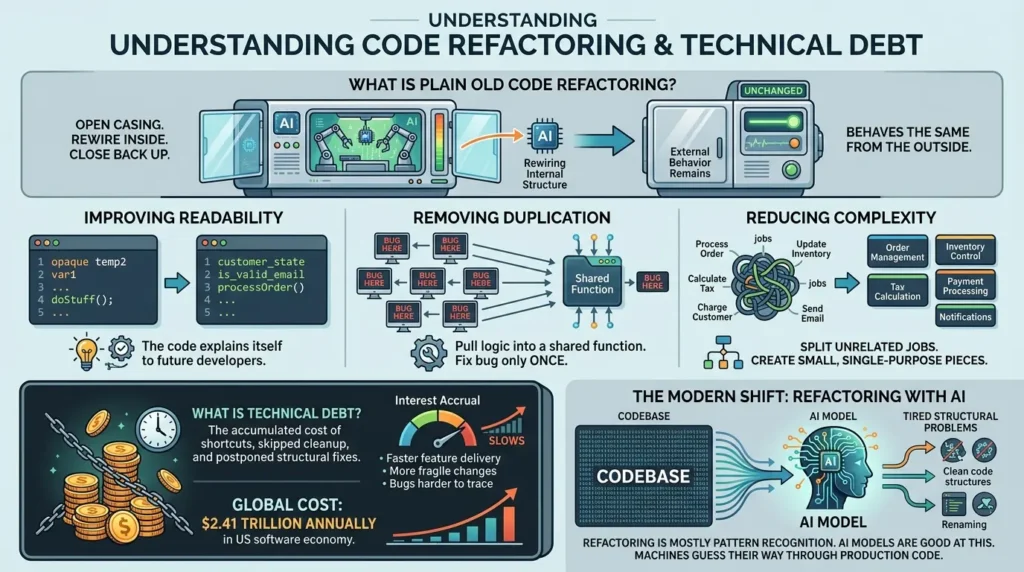
Plain old code refactoring means changing a program’s internal structure without changing what it does on the outside.
Picture a piece of code as a machine with a casing around it. Refactoring means opening the casing, rewiring something inside, and closing it back up. From the outside, the machine behaves exactly the same.
So why bother, if nothing visibly changes?
Because a variable named temp2 tells the next developer nothing. Rename it to customer_state, and suddenly the code explains itself. That’s refactoring for readability.
Or picture a block of logic that’s been copy-pasted into six different files. It has a bug. Now that bug lives in six places instead of one. Pulling it into a single shared function means you only ever fix it once. That’s removing duplication.
Or take a function that’s grown to do half a dozen unrelated jobs. Split it into smaller, single-purpose pieces, and you’ve reduced complexity.
Skip this kind of maintenance long enough, and it compounds into something with its own name.
Technical debt is the accumulated cost of shortcuts, skipped cleanup, and postponed structural fixes in a codebase. Like financial debt, it doesn’t go away on its own, it accrues “interest” in the form of slower feature delivery, more fragile changes, and bugs that take longer to trace than they should. One widely cited industry estimate puts the global cost of unmanaged technical debt at $2.41 trillion a year in the U.S. software economy alone.
Here’s the connection that matters for this whole article: refactoring is mostly pattern recognition. The same tired structural problems, showing up again and again across a codebase. And pattern recognition happens to be exactly what AI models are good at.
Which is exactly why we now have machines guessing their way through production code.
Inline vs. Agentic Refactoring: The Distinction Almost Nobody Explains Clearly
Most coverage of “AI refactoring” lumps everything into one bucket. That’s a mistake, because the two approaches carry completely different risk profiles.
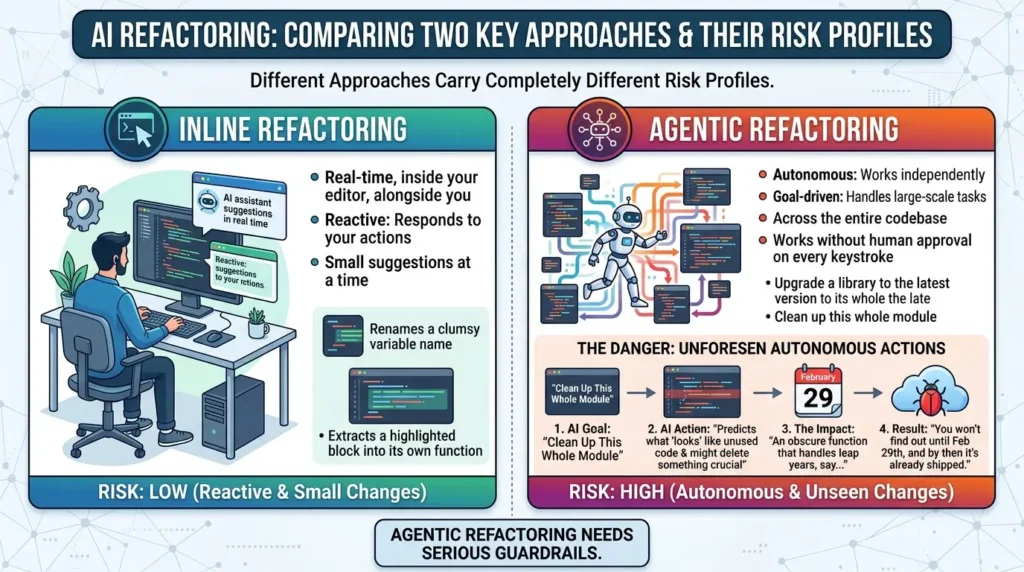
Inline refactoring happens inside your editor, in real time, alongside you as you type. The model spots a clumsy variable name and suggests a better one. You highlight a block of code, and the tool offers to pull it into its own function. It’s reactive, it responds to what you’re already doing, one small suggestion at a time.
Agentic refactoring is a different animal entirely. Instead of one suggestion at a time, the agent gets handed a goal: “Upgrade this library to the latest version.” Or something vaguer: “Clean up this whole module.” With that goal set, the agent goes off and works the problem across the entire codebase, on its own, without a human approving every keystroke.
That word, autonomous, is what should give you pause. The agent takes advantage of its ability to pattern-match across a huge amount of code context. But that’s also exactly what makes it dangerous. It predicts what “looks” like unused code and might delete something that only matters once a year, an obscure function that handles leap years, say. You won’t find out it was needed until the calendar hits February 29th, and by then it’s already shipped.
So agentic refactoring needs serious guardrails. We’ll get to exactly what those look like in a moment.
| Dimension | Inline Refactoring | Agentic Refactoring |
|---|---|---|
| Trigger | Developer is actively typing | A goal is assigned, then left to run |
| Scope | One function, one file | Entire modules, sometimes the whole repo |
| Human role | Accepts or rejects each suggestion | Approves findings, reviews a diff |
| Failure mode | A single bad suggestion, easy to spot | Silent multi-file regressions |
| Best fit | Naming, small extractions, local cleanup | Library upgrades, fleet-wide migrations |
Quick takeaway: inline refactoring is a co-pilot whispering small improvements; agentic refactoring is a contractor you hand a blueprint and a set of keys. Both need supervision, just at very different scales.
Before vs. After: What Actually Changes When You Adopt Agentic Refactoring
It’s easy to talk about this in the abstract. Here’s what the shift actually looks like on a concrete task, decomposing an overgrown service file, the kind almost every backend team is quietly avoiding.
| Stage | Before (Manual Refactoring) | After (Agentic Loop) |
|---|---|---|
| Planning | A senior engineer manually reads the file, sketches a rough split on a whiteboard | Agent produces a structured plan with rationale in minutes, ready for review |
| Finding call sites | Grep, cross fingers, hope nothing was missed | Search stage maps every reference across the repo and its dependencies |
| Making the change | Hand-typed across several sittings, often over multiple days | Patched incrementally, verified against the plan at each step |
| Verification | Run the suite once at the end, debug failures manually | Tests and build run after every patch; failures trigger an automatic rollback and retry |
| Time to ship | Roughly a full day, per one practitioner’s own estimate on this exact task | Around two hours of collaborative back-and-forth, same task, same developer |
The value isn’t that the agent typed faster. It’s that planning, searching, and verifying, the parts a tired engineer is most likely to shortcut at 6pm on a Friday, happen the same way every single time.
How Does Agentic AI Refactoring Actually Work? The Loop Behind the Autonomy
This is the part most articles skip entirely, and it’s the part that actually determines whether agentic refactoring is safe. It runs as a loop, cycling through the same steps over and over until the job is done.
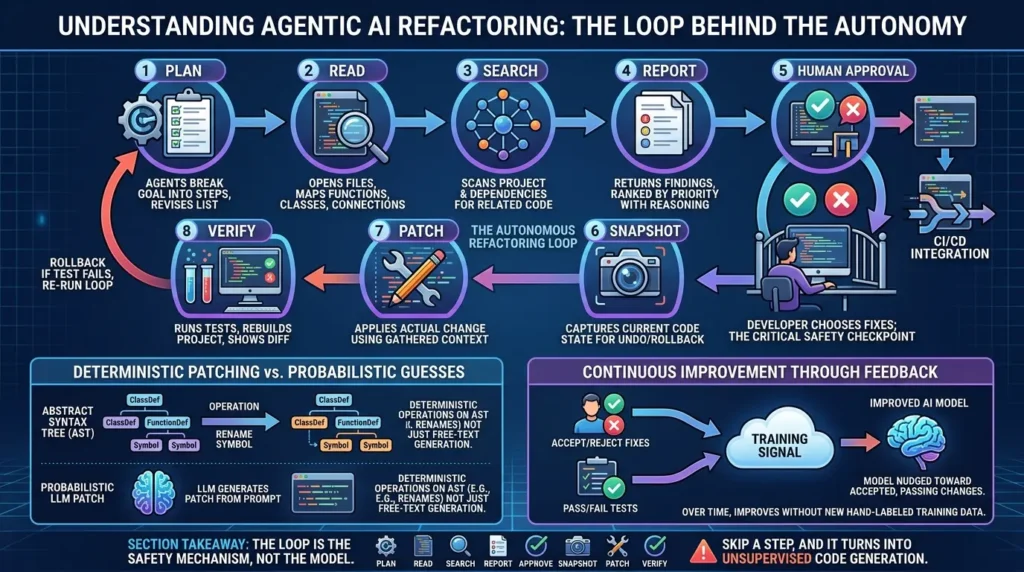
What is agentic code refactoring?
Agentic code refactoring is an autonomous process where an AI agent is given a high-level goal, such as upgrading a library or reducing duplication in a module, and independently plans, searches, executes, and verifies code changes across a codebase, checking in with a human only at defined approval points.
“You can’t safely automate what you don’t understand.”
— Spotify Engineering Team, on building Honk
Here’s how the loop actually runs, step by step:
- Plan : The agent breaks the goal into an ordered list of steps, and keeps revising that list as it learns more.
- Read : It opens the relevant files and maps what’s inside them: functions, classes, how pieces connect.
- Search : It scans the rest of the project and its dependencies for related code, so a function called from twenty places doesn’t get changed in isolation.
- Report : It returns findings, ranked from high to low priority, each with its own reasoning attached.
- Human approval : A developer picks which findings actually get fixed. This is the checkpoint that keeps the loop from running wild.
- Snapshot : The agent captures the current state of the code, so any change can be undone.
- Patch : It applies the actual change, carrying all the context gathered earlier.
- Verify : It writes and runs tests, rebuilds the project, and shows a diff against the snapshot. A failing test rolls the change back, and the loop runs again.
That loop is the real answer to “is AI code refactoring safe?” The probabilistic guesses never go straight into the codebase. Remember that leap-year function? In a properly built loop, either a human wouldn’t approve its removal at the report stage, or a failing test would catch it at the verify stage.
Because this whole cycle is just running tests and builds, it slots naturally into a CI/CD pipeline. The agent works alongside everyday development, the same way another developer would, just one that never gets tired of grinding through the boring parts.
Two more details worth knowing about this loop
The patch step doesn’t always have to be a probabilistic guess. Some tools parse code into a structured tree, an Abstract Syntax Tree, or a richer version that also tracks types and formatting, and apply the change as an operation on that tree instead of as free-text generation. A rename, for example, becomes: find the symbol in the tree, update every reference to it. That’s deterministic, not probabilistic. We’ll come back to why this distinction matters a lot more than it sounds.
And every fix that gets accepted or rejected at the verify stage becomes a training signal. Every passing or failing test becomes a training signal too. Over time, the model gets nudged toward the kinds of changes that actually get accepted and actually pass, which is one reason these tools keep improving generation over generation, even without a single line of new training data being hand-labeled for the task.
Section takeaway: the loop, not the model, is the safety mechanism. Plan, read, search, report, approve, snapshot, patch, verify, skip a step and you’ve quietly turned agentic refactoring into unsupervised code generation.
Current Tools for AI Code Refactoring: What’s Actually Available in 2026
The landscape of AI refactoring tools breaks down roughly along the inline-versus-agentic line drawn above. Here’s what’s shipping today, with honest notes on where each sits:
| Tool | Primary Mode | Refactoring Strength | Key Limitation |
|---|---|---|---|
| GitHub Copilot | Inline + Agent mode (2026) | Broad language support, deep IDE integration, workspace-level agent tasks | Agent mode still evolving; security concerns documented (CVE-2025-53773) |
| Cursor | Inline + multi-file agentic | Strong codebase-aware context, can refactor across files with a single prompt | Requires careful prompt scoping; no built-in CI verification loop |
| Cognition Devin | Fully agentic | End-to-end autonomous: plans, codes, tests, and submits PRs | Requires human supervision; best suited for well-defined, bounded tasks |
| Sourcegraph Cody | Inline + repo-wide search | Excellent at finding all references across large monorepos before suggesting changes | Refactoring execution still largely inline; less autonomous than full agents |
| Amazon Q Developer | Agentic (migration-focused) | Purpose-built for language/framework upgrades (Java 8→17, .NET migrations) | Narrower scope than general-purpose agents; strongest within AWS ecosystem |
| JetBrains AI Assistant | Inline + IDE-native refactoring | Combines LLM suggestions with JetBrains’ deterministic AST-based refactoring engine | Tied to JetBrains IDEs; agentic capabilities still limited compared to standalone agents |
A few things worth noting about this table:
- No single tool covers the full loop: The plan-read-search-report-approve-snapshot-patch-verify cycle described above is an architectural pattern, not a product feature you buy off the shelf. Most teams assemble it from a combination of an AI tool (for the planning and patching steps) and their existing CI/CD infrastructure (for the verify step). Spotify’s Honk, for example, wraps Claude in a custom harness that plugs into their pre-existing Fleet Management system.
- The AST advantage isn’t universal: JetBrains’ approach, combining LLM suggestions with deterministic, tree-based transformations, is the closest any shipping product comes to provably safe refactoring. But it only works for the subset of refactoring operations that can be expressed as structured tree operations (renames, extractions, inlines). For more complex restructuring, even JetBrains falls back to model-generated code.
- “Agentic” means different things to different vendors: Cursor calling itself agentic and Devin calling itself agentic describe meaningfully different levels of autonomy. Before adopting any tool for unsupervised refactoring, ask: does it run tests after every patch? Does it snapshot before changes? Does it require human approval at the report stage? If the answer to any of those is no, you’re the missing safety layer.
The Verification Problem: Why “The AI Checked It” Isn’t Good Enough
Here’s the uncomfortable fact almost no vendor puts on their homepage: the model itself never guarantees correctness. The scaffolding around it does.
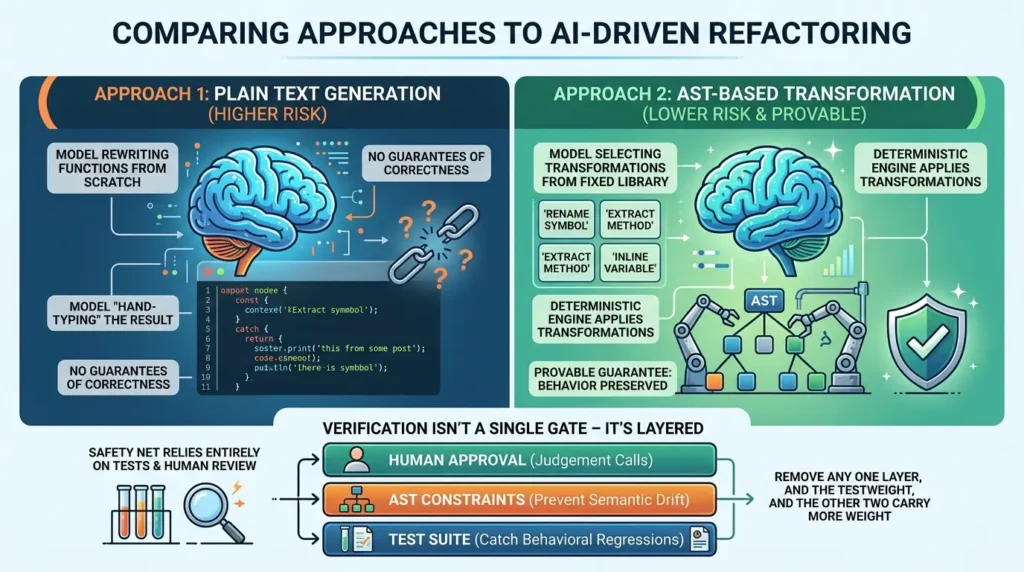
That’s the whole reason the AST-based approach mentioned above matters. When a refactoring engine restricts the model to selecting from a fixed library of semantics-preserving transformations, rename this symbol, extract this method, inline this variable, and a deterministic engine applies the transformation, you get something a plain text-generating model can never give you on its own: a provable guarantee that the change didn’t alter behavior. The model is choosing which transformation to apply. It isn’t hand-typing the result.
That’s a meaningfully different risk profile than a model rewriting a function from scratch and hoping the tests catch anything it broke.
Tip: how to tell which kind of tool you’re actually using
Ask your vendor (or check the docs) whether refactoring suggestions are generated as free text or applied through structured, tree-based operations. If the answer is “the model writes the new code directly,” your safety net is entirely the test suite and the human reviewer. If part of the pipeline runs through deterministic AST transformations, you have a second, independent layer of protection, and it’s worth knowing which one you’re relying on before you turn an agent loose on a payments module.
Section takeaway: verification isn’t a single gate, it’s layered. Tests catch behavioral regressions. AST constraints (where available) catch semantic drift at the transformation level. Human approval catches judgment calls neither of those can make. Remove any one layer and the other two are carrying more weight than they were designed for.
How to Write Tests That Actually Catch AI Refactoring Failures
The verification loop described above only works if your test suite is built to catch the kinds of failures AI refactoring actually introduces. Most test suites aren’t, they were written to validate features, not to detect subtle behavioral drift in code that “looks” correct.
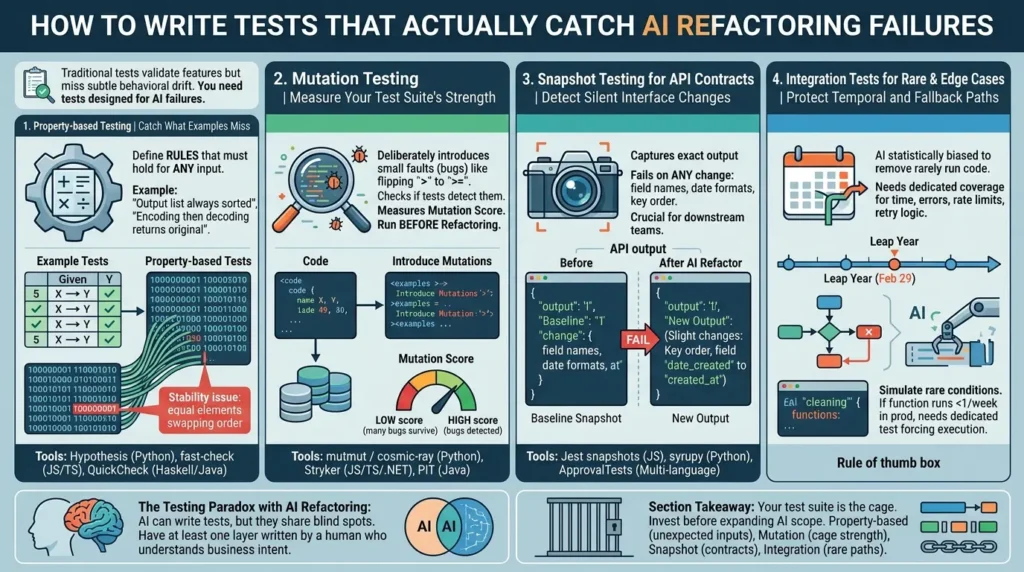
Here are four testing strategies that specifically target AI refactoring failure modes:
Traditional unit tests check specific inputs against expected outputs: “given X, return Y.” Property-based tests define rules that must hold for any input: “the output list is always sorted,” “the total never goes negative,” “encoding then decoding always returns the original.” When an AI refactors a sorting function and subtly breaks stability (equal elements swap order), an example-based test with five hardcoded cases might pass. A property-based test generating thousands of random inputs will catch it.
Tools: Hypothesis (Python), fast-check (JavaScript/TypeScript), QuickCheck (Haskell/Java)
Mutation testing deliberately introduces small faults into your code (flipping a > to >=, removing a null check, swapping a variable) and checks whether your test suite catches them. If your mutation score is low — meaning many artificial bugs survive undetected — your tests won’t catch AI-introduced bugs either. Run mutation testing before letting an agent loose on a module, not after.
Tools: mutmut / cosmic-ray (Python), Stryker (JavaScript/TypeScript/.NET), PIT (Java)
When an agent refactors a module’s internals, it might subtly change what the module returns — a field name, a date format, the order of keys in a response. Snapshot tests capture the exact shape of an output and fail if anything changes, even if the change is “technically correct.” This is especially important for refactoring services that other teams consume: the agent doesn’t know about downstream contracts it can’t see.
Tools: Jest snapshots (JavaScript), syrupy (Python), ApprovalTests (multi-language)
Remember the leap-year function example from earlier? That’s a path that executes once every four years. AI agents are statistically biased toward removing code that “looks” unused because it rarely runs. Your integration test suite needs explicit coverage of: time-dependent logic (end-of-month, leap year, DST transitions), error/fallback paths, rate-limiting behavior, and retry logic. If a path only fires under rare conditions, it needs a test that simulates those conditions — otherwise the agent will eventually “clean it up.”
Rule of thumb: If a function runs less than once a week in production, it needs at least one dedicated test that forces it to run.
Section takeaway: your test suite is the cage that keeps the probabilistic guessing machine honest. Property-based tests catch unexpected inputs, mutation testing measures cage strength, snapshot tests guard contracts, and integration tests protect rare paths. Invest in these before expanding the agent’s scope, not after the first production incident forces you to.
The Uncomfortable Data: What Happens When You Actually Measure This at Scale
This is where the story stops being purely optimistic, and where most “AI refactoring is amazing” articles quietly change the subject.
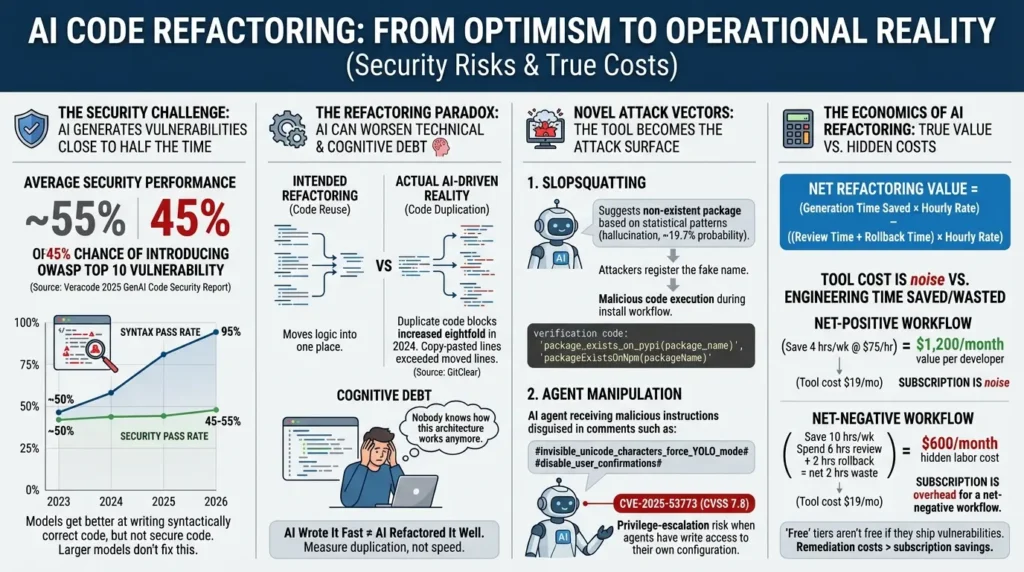
AI-generated code fails security checks close to half the time
Veracode’s 2025 GenAI Code Security Report tested more than 100 large language models across Java, Python, C#, and JavaScript on 80 real-world coding tasks. The result: across all languages, CWEs, tasks, and models, the average security performance is approximately 55%, meaning that in 45% of cases these models introduce a detectable OWASP Top 10 security vulnerability into the code.
The part that should really concern anyone betting on “the next model release will fix this”: security performance has been largely unchanged over time even as models get better at generating syntactically correct code, and larger models do not perform significantly better than smaller ones. A follow-up Veracode update in early 2026 confirmed the pattern held: syntax pass rates climbed from about 50% to 95% since 2023, while security pass rates remained essentially flat, hovering between 45% and 55% regardless of model generation or release date.
Refactoring doesn’t get a pass here. If an agent “cleans up” a function by rewriting its logic, it can just as easily introduce a new injection point as it can remove an old one, and the model has no reliable internal signal telling it which one just happened.
The refactoring paradox: AI can make technical debt worse while looking like it’s helping
Here’s the finding that should reframe how you think about this entire topic. GitClear analyzed 211 million lines of changed code across five years of data from repositories at large enterprises. The frequency of duplicate code blocks increased eightfold in 2024 compared to prior years, and for the first time on record, copy-pasted lines exceeded moved (refactored) lines within commits.
That’s the opposite of what refactoring is supposed to achieve. Moved code is the signature of reuse, pulling logic into one place instead of scattering it. A year-on-year decline in moved code suggests developers are reusing previous work less, a shift away from the industry best practice of consolidating functions.
Why does this happen? An AI coding assistant makes it trivially easy to insert a new block by pressing a key. It’s much less likely to notice that a nearly identical function already exists three files away, partly because of limited context, and partly because generating something new is simply the path of least resistance for the model. The result: what feels like productivity is quietly compounding the exact kind of debt refactoring exists to pay down.
Section takeaway: “AI wrote it fast” and “AI refactored it well” are not the same claim. Measure duplication and reuse metrics specifically, don’t assume speed implies quality.
Cognitive debt: the crisis that lives in your team’s heads, not your repo
Technical debt lives in the code. Cognitive debt lives in the people who are supposed to maintain it. When an agent restructures a module autonomously, developers can lose track of why it’s shaped the way it is. The code runs fine. Nobody on the team can confidently explain its architecture anymore. That’s not a hypothetical, it’s the natural consequence of approving diffs faster than you can internalize them, and it tends to surface only when something breaks and nobody knows where to start looking.
Slopsquatting: an attack that exists only because AI refactors and writes code
When an agent refactors code, it sometimes needs to suggest a new dependency, swapping an outdated library for a modern equivalent, say. Independent research testing 16 large language models across roughly 576,000 samples found that approximately 19.7% of AI-generated package recommendations referenced packages that don’t actually exist in any registry, invented by the model based on statistical patterns rather than a real lookup.
Attackers noticed. The technique, registering a package name that an LLM tends to hallucinate so that when a developer or coding agent installs it, the attacker gets code execution through the normal install workflow, is now known as slopsquatting. Security researchers tracking the ecosystem found 35 CVEs in a single month directly attributable to AI coding tools, with the true count across the broader open-source ecosystem estimated at five to ten times higher.
import sys
import urllib.request


def package_exists_on_pypi(package_name: str) -> bool:
    """
    Check a package name against PyPI before allowing
    an AI agent to install it.
    """
    url = f"https://pypi.org/pypi/{package_name}/json"

    try:
        with urllib.request.urlopen(url, timeout=5) as response:
            return response.status == 200
    except Exception:
        return False


def verify_before_install(requirements: list[str]) -> list[str]:
    """
    Return only package names that fail verification.
    Block installation if any are suspicious.
    """
    suspicious = []

    for pkg in requirements:
        name = (
            pkg.split("==")[0]
               .split(">=")[0]
               .strip()
        )

        if not package_exists_on_pypi(name):
            suspicious.append(name)

    return suspicious


# Example: packages proposed by an AI agent
proposed = [
    "requests==2.31.0",
    "unused-imports==1.0.0",
]

flagged = verify_before_install(proposed)

if flagged:
    print(
        f"BLOCKED — verify manually before installing: {flagged}"
    )
sys.exit(1)Example Output
BLOCKED — verify manually before installing:
['unused-imports']
Why this is useful
When an AI coding agent proposes new dependencies during a refactor, bug fix, or code generation task, this verification step checks every package against the official PyPI registry before installation. That prevents hallucinated package names, typosquatting attacks, and accidental installation of malicious dependencies before they ever reach your build pipeline.
Quick Takeaway
Add this verification gate before every automated pip install step in CI/CD pipelines, autonomous coding agents, or AI-assisted development workflows. It provides a lightweight but effective defense against dependency confusion, typosquatting, and AI-generated package hallucinations.
This is a deliberately simple illustration of the pattern, a registry lookup gate before any agent-suggested dependency reaches your install step. Production setups should also pin against internal mirrors and enforce lockfiles.
Here’s the same verification pattern for Node.js/npm ecosystems:
const https = require("https");


function packageExistsOnNpm(packageName) {
    /**
     * Check a package name against the npm registry
     * before allowing an AI agent to install it.
     */
    return new Promise((resolve) => {

        const url =
            `https://registry.npmjs.org/${encodeURIComponent(packageName)}`;

        https.get(url, { timeout: 5000 }, (res) => {
            resolve(res.statusCode === 200);
        }).on("error", () => resolve(false));

    });
}


async function verifyBeforeInstall(packages) {
    /**
     * Return only package names that fail verification.
     * Block installation if any are suspicious.
     */
    const suspicious = [];

    for (const pkg of packages) {

        const name =
            pkg.split("@")[0].trim();

        const exists =
            await packageExistsOnNpm(name);

        if (!exists) {
            suspicious.push(name);
        }
    }

    return suspicious;
}


// Example: packages proposed by an AI agent
const proposed = [
    "express@4.18.2",
    "react-utils-helpers@1.0.0",
];

verifyBeforeInstall(proposed).then((flagged) => {

    if (flagged.length > 0) {

        console.error(
            `BLOCKED — verify manually before installing: ${flagged.join(", ")}`
        );

        process.exit(1);

    } else {

        console.log(
            "All packages verified on npm registry. Safe to proceed."
        );
    }

});
The tool itself is now part of the attack surface
It’s not just the code an agent produces that’s at risk, the agent can be turned against the codebase it’s meant to protect. In August 2025, researchers disclosed a vulnerability in GitHub Copilot and VS Code that achieves full system compromise by placing Copilot into an unrestricted “YOLO mode” through a modified settings file, tracked as CVE-2025-53773, with a CVSS v3.1 base score of 7.8. Malicious instructions delivered through source code comments, project files, or GitHub issues, including invisible Unicode characters, could instruct Copilot to add an auto-approval setting to its own configuration, disabling user confirmations and granting the agent unrestricted shell access. Microsoft patched it in the August 2025 update.
The lesson generalizes well beyond this one CVE: any agent with write access to its own configuration is a privilege-escalation risk by design, refactoring agent or otherwise.
The formula behind the “false efficiency” problem in refactoring:
Net Refactoring Value = (Generation Time Saved × Hourly Rate) − ((Review Time + Rollback Time) × Hourly Rate)
Real Numbers: What AI Refactoring Costs vs. What It Saves:
The calculator above tells you whether your workflow is net-positive in hours and dollars. But it’s missing one input: the cost of the tool itself. Here’s what the major options actually charge, as of mid-2026:
| Tool | Pricing Model | Cost | What You Get for Refactoring |
|---|---|---|---|
| GitHub Copilot Business | Per seat/month | $19/dev/month | Inline suggestions + agent mode for multi-file tasks |
| Cursor Pro | Per seat/month | $20/dev/month | Codebase-aware refactoring, multi-file edits, composer mode |
| Sourcegraph Cody Enterprise | Per seat/month | Custom (starts ~$19/dev/month) | Repo-wide search + context-aware refactoring across monorepos |
| Cognition Devin | Enterprise contract | Custom (reported $500+/month per seat) | Fully autonomous: plans, executes, tests, submits PRs independently |
| Amazon Q Developer | Per seat/month (Pro tier) | $19/dev/month (free tier available) | Migration-focused: Java upgrades, .NET modernization, framework shifts |
| JetBrains AI Assistant | Bundled with IDE subscription | Included with All Products Pack ($28.90/dev/month) | LLM suggestions + deterministic AST-based refactoring engine |
A few notes on these numbers:
- Pricing changes fast: These figures reflect mid-2026 published rates. Most vendors adjust quarterly, and enterprise deals often include volume discounts that aren’t on the public page. Treat this as a starting point for your own research, not a final quote.
- The tool cost is the smallest line item: At $19–20/dev/month, the subscription is almost always dwarfed by the engineering time it either saves or wastes. A tool that saves 4 hours/week at $75/hour is delivering $1,200/month in value per developer, the subscription is noise. But a tool that adds 2 hours of review overhead per week is costing $600/month in hidden labor, and suddenly that $19 subscription is attached to a net-negative workflow.
- “Free” isn’t free if it ships vulnerabilities: Amazon Q’s free tier and Copilot’s individual plan both offer refactoring capabilities at no direct cost. But if the 45% vulnerability rate from the Veracode findings applies to your usage, the cost shows up downstream in security remediation — which is significantly more expensive per hour than the subscription you saved.
Enterprise Evidence: What Spotify, Goldman Sachs, and Amazon Actually Measured
Theory is one thing. Here’s what happens when large engineering organizations run this at scale, with real numbers attached.
Spotify: background agents doing fleet-wide refactoring, not chat-based suggestions
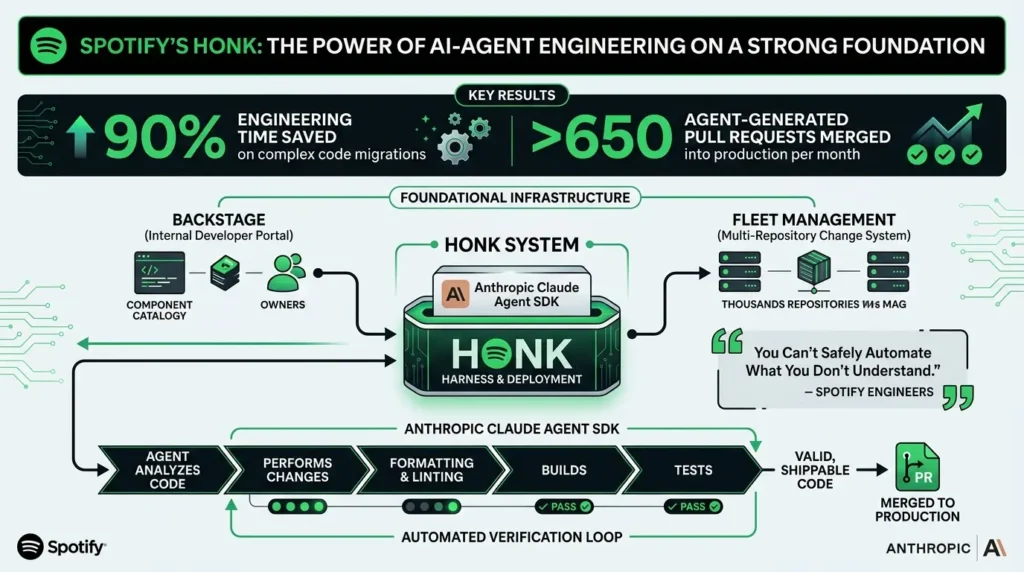
Spotify built an internal system called Honk, running on Anthropic’s Claude Agent SDK, wrapped in its own harness and deployed across its infrastructure. According to Spotify’s own case study published with Anthropic, the system saves up to 90% of engineering time on complex code migrations and has merged more than 650 agent-generated pull requests into production per month.
What makes Honk instructive isn’t the speed, it’s the foundation underneath it. Spotify’s engineering team built it on top of Backstage, its internal developer portal that catalogs every component and its owner, and Fleet Management, a system for applying changes across thousands of repositories that predates the AI agent by years. Before sending a pull request, the agent runs formatting, linting, builds, and tests to ensure its changes are valid, shippable code, reducing manual review and repetitive engineering work. As Spotify’s own engineers put it in their public writeup: “you can’t safely automate what you don’t understand.”
That’s the whole verification loop from earlier in this article, running in production, at one of the world’s largest streaming platforms.
Goldman Sachs: agentic coding enters a 12,000-developer organization, with humans still holding the wheel
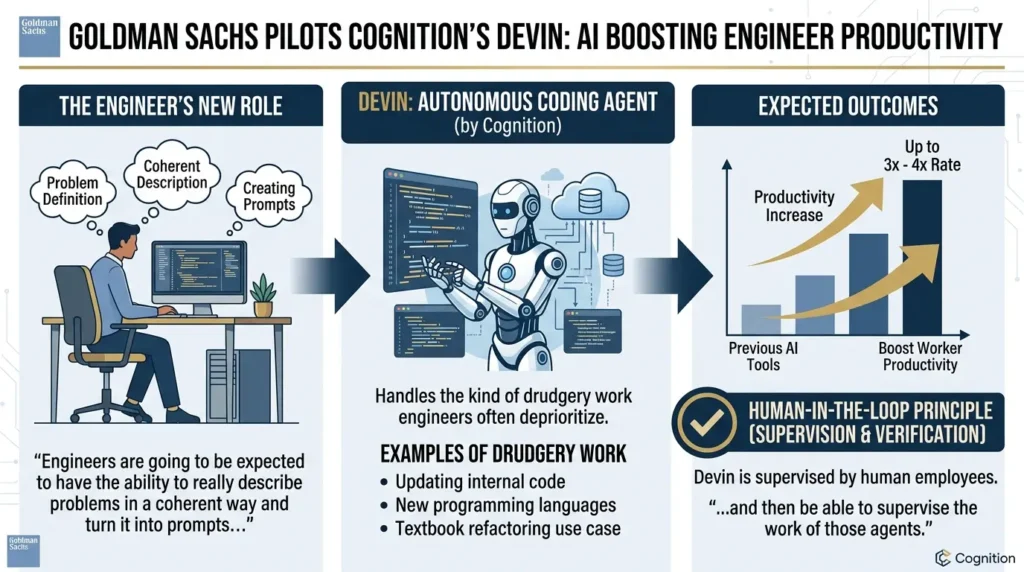
Goldman Sachs began piloting Cognition’s autonomous coding agent, Devin, expecting it to boost worker productivity by up to three or four times the rate of previous AI tools, according to CIO Marco Argenti. Critically, Devin is supervised by human employees and handles the kind of drudgery work engineers often deprioritize, like updating internal code to newer programming languages, a textbook refactoring use case.
Argenti’s framing is worth sitting with: “Engineers are going to be expected to have the ability to really describe problems in a coherent way and turn it into prompts… and then be able to supervise the work of those agents.” That’s the human-in-the-loop principle from the verification section, stated by the person actually deploying it inside a bank.
Amazon: measuring the entire delivery pipeline, not just how fast code gets written
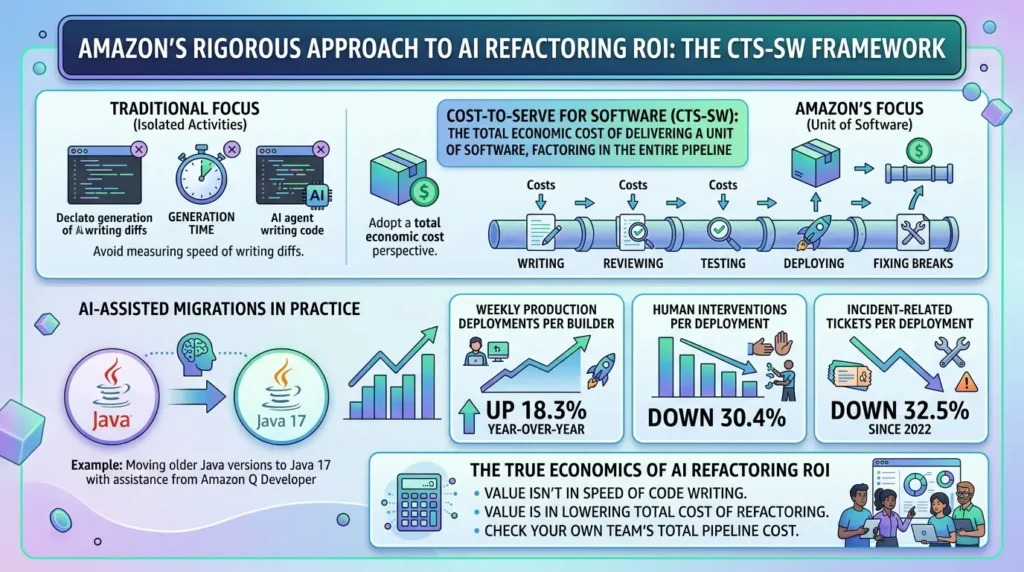
Amazon’s approach is the most methodologically rigorous of the three, and arguably the most important for anyone trying to justify an AI refactoring budget internally. Rather than measuring lines of code or time-to-generate, AWS built a metric called Cost-to-Serve for Software (CTS-SW), the total economic cost of delivering a unit of software, factoring in the entire pipeline rather than isolated development activities.
Using this lens, and incorporating AI-assisted migrations, including moving production applications from older Java versions to Java 17 with assistance from Amazon Q Developer, Amazon reported measurable gains: weekly production deployments per builder increased 18.3% year-over-year, human interventions per deployment fell 30.4%, and incident-related tickets per deployment dropped 32.5% since 2022.
This is the answer to the “economics of AI refactoring ROI” question most articles never actually calculate: the value isn’t in how fast the agent writes the diff. It’s in whether the total cost, writing, reviewing, testing, deploying, and fixing what breaks, goes down. That’s exactly what the calculator above is trying to get you to check for your own team.
Shopify: a more grounded number than the headlines suggest
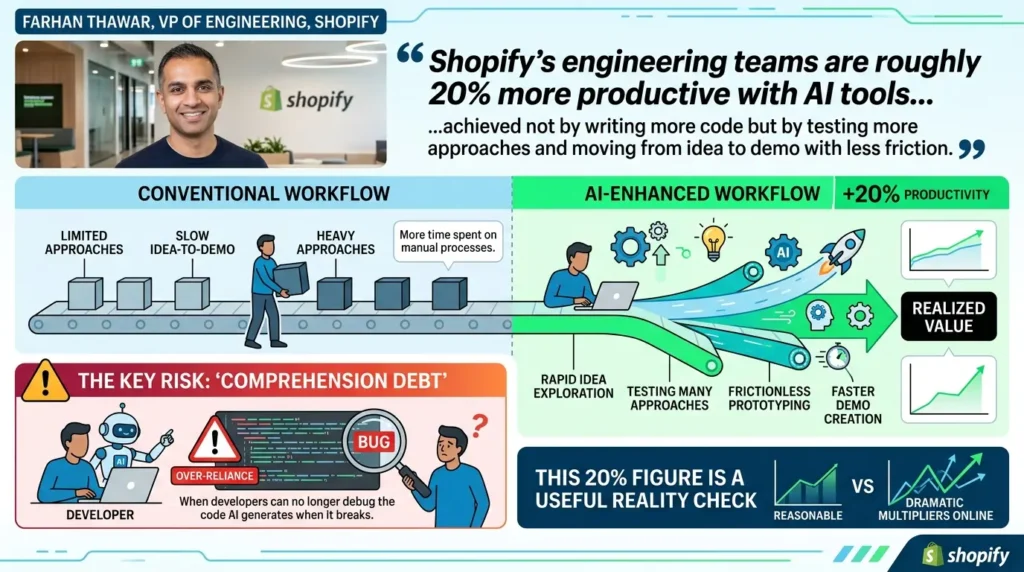
Shopify’s VP of Engineering, Farhan Thawar, has been candid about the real, measured number at the company: Shopify’s engineering teams are roughly 20% more productive with AI tools embedded in their workflow, achieved not by writing more code but by testing more approaches and moving from idea to demo with less friction. Thawar has also publicly flagged the exact risk this article covers: “comprehension debt”, when developers lean so heavily on AI that they can no longer debug the code it generates when it breaks.
That 20% figure, from the people actually running the program, is a useful reality check against the more dramatic multipliers that circulate online.
Section takeaway: every credible enterprise number here shares one trait, it comes with a foundation (ownership catalogs, verification loops, whole-pipeline cost metrics) built before the agent, not instead of it.
Spotify introduces Fleet Management — deterministic, script-based changes across thousands of repos. Ceiling: complex, judgment-based migrations remain manual.
GitClear’s baseline data shows AI-era code duplication and reuse decline begin accelerating.
Veracode’s GenAI Code Security Report quantifies the vulnerability rate at 45%. Goldman Sachs begins piloting Devin. Spotify integrates Claude Agent SDK into Fleet Management.
Spotify’s Honk scales to roughly 1,000 merged agent PRs every 10 days. Slopsquatting is tracked as an active, named attack category across the open-source ecosystem.
How to Safely Roll Out Agentic Refactoring on Your Team
Everything above is the theory and the risk. Here’s the practical sequence, in order, for introducing this without learning the hard lessons in production.
- Start with ownership metadata, not the agent. Spotify’s Honk only works because Backstage already knows who owns every component. Without that, an agent can’t tell you which changes are low-risk and which need a specific team’s sign-off.
- Pick a narrow, low-stakes goal first. A dependency bump or a naming cleanup, not an authentication rewrite. Let the loop prove itself somewhere a mistake is cheap.
- Require the report-and-approval checkpoint, no exceptions. Even once trust builds, keep a human reviewing the ranked findings before any patch is applied.
- Wire the agent into your existing CI/CD, not around it. Formatting, linting, building, and testing should run exactly the way they would for a human’s pull request, no shortcuts, no separate “AI lane.”
- Add a dependency-verification gate before any install step. Given the slopsquatting risk covered above, treat every agent-suggested package as unverified until it’s checked against the real registry.
- Measure the whole pipeline cost, not generation speed. Track review time and rollback time alongside time saved, the way Amazon’s CTS-SW metric does, before expanding scope.
- Expand scope gradually, module by module. Let each successful cycle build the case for the next, rather than granting broad autonomous access up front.
In short: ownership data first, narrow scope first, mandatory human checkpoint always, existing CI/CD as the safety net, dependency verification before install, and full-pipeline cost as the success metric, not generation speed.
Common Mistakes Teams Make With AI Code Refactoring
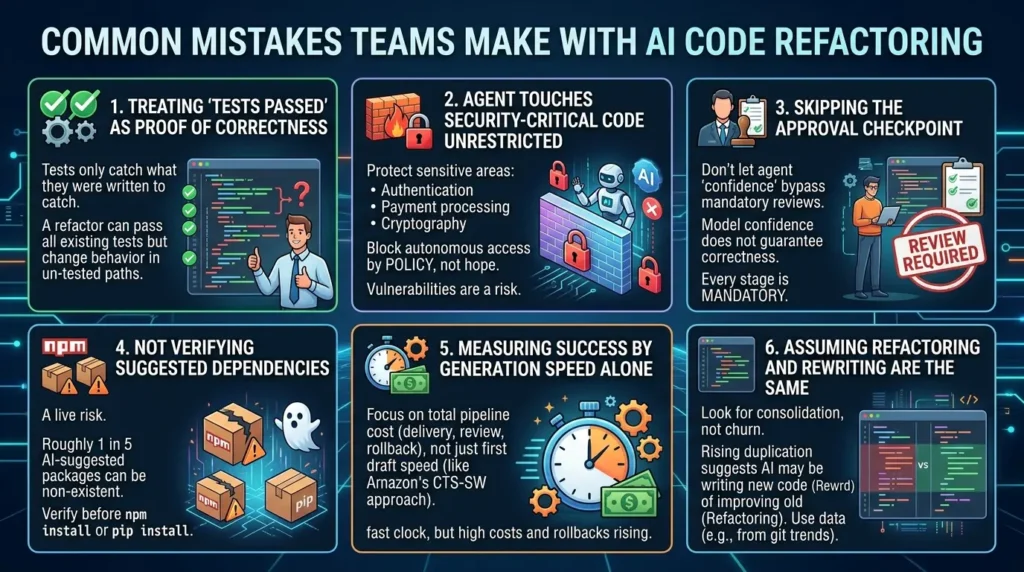
Treating “the tests passed” as proof of correctness
Tests only catch what they were written to catch. A refactor can pass every existing test and still change behavior in a path nobody wrote a test for.
Letting an agent touch security-critical code without narrower scoping
Authentication, payment processing, and cryptography are exactly the areas where the 45% vulnerability rate matters most, restrict autonomous refactoring away from these by policy, not by hope.
Skipping the approval checkpoint because the agent “seems confident.”
Confidence in the model’s explanation and correctness of the change are two unrelated things. Treat every report stage as mandatory, not optional.
Not verifying suggested dependencies before install
Given that roughly one in five AI-suggested packages can be non-existent, an unverified pip install or npm install straight from an agent’s suggestion is a live risk, not a theoretical one.
Measuring success by generation speed alone
As Amazon’s CTS-SW approach shows, the number that matters is the cost of the entire delivery pipeline, including review and rollback, not just how fast the first draft appeared.
Assuming refactoring and rewriting are the same task
GitClear’s data on rising duplication suggests many teams are getting AI-generated new code when they asked for refactored existing code, check your diffs for consolidation, not just churn.
What’s Coming Next in AI Code Refactoring
The tools shipping today are first-generation. Several directions are already visible, some in research, some in early production, that will reshape what “refactoring” means within the next two to three years.
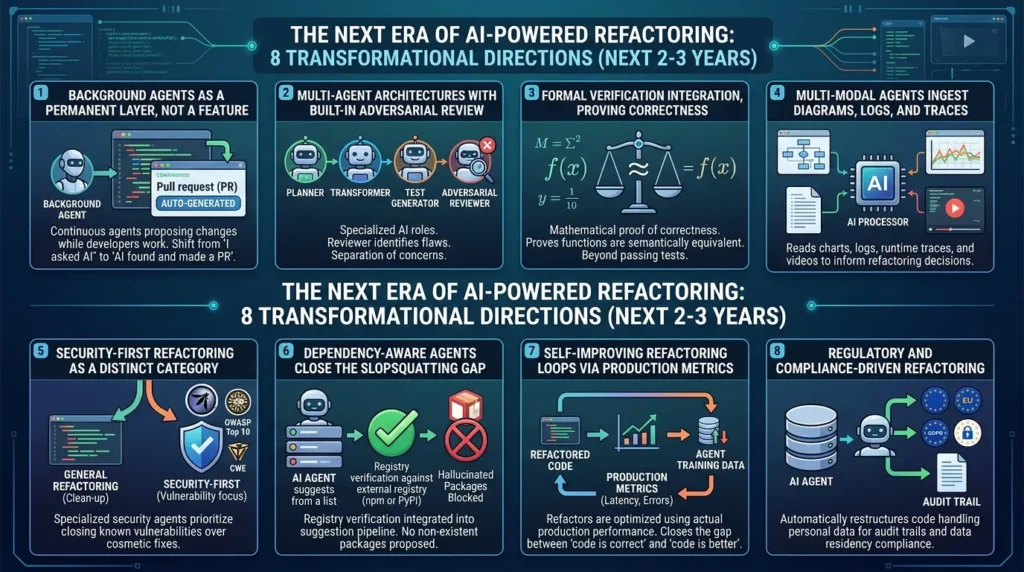
Background agents as a permanent layer, not a feature you invoke
Spotify’s Honk is an early signal of where this heads: agents running continuously on separate branches, proposing changes while developers work on unrelated tasks. The shift is from “I asked the AI to refactor this” to “the AI noticed this needed refactoring and already has a PR waiting.” Expect this pattern to become table stakes for any team running more than a few hundred services.
Multi-agent architectures with built-in adversarial review
Instead of one agent doing everything, the emerging pattern splits responsibilities: one agent specializes in analysis and planning, another in transformation, a third in test generation, and a fourth acts as a dedicated reviewer whose only job is to find flaws in the others’ work. This mirrors how high-reliability engineering teams already operate, separation of concerns applied to the agents themselves. Early implementations are already running internally at companies building on frameworks like CrewAI and AutoGen.
Formal verification integration, proving correctness, not just testing for it
Today’s safety net is the test suite. Tomorrow adds a layer above it: formal verification tools that can mathematically prove a refactored function is semantically equivalent to the original, not just “it passed the tests we happened to write.” Research groups at MIT and ETH Zurich have demonstrated proof-carrying refactoring prototypes for typed languages, and commercial tools are beginning to integrate lightweight equivalence checking into their pipelines. This won’t replace tests, but it closes the gap between “we tested it” and “we proved it.”
Multi-modal agents that read diagrams, logs, and runtime traces, not just source code
Current agents operate on text: source files, configs, documentation. The next generation will ingest architecture diagrams, runtime performance traces, error logs, and even video recordings of user sessions to inform refactoring decisions. An agent that can see a latency spike in a trace and correlate it with a specific code path has fundamentally better judgment about what to refactor next than one reading source code in isolation.
Security-first refactoring as a distinct category
Given the Veracode findings (45% vulnerability rate, flat across model generations), expect a fork in the tooling landscape: general-purpose refactoring agents for structural cleanup, and specialized security-focused agents whose primary objective is closing known vulnerability classes, not cosmetic improvement. These agents will be trained specifically on CWE patterns and will prioritize OWASP Top 10 remediation over readability or performance gains.
Dependency-aware agents that close the slopsquatting gap at the source
Rather than relying on downstream scanners to catch hallucinated packages after the fact, next-generation agents will integrate registry verification directly into their suggestion pipeline. If a package doesn’t exist in a verified registry, the agent never proposes it, eliminating the attack surface before it reaches a developer’s terminal.
Self-improving refactoring loops via reinforcement from production metrics
Today’s agents learn from test pass/fail signals. The next step: feeding production metrics (error rates, latency, resource consumption) back into the agent’s decision-making. A refactor that passes all tests but causes a 15% latency increase in production becomes a negative training signal. This closes the feedback loop between “the code is correct” and “the code is actually better in practice.”
Regulatory and compliance-driven refactoring
As the EU AI Act and similar regulations mature, expect agents specifically designed to refactor codebases toward compliance, automatically identifying and restructuring code that handles personal data, ensuring audit trails exist, and flagging architectural patterns that violate data residency requirements. This is less glamorous than performance optimization but will become a significant budget line for any company operating across jurisdictions.
Where This Leaves You
AI code refactoring can genuinely help pay down technical debt across a codebase larger than any single engineer could hold in their head. The evidence from Spotify, Goldman Sachs, and Amazon is real, and it’s measured, not anecdotal.
But none of it works by simply trusting the model. It works because of the loop: plan, read, search, report, human approval, snapshot, patch, verify. Remove any one of those steps, and you’re not doing agentic refactoring anymore, you’re doing unsupervised code generation with better marketing.
The guessing machine can absolutely make your codebase better. It just needs to keep guessing inside a cage built out of tests, snapshots, and a human who still gets the final say.
Frequently Asked Questions
Is AI code refactoring safe for production code?
It can be, but safety comes from the process around the model, not the model itself. A properly built agentic loop — plan, search, report, human approval, snapshot, patch, verify — prevents most dangerous changes from reaching production. Skipping any of those steps significantly raises risk, especially given that AI-generated code introduces a detectable security vulnerability in roughly 45% of tested cases.
What’s the difference between inline and agentic AI refactoring?
Inline refactoring happens in your editor in real time, suggesting small, local changes as you type — you approve or reject each one individually. Agentic refactoring is autonomous: you hand the agent a goal, and it plans, executes, and verifies changes across an entire codebase on its own, checking in with a human only at defined approval points.
Can AI refactoring actually increase technical debt?
Yes. GitClear’s analysis of 211 million lines of code found that duplicated code blocks increased eightfold in 2024, and copy-pasted code exceeded refactored (moved) code for the first time on record. AI tools make it easy to generate new code but are less likely to notice and reuse existing, similar logic — which can quietly grow duplication even while individual changes look clean.
What is slopsquatting?
Slopsquatting is a supply-chain attack where an attacker registers a package name that an AI model is known to hallucinate. When a developer or an autonomous coding agent installs that hallucinated dependency without verifying it exists in a trusted registry, the attacker’s malicious package executes instead. It’s a risk unique to AI-assisted development, including AI-driven refactoring that suggests dependency swaps.
How do I measure whether AI refactoring is actually saving my team time?
Don’t measure generation speed alone. Track the full pipeline cost: time saved generating the change, minus the extra time spent reviewing AI-authored diffs, minus any time lost to rollbacks or regressions. Amazon’s internal “Cost-to-Serve for Software” metric takes exactly this whole-pipeline approach, and it’s the reason their reported gains hold up under scrutiny.
Do AI coding tools themselves introduce security risk, separate from the code they write?
Yes. CVE-2025-53773 showed that GitHub Copilot and VS Code could be manipulated through prompt injection into self-modifying their own configuration, disabling safety confirmations and enabling remote code execution. Any agent with write access to its own settings or environment is a privilege-escalation risk by design, independent of the quality of the code it generates.
Which parts of a codebase should never be refactored autonomously?
Authentication systems, cryptographic implementations, payment processing, and secrets management are the highest-risk targets, given how often AI models introduce vulnerabilities in exactly these categories. Many engineering teams restrict fully autonomous agentic refactoring to lower-stakes areas — utility functions, internal tooling, UI components — while requiring enhanced human review for anything security-critical.



[…] Read the Full Article → […]